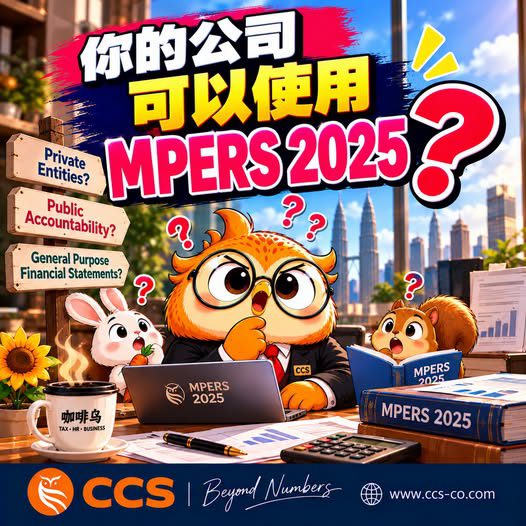
Many business owners ask:
“My company is a Sdn. Bhd., so of course we use MPERS. Why do we still need to ask?”
Not so fast.
Sdn. Bhd. describes the company’s legal status. MPERS eligibility concerns the financial reporting framework the entity is permitted to apply.
Although both may involve the word “private”, they are not the same concept.
The first question under MPERS 2025 Section 1 is:
Who is eligible to apply MPERS?
MPERS is intended for private entities that meet the relevant requirements. Two important concepts must be considered:
- The entity does not have public accountability; and
- The entity prepares general-purpose financial statements.
Therefore, the fact that the Registrar classifies an entity as a private company does not automatically mean that MPERS can be applied.
What Is Public Accountability?
In simple terms, an entity may have public accountability when it holds or manages resources on behalf of a broad group of external parties in a significant fiduciary capacity.
For example, an entity may have public accountability if its debt or equity instruments are traded, or are in the process of being issued for trading, in a public market.
Another situation arises when an entity holds assets for a broad group of external parties in a fiduciary capacity as one of its primary businesses.
Typical examples include:
- Listed companies;
- Commercial banks; and
- Insurance companies.
These entities would generally not be ordinary MPERS entities.
The important question is not whether the company name ends with Sdn. Bhd. The real question is:
Does the entity have public accountability?
That is the issue Section 1 requires the entity to assess.
Borderline Cases Require Further Assessment
Some entities are easy to classify.
A listed company is generally clear. A small private trading company may also be relatively straightforward.
The more difficult cases are those in between.
For example:
- A private company issues retail bonds to the public; or
- A special-purpose vehicle (SPV) issues sukuk to public investors.
In such cases, the entity cannot simply conclude:
“We are not listed, so we must be eligible to apply MPERS.”
The entity must assess whether public accountability exists based on the facts and circumstances.
What About a Subsidiary of a Listed Group?
Another common misunderstanding concerns subsidiaries.
The fact that a parent company applies MFRS does not automatically mean that every subsidiary must also apply MFRS.
If a subsidiary independently satisfies the MPERS eligibility requirements, it may still be able to apply MPERS.
However, when the parent prepares consolidated financial statements, it must address any differences between MPERS and MFRS in areas such as:
- Recognition;
- Measurement;
- Presentation; and
- Disclosure.
Conversely, if the subsidiary itself has public accountability, it cannot continue applying MPERS merely because it is legally a Sdn. Bhd.
The following assumptions are therefore not necessarily correct:
- Parent applies MFRS, therefore subsidiary must apply MFRS; or
- Subsidiary is a Sdn. Bhd., therefore subsidiary must apply MPERS.
Accounting standards cannot be selected by simply matching one company with another.
Eligibility Must Be Reassessed Continuously
MPERS eligibility is not a one-time assessment.
A company may qualify to apply MPERS this year but no longer qualify next year because its circumstances have changed.
Potential changes may include:
- A group restructuring;
- Preparations for an IPO;
- The issuance of public debt;
- The issuance of sukuk to public investors; or
- Obtaining a licence involving public funds or fiduciary activities.
Entities must therefore reassess their eligibility continuously.
A conclusion documented in last year’s audit file stating that:
“The Company is eligible to apply MPERS”
should not simply be copied and updated with a new date.
The entity must ask again:
Has anything changed this year that may have created public accountability?
Practical Summary
MPERS 2025 Section 1 can be remembered through three key points:
- Private Company does not automatically mean MPERS.
- The critical issue is whether the entity has public accountability.
- MPERS eligibility must be reassessed continuously rather than determined once and treated as permanent.
Although Section 1 is relatively short, it addresses one of the most important questions before the financial statements are prepared:
Is the entity eligible to be on the MPERS reporting track?
If the wrong framework is selected, subsequent recognition, measurement, presentation and disclosure may all be performed under the wrong requirements.
For accountants and auditors, the MPERS eligibility assessment should be documented afresh during each year’s planning stage, with particular attention to group restructurings, financing arrangements, IPO plans and changes in the entity’s business or licensing activities.
Section 1 is not boilerplate. It is the first gate in determining the entity’s entire financial reporting framework.
MPERS 2025 第 1 节:Sdn. Bhd. 就一定可以采用 MPERS 吗?
很多老板会问:
“我的公司是 Sdn. Bhd.,当然可以用 MPERS 啦,还需要问吗?”
先别急。
Sdn. Bhd. 说明的是公司的法律身份,而 MPERS 适用资格则涉及企业可以采用哪一种财务报告框架。
虽然两者都可能涉及“私人”的概念,但它们并不是同一回事。
MPERS 2025 第 1 节首先要解决的问题是:
谁有资格采用 MPERS?
MPERS 是供符合相关条件的私营实体使用的财务报告准则。判断时必须考虑两个重要概念:
- 企业没有公众问责(Public Accountability);以及
- 企业需要编制通用财务报表(General-purpose Financial Statements)。
因此,仅仅因为 Registrar 将企业登记为 Private Company,并不代表企业就自动可以采用 MPERS。
什么是 Public Accountability?
简单来说,如果企业以较重大的受托身份,为广泛的外部人士持有或管理资源,企业就可能具有公众问责。
例如,如果企业的债务或权益工具已经在公开市场交易,或正在申请于公开市场交易,企业就可能具有公众问责。
另一种情况是,企业的主要业务之一,是以受托身份为广泛外部人士持有资产。
典型例子包括:
- 上市公司;
- 商业银行;以及
- 保险公司。
这些企业通常不属于一般意义上的 MPERS 实体。
真正重要的问题,不是公司名称后面有没有 Sdn. Bhd.,而是:
企业是否具有 Public Accountability?
这才是 MPERS 第 1 节要求企业评估的核心问题。
Borderline Cases:最容易判断错误的情况
有些企业很容易判断。
上市公司通常十分明确,而普通的小型私人贸易公司也可能相对容易评估。
真正麻烦的,是处于两者之间的 Borderline Cases。
例如:
- 一家私人公司向公众发行零售债券;或
- 一家特殊目的公司(SPV)向公众投资者发行 Sukuk。
在这些情况下,企业不能简单地说:
“我不是上市公司,所以一定符合 MPERS 资格。”
企业必须根据实际情况,进一步判断是否已经具有 Public Accountability。
Listed Group 的子公司怎么办?
另一个常见误解,是关于集团子公司的会计准则选择。
母公司采用 MFRS,并不代表每一家子公司就自动必须采用 MFRS。
如果子公司本身仍然符合 MPERS 的适用条件,它可能仍然可以采用 MPERS。
不过,当母公司编制合并财务报表时,就必须处理 MPERS 与 MFRS 在以下方面可能存在的差异:
- 确认;
- 计量;
- 列报;以及
- 披露。
相反,如果子公司本身具有公众问责,就不能因为它的法律身份是 Sdn. Bhd.,而继续采用 MPERS。
因此,以下两个假设都不一定正确:
- Parent 采用 MFRS,所以 Subsidiary 一定必须采用 MFRS;或
- Subsidiary 是 Sdn. Bhd.,所以 Subsidiary 一定可以采用 MPERS。
会计准则不能简单地通过集团关系“连连看”来决定。
MPERS 资格必须持续重新评估
MPERS 的适用资格并不是一次性判断。
公司今年符合 MPERS 资格,并不代表明年在情况改变后仍然符合。
可能影响资格的变化包括:
- 集团重组;
- 开始准备 IPO;
- 发行公众债务;
- 向公众投资者发行 Sukuk;或
- 取得涉及公众资金或受托活动的牌照。
因此,企业必须持续重新评估其 MPERS 适用资格。
如果去年的 audit file 已经写着:
“The Company is eligible to apply MPERS.”
今年就不应该只是复制粘贴,再换上一个新的日期。
企业必须重新问:
今年有没有发生任何事情,使公司产生了 Public Accountability?
实务总结
MPERS 2025 第 1 节可以记住以下三个重点:
- Private Company 不等于自动可以采用 MPERS。
- 真正关键的是企业是否具有 Public Accountability。
- MPERS 适用资格必须持续重新评估,而不是公司成立时决定一次后就永久不变。
虽然第 1 节的篇幅相对较短,但它所问的问题,是编制财务报表之前最重要的问题之一:
企业是否有资格站在 MPERS 这条财务报告跑道上?
如果一开始选错财务报告框架,后续的确认、计量、列报及披露,都可能是在错误的要求下进行。
对于会计师及审计师而言,每年的 planning stage 都应该重新记录及评估 MPERS 的适用资格,尤其要关注集团重组、融资安排、IPO 计划,以及企业业务或牌照性质的改变。
Section 1 不是 Boilerplate,而是决定整套财务报告框架的第一道门。