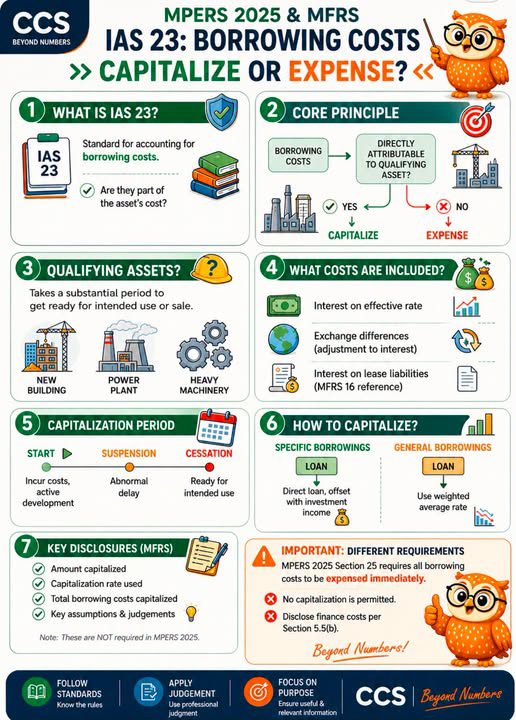
When a company incurs borrowing costs, should they be added to the cost of an asset or recognised as an expense immediately?
The answer depends on whether the company applies MFRS or MPERS 2025.
Borrowing Costs under MFRS
Under MFRS, which follows the full IFRS framework, borrowing costs that are directly attributable to the acquisition, construction or production of a qualifying asset are generally capitalised as part of the cost of that asset.
Examples of qualifying assets may include:
- Buildings;
- Factories;
- Major plant and machinery; and
- Other assets that take a substantial period of time to prepare for their intended use or sale.
Borrowing costs that do not meet the requirements for capitalisation are recognised as expenses in profit or loss.
When Does Capitalisation Begin?
Capitalisation generally begins when all of the following conditions are met:
- The company is incurring expenditure on the qualifying asset;
- Borrowing costs are being incurred; and
- Activities necessary to prepare the asset for its intended use or sale are in progress.
When Should Capitalisation Be Suspended?
Capitalisation may need to be suspended during extended periods in which the company temporarily stops carrying out the activities necessary to prepare the qualifying asset.
However, temporary delays that are a normal part of the construction or development process do not necessarily require capitalisation to be suspended.
When Does Capitalisation Cease?
Capitalisation generally ceases when substantially all activities necessary to prepare the qualifying asset for its intended use or sale have been completed.
If an asset is completed in separate parts and each part can be used independently, capitalisation may cease separately for each completed part.
What Borrowing Costs May Be Included?
Depending on the circumstances, borrowing costs may include:
- Interest expense calculated using the effective interest method;
- Certain exchange differences arising from foreign currency borrowings, to the extent that they are regarded as an adjustment to interest costs; and
- Interest relating to lease liabilities, where applicable.
The borrowing costs must be directly attributable to the qualifying asset and must be determined in accordance with the applicable requirements.
Borrowing Costs under MPERS 2025
Under MPERS 2025, borrowing costs are recognised as an expense when incurred.
Unlike MFRS, MPERS 2025 does not permit borrowing costs to be capitalised as part of the cost of a qualifying asset.
This creates an important difference:
| Issue | MFRS | MPERS 2025 |
|---|---|---|
| Borrowing costs for a qualifying asset | Generally capitalised if the requirements are met | Recognised as an expense |
| Capitalisation period | Begins when the relevant conditions are met and ends when substantially complete | Not applicable |
| Suspension of capitalisation | May be required during extended interruptions | Not applicable |
| Cessation of capitalisation | When substantially all necessary activities are complete | Not applicable |
The Key Difference
MFRS: Qualifying-asset borrowing costs are generally capitalised.
MPERS 2025: Borrowing costs are expensed when incurred.
Finance teams, auditors and business owners should identify the applicable financial reporting framework before determining the accounting treatment.
The distinction affects:
- The carrying amount of assets;
- Finance costs reported in profit or loss;
- Profit during the construction or development period; and
- Future depreciation or amortisation.
Borrowing costs should therefore not be capitalised or expensed based only on the name of the loan. The company should first determine whether it applies MFRS or MPERS 2025 and then assess the relevant requirements.
Beyond Numbers. Clear Standards. Smart Application.
MPERS 2025 与 MFRS:借款成本——资本化还是费用化?
当企业发生借款成本时,究竟应该把它计入资产成本进行资本化,还是在发生时立即确认为费用?
答案取决于企业采用的是 MFRS 还是 MPERS 2025。
MFRS 下的借款成本
根据遵循完整 IFRS 框架的 MFRS,如果借款成本是直接归属于取得、建造或生产一项合资格资产(Qualifying Asset),一般需要将其资本化,并计入该资产的成本。
合资格资产的例子包括:
- 建筑物;
- 工厂;
- 大型厂房及机器;以及
- 需要经过相当长时间才能达到预定可使用状态或可供出售状态的其他资产。
不符合资本化条件的借款成本,则应在损益中确认为费用。
什么时候开始资本化?
当以下条件同时满足时,一般开始资本化:
- 企业已经开始为合资格资产发生支出;
- 企业正在发生借款成本;以及
- 企业正在进行使该资产达到预定可使用或可出售状态所必需的活动。
什么时候需要暂停资本化?
如果企业在一段较长期间内暂时停止进行准备合资格资产所必需的活动,可能需要暂停借款成本的资本化。
不过,如果有关延误属于建造或开发过程中的正常暂时性延误,则不一定需要暂停资本化。
什么时候停止资本化?
当使合资格资产达到预定可使用或可出售状态所必需的主要活动已经大致完成时,一般应停止资本化。
如果一项资产由多个部分组成,而每个部分都可以独立使用,则每个部分可能在完成时分别停止资本化。
哪些借款成本可能被纳入?
根据具体情况,借款成本可能包括:
- 按实际利率法计算的利息费用;
- 外币借款产生的部分汇兑差额,但仅限于该汇兑差额可视为利息成本的调整;以及
- 在适用情况下,与租赁负债有关的利息。
相关借款成本必须是直接归属于合资格资产的成本,并且必须根据适用的财务报告要求进行确定。
MPERS 2025 下的借款成本
根据 MPERS 2025,借款成本应在发生时确认为费用。
与 MFRS 不同,MPERS 2025 不允许企业把借款成本资本化并计入合资格资产的成本。
这带来一个重要分别:
| 项目 | MFRS | MPERS 2025 |
|---|---|---|
| 合资格资产的借款成本 | 符合条件时,一般进行资本化 | 发生时确认为费用 |
| 资本化期间 | 从相关条件满足时开始,直到资产大致完成 | 不适用 |
| 暂停资本化 | 长时间中断相关活动时,可能需要暂停 | 不适用 |
| 停止资本化 | 主要准备活动大致完成时停止 | 不适用 |
最关键的分别
MFRS:合资格资产的借款成本一般需要资本化。
MPERS 2025:借款成本在发生时确认为费用。
财务团队、审计师及企业老板在决定会计处理前,应先确认企业所采用的财务报告框架。
这项区别会影响:
- 资产的账面金额;
- 损益中列报的融资成本;
- 建造或开发期间的利润;以及
- 未来的折旧或摊销金额。
因此,企业不能只看贷款的名称,就决定借款成本应该资本化还是费用化。首先应确定企业采用的是 MFRS 还是 MPERS 2025,再根据相关要求进行评估。
Beyond Numbers. Clear Standards. Smart Application.