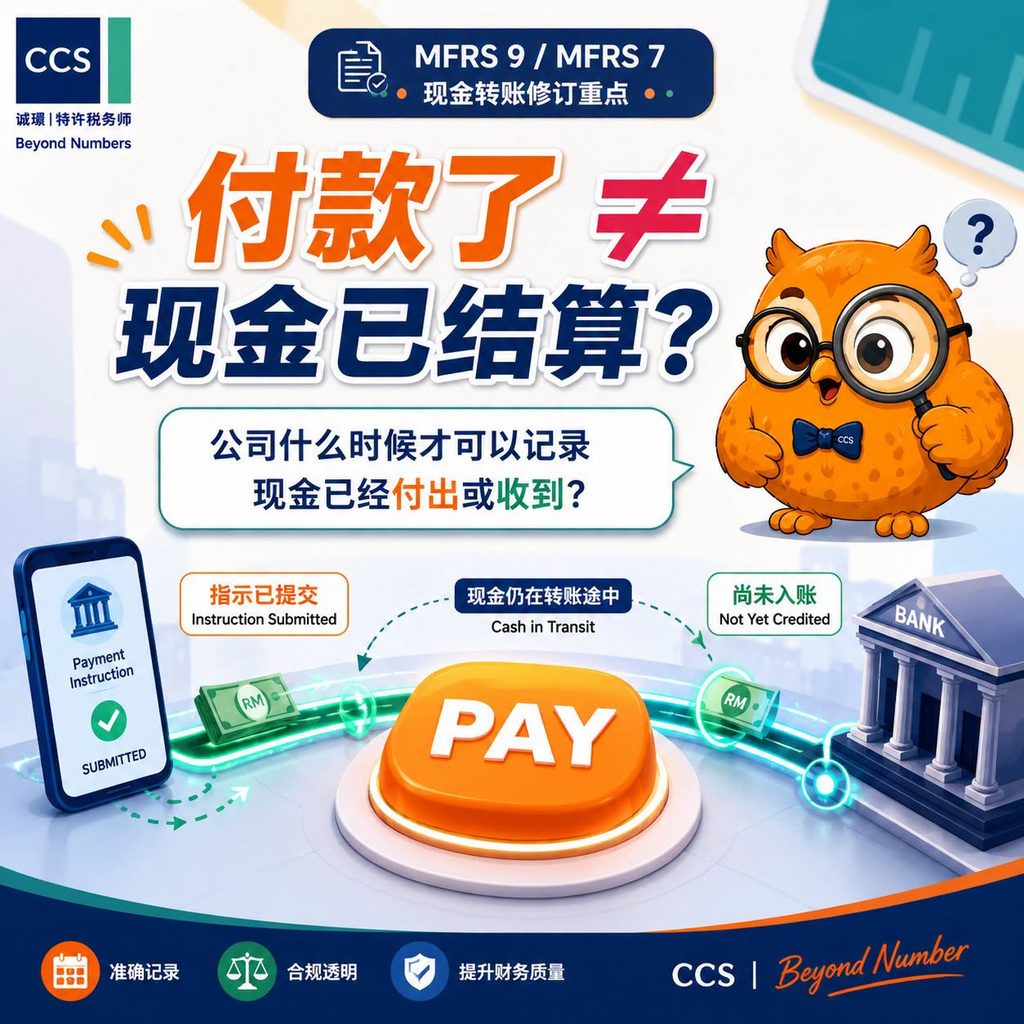
The amendments issued by the Malaysian Accounting Standards Board (MASB) to MFRS 9 Financial Instruments and MFRS 7 Financial Instruments: Disclosures clarify how companies should account for payments and receipts that are still in transit.
The central question is:
When should a company recognise that cash has been paid or received?
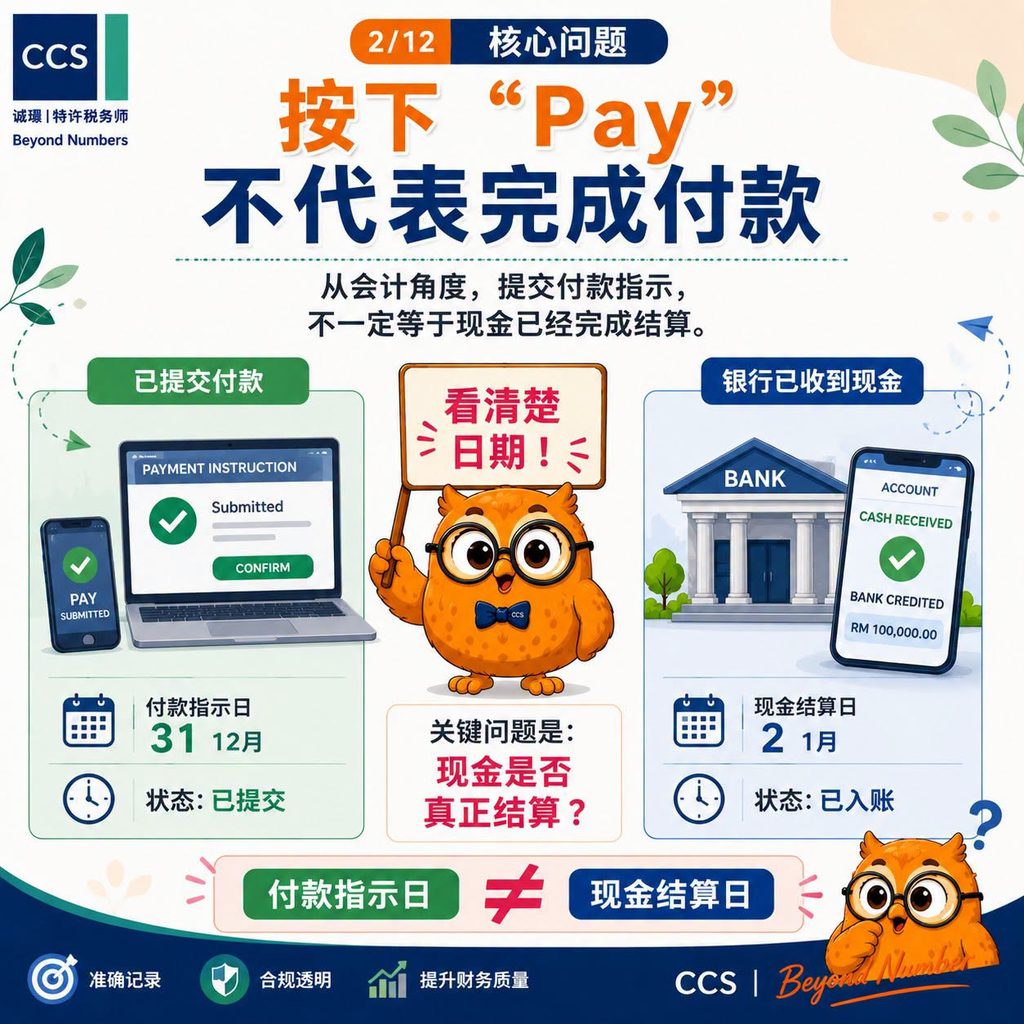
Many people assume that a payment is complete as soon as someone presses “Submit” or “Pay” in an online banking system. From an accounting perspective, that may not be the case.
If the funds have not yet reached the recipient’s bank account, or the bank has not completed settlement, the payment or receipt may not yet be treated as complete.
Key Terms
Recognition means recording an item in the accounts. For example, if a customer owes the company RM10,000, the company recognises a trade receivable.
Derecognition means removing an item from the accounts. When the customer pays RM10,000 and the funds reach the company’s bank account, the company derecognises the trade receivable and recognises cash.
Trade receivables are amounts owed to the company by its customers, while trade payables are amounts owed by the company to its suppliers.
The settlement date is the date on which the cash transfer is actually completed. If an online payment is initiated on Monday but the supplier receives the funds on Wednesday, Wednesday is the settlement date for this purpose.
Cash in transit refers to money that has been sent, or for which payment instructions have been initiated, but which has not yet reached the receiving bank account.
Why the Amendments Matter
Although electronic payments are now faster, many payments are still not settled immediately.
| Payment method | Payment instruction date | Cash received date |
|---|---|---|
| Customer online transfer | 30 December | 2 January |
| Cheque payment | 31 December | 3 January |
| Cross-border transfer | 28 December | 4 January |
Previously, some companies recorded payments when the payment instruction was submitted, while others recorded them only when the bank confirmed settlement. This resulted in inconsistent financial reporting.
For example, two companies may both make payments on 31 December. One records the payment immediately after pressing “Pay”, while the other waits until the bank confirms settlement. Their year-end financial statements may therefore show different cash and payable balances, even though the underlying transactions are similar.
The amendments aim to reduce this inconsistency.
General Principles
Financial Assets
Financial assets include:
- Cash;
- Trade receivables;
- Amounts owed by customers; and
- Loan receivables.
A company recognises a financial asset when it has the right to receive cash. It derecognises the asset when that right expires or is transferred.
Financial Liabilities
Financial liabilities include:
- Trade payables;
- Bank loans;
- Amounts owed to suppliers; and
- Intercompany payables.
A company recognises a financial liability when it has an obligation to pay. The liability is generally derecognised when the obligation is extinguished, usually when payment is settled.
The amendments mainly concern cash transfers. They do not change the existing accounting treatment for regular-way purchases or sales of financial assets, such as shares and bonds. Existing trade-date or settlement-date accounting requirements may continue to apply to those transactions.
Accounting by the Receiving Entity
The general rule for the receiving entity is:
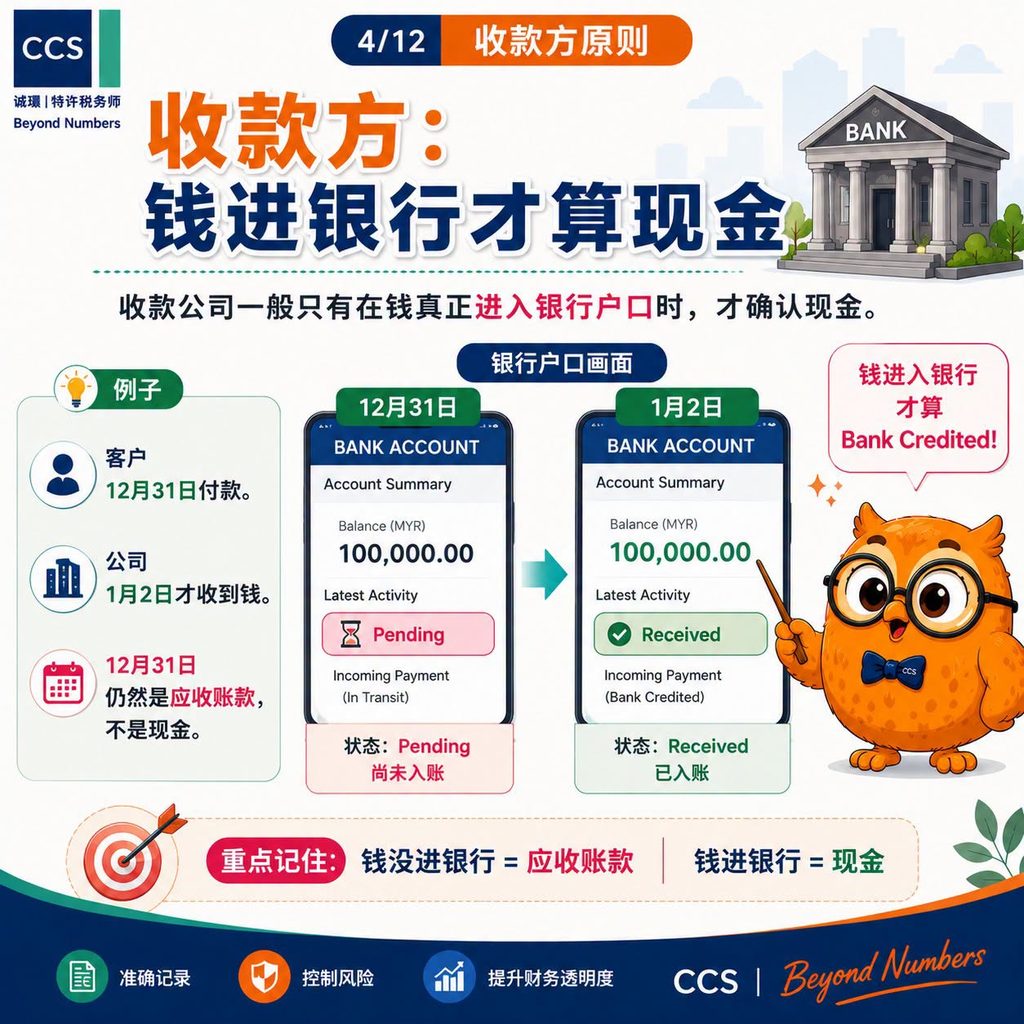
Cash is recognised only when the funds have actually been deposited into the entity’s bank account.
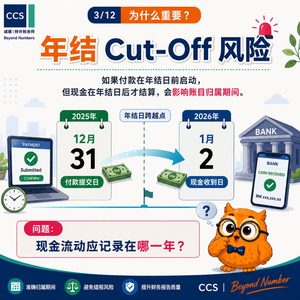
For example, if a customer initiates payment on 30 December but the company receives the funds on 2 January, the company should generally continue to recognise a trade receivable at 31 December rather than cash.
Receipts by Cheque
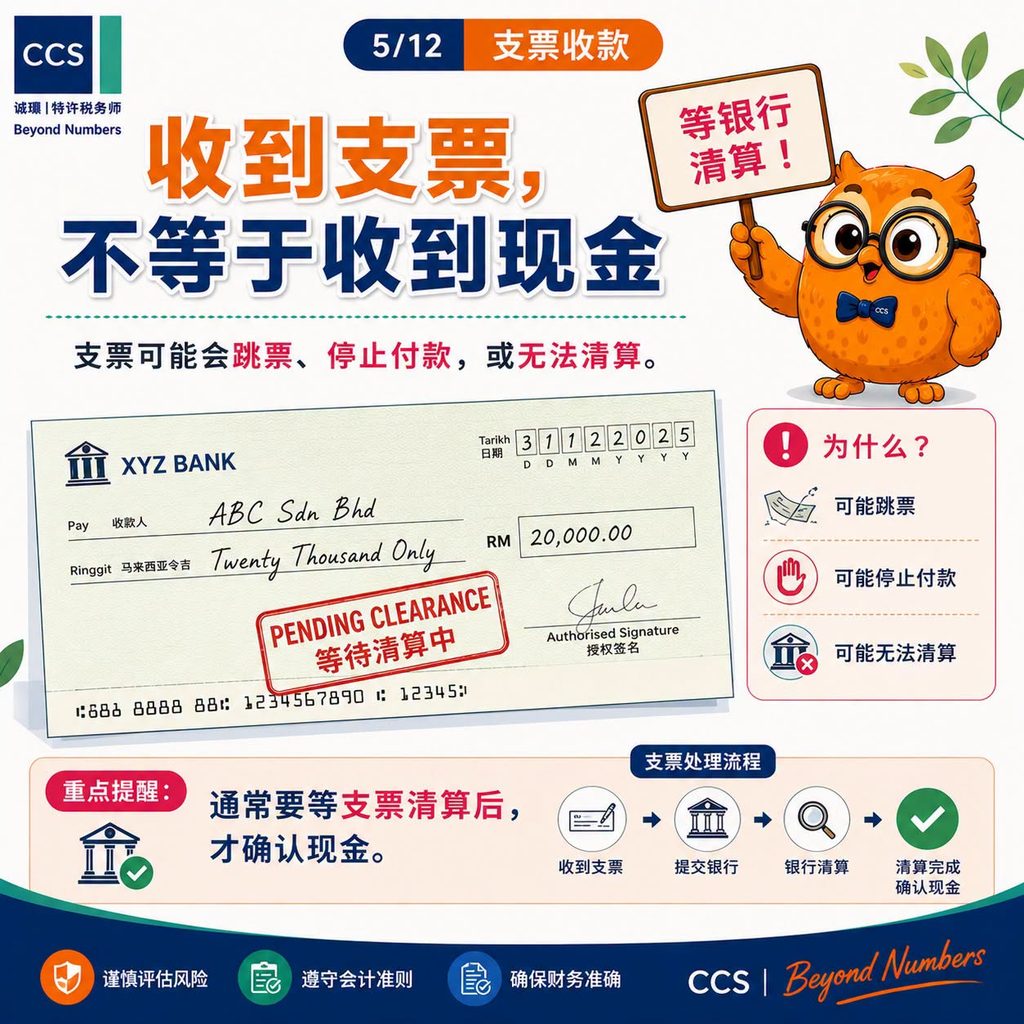
Receiving a cheque does not necessarily mean that cash has been received. A cheque may be rejected because of:
- Insufficient funds;
- A closed bank account;
- A stopped payment; or
- A technical banking issue.
For example:
- Company A receives a cheque for RM20,000 on 30 December;
- The cheque is deposited on 31 December; and
- The bank clears it on 3 January.
Company A should generally recognise cash on 3 January. Before clearance, the amount remains a receivable or an amount pending clearance.
Receipts through Electronic Payment Systems
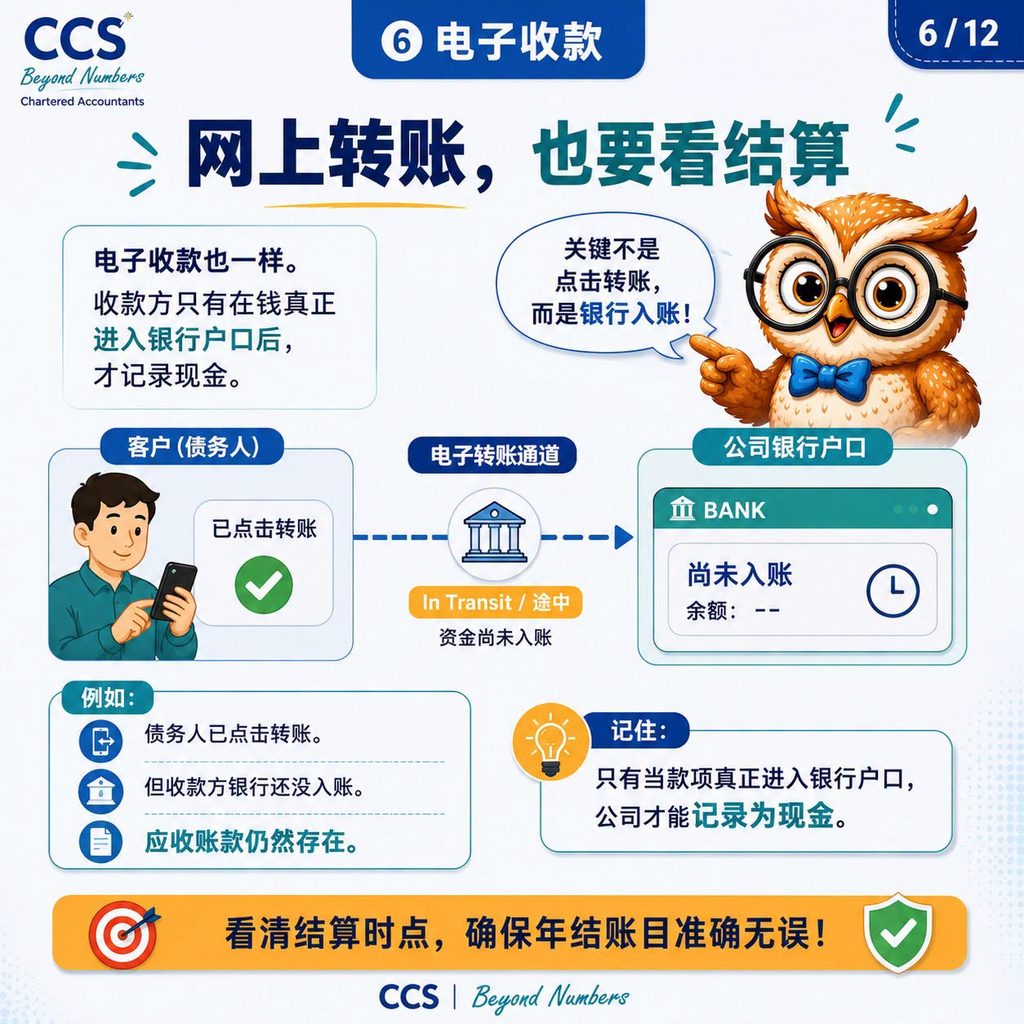
The same principle generally applies to electronic receipts.
If a customer transfers money on 31 December but the company’s bank account is credited on 2 January, the company has not yet received cash at 31 December. The amount should generally remain recorded as a trade receivable.
The receiving entity cannot derecognise the receivable merely because the customer has initiated payment.
For example:
- Customer B initiates a RM75,000 electronic payment on Day 30;
- Company A receives the money on Day 33; and
- Company A’s reporting date is Day 32.
At Day 32, Company A continues to recognise the trade receivable and does not recognise cash. On Day 33, it recognises cash and derecognises the receivable.
Accounting by the Paying Entity
The general rule for the paying entity is:
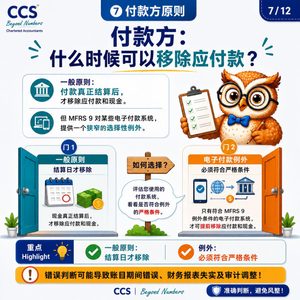
The payable and cash are generally derecognised when the payment is settled.
There is, however, a narrow optional exception for certain electronic payment systems.
Scope of the Exception
The exception applies only to:
- Electronic payment systems; and
- Financial liabilities.
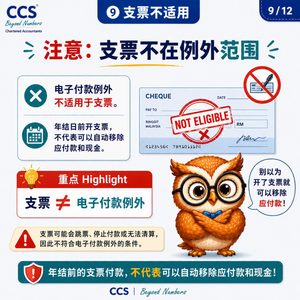
It does not apply to all payment methods and does not apply to cheques.
If a company issues a cheque to a supplier on 31 December, it cannot automatically derecognise the payable and cash merely because the cheque has been issued. The company must assess whether the payment obligation has been extinguished under the normal MFRS 9 requirements.
Conditions for Applying the Exception
The paying entity may apply the exception only when all relevant conditions are satisfied. The entity must have initiated the payment instruction and:
- Have no practical ability to withdraw, stop or cancel the payment;
- Have no practical ability to access or use the cash designated for settlement; and
- Face insignificant settlement risk.
In practical terms, the payment should be highly likely to complete through the normal banking process.
For example, the exception may be available where:
- The payment cannot be cancelled after submission;
- The bank has blocked or deducted the funds;
- Settlement is expected within one or two days; and
- The risk of payment failure is insignificant.
If Company A owes Supplier B RM100,000 and submits an irrevocable electronic payment on 31 December, it may be able to derecognise the financial liability and cash on 31 December if all the conditions are met, even though the bank settles the payment on 2 January.
Payment Instructions Prepared in Advance
A payment file prepared in advance generally does not qualify for the exception if it can still be amended, cancelled or withdrawn.
For example, if the finance team prepares a payment file on 28 December for payment on 5 January, and management can still change or cancel it before 5 January, the company continues to control the cash. The exception is therefore not available before settlement.
Payments Settled through an Overdraft
The exception is not limited to payments made from cash held in a current account. It may also apply where the payment is settled through an overdraft or similar financing facility, provided all the conditions are satisfied.
Apply the Exception by Payment System
The exception is applied by payment system, not by individual transaction.
If a company elects to apply the exception to Payment System X, it must apply the policy consistently to similar payments made through that system. It cannot select the exception transaction by transaction based on the preferred accounting result.
Intercompany Payments and Consolidated Financial Statements
Intercompany payments require careful consideration.
For example:
- A parent company owes its subsidiary RM500,000;
- The parent initiates payment on 31 December and applies the exception;
- The parent derecognises the payable and cash; and
- The subsidiary receives the money on 2 January.
In the parent’s separate financial statements, the payable and cash may already have been derecognised. In the subsidiary’s separate financial statements, the receivable may remain recognised because the cash has not yet been received.
When preparing consolidated financial statements, the group must eliminate the intercompany balances correctly. Internal payments should not create an artificial cash movement before the group’s cash has actually changed externally.
Other Practical Effects
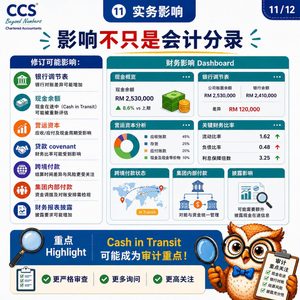
Bank Reconciliations
Bank reconciliation procedures may change.
Previously, common reconciling items included:
- Outstanding cheques;
- Deposits in transit;
- Payments recorded in the accounts but not yet shown on the bank statement; and
- Bank-processed items not yet recorded by the company.
For example, if a company records a cheque payment on 31 December but the bank clears it on 3 January, the bank reconciliation may show an outstanding cheque.
Under the clarified treatment, the company may wait until settlement before recording the payment. The outstanding-cheque item may therefore reduce or appear differently.
Financial Ratios and Loan Covenants
The amendments may affect:
- Cash balances;
- Net debt;
- Working capital;
- Current ratios;
- Free cash flow; and
- Debt-to-equity ratios.
For example, a company has RM1,000,000 in its bank account on 31 December and initiates a RM400,000 payment on the same day. The payment settles on 2 January.
Depending on the accounting treatment, year-end cash may appear as RM1,000,000 or RM600,000. This difference may affect financial ratios and loan covenant calculations.
Cross-Border Payments
Cross-border payments may be more complex because settlement practices differ between countries, banks and intermediary banks.
For example, a Malaysian company transfers money to a supplier in China on 29 December, but the funds pass through intermediary banks and reach the supplier on 3 January.
The Malaysian company must determine whether the liability was settled before or after year end and should maintain sufficient tracking and supporting documentation.
Multinational Payment Systems
For multinational groups, the exception is assessed system by system, not country by country.
A group may use:
- A Malaysian payment system;
- A Singapore payment system;
- A European treasury platform; and
- A US ACH system.
Each system must be assessed separately. The group cannot simply conclude that the exception applies globally.
Presentation and Disclosure
The amendments do not introduce an entirely new disclosure framework for cash transfers. However, where the effect is material, additional explanation may be necessary, especially when significant payments remain in transit at the reporting date.
Possible disclosures may include:
- Whether the cash is restricted;
- Whether the cash remains available for use;
- The effect on liquidity;
- The amount of cash unavailable for general use; and
- The nature of payments that remain in transit.
For example, a company may report cash of RM2,000,000 at year end, of which RM800,000 has already been committed to an irrevocable electronic payment. Although the bank has not yet deducted the amount, the RM800,000 may no longer be practically available for general use.
Transition and Effective Date
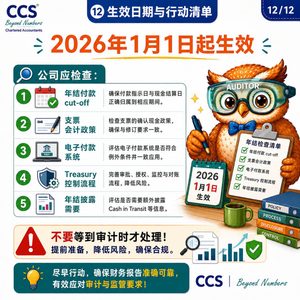
The amendments apply to annual reporting periods beginning on or after 1 January 2026, with early application permitted.
Entities apply the amendments retrospectively. However, prior periods may not need to be restated if doing so would require the use of hindsight or is not practicable.
Example: Cheque Payment
Entity A’s financial year ends on 31 December.
- Entity A issues a cheque for RM75,000 on 31 December 2025;
- The cheque is settled on 2 January 2026; and
- Under the old policy, the payable and cash were derecognised on 31 December 2025.
Under the new policy, payment by cheque is generally recognised when settled.
On 1 January 2026, Entity A may need to:
- Restore a trade payable of RM75,000; and
- Restore cash of RM75,000.
When the cheque clears on 2 January 2026:
- The trade payable is derecognised; and
- Cash is derecognised.
Example: Electronic Cash Receipt
Entity A has a trade receivable of RM75,000.
- The customer initiates an electronic payment on 31 December 2025;
- Entity A receives the money on 2 January 2026; and
- Under the old policy, Entity A recorded cash on 31 December 2025.
Under the new policy, cash is recognised only when received.
On 1 January 2026, Entity A may need to:
- Reverse cash of RM75,000; and
- Restore the trade receivable of RM75,000.
On 2 January 2026:
- Cash is recognised; and
- The trade receivable is derecognised.
Ongoing Accounting Policy Election
The electronic payment exception is an ongoing accounting policy election.
If a company does not elect to apply the exception when it first adopts the amendments, it may subsequently choose to apply it. However, the subsequent decision would be treated as a voluntary change in accounting policy and must comply with MFRS 108 Accounting Policies, Changes in Accounting Estimates and Errors.
Before the amendments become effective, companies may also need to disclose the expected impact if the amendments are relevant and material.
Management should assess:
- Whether the amendments affect the company;
- Which payment systems are involved;
- Whether prior transactions are affected;
- Whether future transactions may be affected; and
- Whether users of the financial statements require additional information.
Practical Reminder
Pressing “Pay” does not necessarily mean that payment has been completed.
Companies should review:
- Cheque payment procedures;
- Electronic payment systems;
- Year-end cut-off procedures;
- Bank reconciliation templates;
- Treasury approval workflows;
- Intercompany payment arrangements;
- Cross-border settlement timing;
- Financial statement disclosures; and
- Loan covenant calculations.
For auditors and finance teams, the main risk area is cut-off: whether cash, trade receivables and trade payables are recorded in the correct accounting period.
CCS | Beyond Numbers
MFRS 9 与 MFRS 7 修订:付款什么时候才算真正结算?
马来西亚会计准则委员会(MASB)对 **MFRS 9《金融工具》**及 **MFRS 7《金融工具:披露》**作出的修订,主要是为了厘清付款或收款仍在途中的会计处理。
核心问题是:
公司应该在什么时候确认现金已经付出或收到?
很多人以为,只要按下网上银行的 “Submit” 或 “Pay”,付款就已经完成。
但从会计角度来看,事情未必这么简单。
如果款项还没有真正进入收款人的银行户口,或者银行还没有完成结算,付款或收款可能还不能被视为已经完成。
非会计人士需要了解的几个词
确认(Recognition),就是把某个项目记录进账目。
例如,客户欠公司 RM10,000,公司就在账上确认一项应收账款。
终止确认(Derecognition),就是把某个项目从账目中移除。
当客户支付 RM10,000,而且款项已经进入公司银行户口,公司就终止确认应收账款,并确认现金。
应收账款(Trade Receivables),是客户欠公司的钱;应付账款(Trade Payables),则是公司欠供应商的钱。
结算日(Settlement Date),是现金转账真正完成的日期。如果公司星期一启动网上付款,但供应商星期三才收到钱,在本文的语境下,星期三才是结算日。
在途现金(Cash in Transit),是指款项已经发出或已经启动付款程序,但还没有真正进入收款人的银行户口。
为什么会有这项修订?
虽然电子付款越来越快,但很多付款仍然不是即时完成的。
| 付款方式 | 启动付款日期 | 真正收到款项日期 |
|---|---|---|
| 客户网上转账 | 12 月 30 日 | 1 月 2 日 |
| 公司开出支票 | 12 月 31 日 | 1 月 3 日 |
| 跨境汇款 | 12 月 28 日 | 1 月 4 日 |
过去,有些公司在提交付款指示时就入账;有些公司则等银行确认结算后才入账。这会造成财务报告之间的不一致。
例如,两家公司都在 12 月 31 日付款。一家公司按下网上付款后马上入账,另一家公司则等银行确认付款完成后才入账。
因此,即使两笔交易的经济实质相近,两家公司的年结现金及应付款余额也可能看起来不同。
这项修订的目的,就是减少这种不一致。
一般原则
金融资产
金融资产包括:
- 现金;
- 应收账款;
- 客户欠款;以及
- 贷款应收款。
当公司拥有收取现金的权利时,就确认金融资产。当这项收款权利已经到期或转移时,才终止确认该资产。
金融负债
金融负债包括:
- 应付账款;
- 银行贷款;
- 应付供应商款项;以及
- 集团内部应付款。
当公司有付款义务时,就确认金融负债。一般来说,当付款义务已经解除,通常是在付款真正结算时,才终止确认该负债。
这项修订主要针对现金转账,并不改变股票及债券等普通金融资产买卖的现有会计处理。有关交易原本适用的交易日或结算日会计要求,可能继续有效。
收款方的会计处理
收款方的一般原则是:
只有在现金真正进入企业银行户口时,才确认现金。
例如,客户在 12 月 30 日启动付款,但公司在 1 月 2 日才收到款项,公司在 12 月 31 日一般仍应确认应收账款,而不是现金。
通过支票收款
收到支票,并不代表公司已经立即收到现金。
支票可能因为以下原因被拒绝:
- 户口余额不足;
- 银行户口已经关闭;
- 对方停止付款;或
- 银行技术问题。
例如:
- A 公司在 12 月 30 日收到 RM20,000 支票;
- 12 月 31 日将支票存入银行;以及
- 银行在 1 月 3 日才清算成功。
A 公司一般应在 1 月 3 日才确认现金。在支票清算之前,这笔金额仍然属于应收款或待清算款项。
通过电子付款系统收款
电子收款一般遵循相同原则。
如果客户在 12 月 31 日进行网上转账,但公司银行户口在 1 月 2 日才收到钱,那么公司在 12 月 31 日还没有真正收到现金,相关金额一般仍应记录为应收账款。
收款方不能仅仅因为客户已经启动付款,就马上终止确认应收账款。
例如:
- 客户 B 在 Day 30 启动 RM75,000 的电子付款;
- A 公司在 Day 33 才收到钱;以及
- A 公司的报告日是 Day 32。
在 Day 32,A 公司仍然确认应收账款,不能确认现金。到了 Day 33,A 公司确认现金,并终止确认应收账款。
付款方的会计处理
付款方的一般原则是:
付款方通常要等到付款真正结算时,才终止确认应付款和现金。
不过,对于某些电子付款系统,有一个范围非常狭窄的特别例外。
例外的适用范围
这个例外只适用于:
- 电子付款系统;以及
- 金融负债。
它并不适用于所有付款方式,也不适用于支票。
如果公司在 12 月 31 日开出支票给供应商,公司不能仅因为支票已经开出,就自动终止确认应付款和现金。企业需要按照 MFRS 9 的一般要求,判断付款义务是否已经解除。
使用例外的条件
付款方只有在符合所有相关条件时,才可以使用这个例外。企业已经启动付款指示,并且:
- 实际上不能撤回、停止或取消付款;
- 实际上不能再使用用于结算的那笔现金;以及
- 结算风险很低。
换句话说,付款应该非常可能通过正常银行程序完成。
例如,以下情况可能符合条件:
- 付款提交后不能取消;
- 银行已经锁定或扣除有关资金;
- 付款预计在一至两天内完成;以及
- 付款失败的风险并不重大。
如果 A 公司欠供应商 B RM100,000,并在 12 月 31 日提交不可撤销的电子付款,而银行在 1 月 2 日才完成结算,只要所有条件都符合,A 公司可能可以选择在 12 月 31 日终止确认金融负债和现金。
预先准备付款指示
如果公司只是预先准备付款文件,但付款仍然可以修改、取消或撤回,一般不能使用这个例外。
例如,财务部在 12 月 28 日准备了一份付款文件,付款日期是 1 月 5 日,而管理层在 1 月 5 日前仍可以取消或修改付款。
在这种情况下,公司仍然实际控制这笔钱,因此在付款结算前不能使用这个例外。
通过透支或类似融资安排付款
这个例外不只适用于从普通银行户口扣款的付款。
如果电子付款是通过透支或类似融资安排结算,只要符合所有条件,也可能适用这个例外。
例外必须按付款系统一致应用
这个例外是按付款系统选择,而不是按单一交易选择。
如果公司选择对 Payment System X 使用这个例外,就必须一致地应用在通过该系统进行的相关付款。
公司不能根据某一笔交易想要的会计结果,选择性地使用或不使用例外。
集团内部付款与合并财务报表
集团内部付款需要特别注意。
例如:
- 母公司欠子公司 RM500,000;
- 母公司在 12 月 31 日启动付款并使用电子付款例外;
- 母公司终止确认应付款和现金;以及
- 子公司在 1 月 2 日才收到钱。
在母公司的独立财务报表中,应付款和现金可能已经终止确认;但在子公司的独立财务报表中,由于现金尚未收到,应收账款可能仍然保留。
编制合并财务报表时,集团必须正确抵销内部余额。集团内部付款不应在集团现金尚未真正对外发生变化前,制造人为的外部现金流动。
修订带来的其他实务影响
对银行调节表的影响
银行调节程序可能需要改变。
过去常见的调节项目包括:
- 未兑现支票;
- 在途存款;
- 公司已经入账但银行尚未显示的付款;以及
- 银行已经处理但公司尚未入账的项目。
例如,公司在 12 月 31 日记录支票付款,但银行在 1 月 3 日才清算,银行调节表可能显示“未兑现支票”。
根据修订后的处理方式,公司可能需要等到结算后才记录付款。因此,银行调节表中的“未兑现支票”项目可能减少或以不同方式出现。
对财务指标及贷款契约的影响
这项修订可能影响:
- 现金余额;
- 净债务;
- 营运资本;
- 流动比率;
- 自由现金流;以及
- 负债权益比率。
例如,公司在 12 月 31 日的银行现金为 RM1,000,000,并在当天启动 RM400,000 的付款,但付款在 1 月 2 日才完成。
根据所采用的会计处理,年结现金可能显示为 RM1,000,000 或 RM600,000。这种差异可能影响财务比率及银行贷款契约的计算。
跨境付款的考虑
跨境付款通常更复杂,因为不同国家、银行及中转银行的结算时间可能不同。
例如,马来西亚公司在 12 月 29 日汇款给中国供应商,但款项经过中转银行后,供应商在 1 月 3 日才收到钱。
马来西亚公司需要判断相关负债是在年结日前还是年结日后结算,并保留清楚的付款追踪记录及支持文件。
跨国集团的付款系统
对于跨国集团,这个例外是按付款系统判断,而不是按国家判断。
集团可能使用:
- 马来西亚付款系统;
- 新加坡付款系统;
- 欧洲资金平台;以及
- 美国 ACH 系统。
集团必须逐个系统进行评估,不能简单地说:“我们全球都使用这个例外。”
列报与披露
这项修订并没有新增一套完全针对现金转账的披露制度。不过,如果影响重大,公司可能需要提供额外说明,尤其是在报告日有大量付款仍在途中的情况下。
可能需要披露的内容包括:
- 现金是否受到限制;
- 现金是否仍可自由使用;
- 对流动性的影响;
- 不能供一般用途使用的现金金额;以及
- 仍在途中的付款说明。
例如,公司年结日显示现金 RM2,000,000,但其中 RM800,000 已经用于不可取消的电子付款。
虽然银行还没有扣账,但这 RM800,000 可能已经不能实际供企业自由使用,公司可能需要作出清楚披露。
过渡及生效日期
这项修订适用于 2026 年 1 月 1 日或之后开始的年度报告期间,企业也可以选择提前应用。
企业需要追溯应用相关修订。不过,如果重列以前年度需要使用事后判断,或实际上不可行,则不一定需要重列以前年度。
例子:支票付款
A 公司的财政年结日是 12 月 31 日。
- A 公司在 2025 年 12 月 31 日开出 RM75,000 支票;
- 支票在 2026 年 1 月 2 日才结算;以及
- 根据旧政策,A 公司在 2025 年 12 月 31 日已经终止确认应付款和现金。
根据新政策,支票付款一般要等到结算时才确认。
因此,A 公司在 2026 年 1 月 1 日可能需要:
- 恢复 RM75,000 应付账款;以及
- 恢复 RM75,000 现金。
在 2026 年 1 月 2 日支票清算时:
- 终止确认应付账款;以及
- 终止确认现金。
例子:电子收款
A 公司有 RM75,000 的应收账款。
- 客户在 2025 年 12 月 31 日启动电子付款;
- A 公司在 2026 年 1 月 2 日才收到钱;以及
- 根据旧政策,A 公司在 2025 年 12 月 31 日已经记录现金。
根据新政策,现金只有在真正收到时才确认。
因此,A 公司在 2026 年 1 月 1 日可能需要:
- 冲回 RM75,000 现金;以及
- 恢复 RM75,000 应收账款。
在 2026 年 1 月 2 日:
- 确认现金;以及
- 终止确认应收账款。
持续的会计政策选择
电子付款例外是一项持续的会计政策选择。
如果公司首次采用修订时没有选择使用这个例外,之后仍然可能选择使用。不过,之后的选择会被视为自愿改变会计政策,公司必须遵守 **MFRS 108《会计政策、会计估计变更及差错》**的相关要求。
在修订正式生效前,如果影响重大,公司也可能需要披露预计影响。
管理层应评估:
- 修订是否影响公司;
- 哪些付款系统受到影响;
- 过去的交易是否受到影响;
- 未来交易是否可能受到影响;以及
- 财务报表使用者是否需要更多资料。
最重要的实务提醒
按下“Pay”,不一定代表付款已经完成。
企业
- 财务报表披露;以及
- 银行贷款契约的计算方式。
对审计师及财务团队来说,最大的风险领域是截止测试(Cut-off):现金、应收账款及应付账款是否记录在正确的会计期间。
CCS | Beyond Numbers