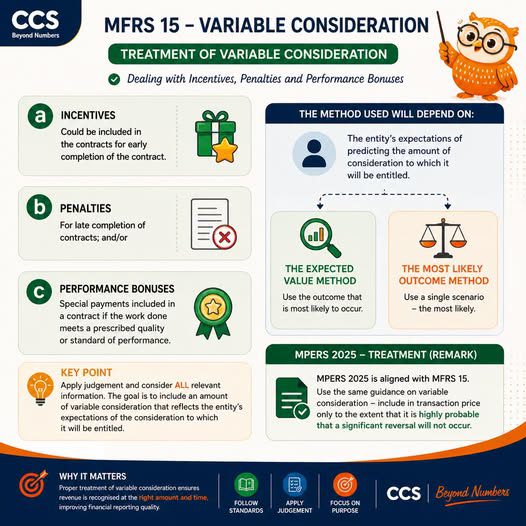
Contracts may include payments that vary depending on performance or other future events. Examples include incentives, penalties, rebates and performance bonuses.
Under MFRS 15, variable consideration should be estimated using one of two methods:
Expected Value Method
The expected value method uses a probability-weighted estimate of the possible outcomes.
This method may be appropriate when the contract includes a wide range of possible outcomes. Each potential outcome is assigned a probability, and the amounts are combined to determine the expected consideration.
Most Likely Outcome Method
The most likely outcome method uses the single outcome that is most likely to occur.
This method may be appropriate when the contract has only two possible outcomes, such as:
- A performance bonus is either received or not received; or
- A penalty is either imposed or not imposed.
The Variable Consideration Constraint
Regardless of the estimation method used, variable consideration should be included in the transaction price only to the extent that it is highly probable that a significant reversal of recognised revenue will not occur when the uncertainty is subsequently resolved.
This requires professional judgement. Factors to consider may include:
- The amount of consideration that is highly susceptible to reversal;
- The entity’s experience with similar contracts;
- The extent to which external factors may affect the outcome; and
- The time required before the uncertainty is resolved.
The estimate should be reassessed at each reporting date.
MPERS 2025 is aligned with the same general revenue recognition principles, while providing a simpler reporting framework for private entities.
In simple terms:
Estimate the variable payment carefully, apply professional judgement and recognise it only when a significant revenue reversal is highly unlikely.
CCS | Beyond Numbers
MFRS 15:可变对价——奖励、罚款与绩效奖金的会计处理
合同中的付款金额,有时会根据业绩表现或未来事件而改变。常见例子包括奖励、罚款、回扣及绩效奖金。
根据 MFRS 15,企业可以采用以下其中一种方法估计可变对价:
预期价值法(Expected Value Method)
预期价值法是根据各种可能结果及其发生概率,计算概率加权后的预期金额。
当合同存在多个可能结果时,这种方法可能较为适合。企业会先为每个可能结果估计发生概率,再计算预期可收取的对价。
最可能结果法(Most Likely Outcome Method)
最可能结果法是采用最有可能发生的单一结果作为估计金额。
当合同只有两个主要可能结果时,这种方法可能较为适合,例如:
- 绩效奖金要么可以收到,要么无法收到;或
- 罚款要么会被征收,要么不会被征收。
可变对价的限制条件
无论采用哪一种估计方法,只有在以下情况下,企业才可以把可变对价计入交易价格:
高度可能在未来不确定性解决时,已确认的收入不会发生重大转回。
这需要企业运用专业判断。考虑因素可能包括:
- 相关金额是否很容易发生重大转回;
- 企业过去处理类似合同的经验;
- 外部因素对最终结果的影响程度;以及
- 需要等待多久才能解决相关不确定性。
企业也应在每个报告日重新评估可变对价的估计金额。
MPERS 2025 与上述收入确认的基本原则保持一致,但为私人实体提供较为简明的财务报告框架。
简单来说:
谨慎估计可变付款,运用专业判断,并且只有在收入高度可能不会发生重大转回时,才确认相关金额。
CCS | Beyond Numbers