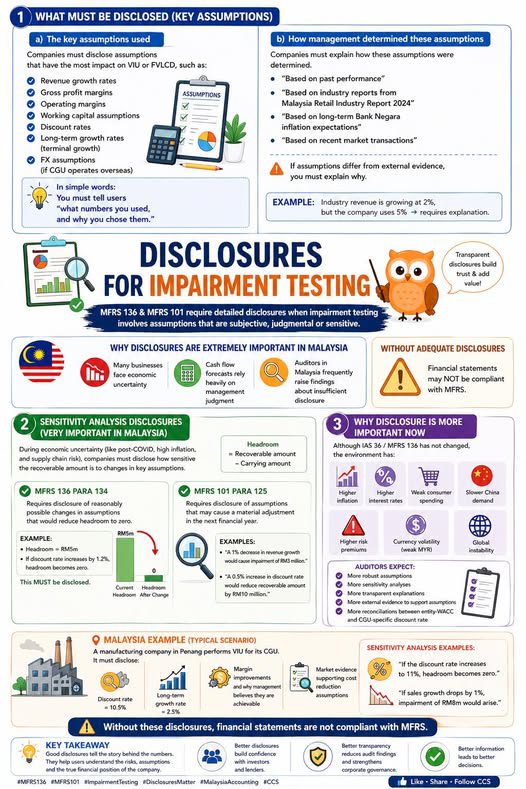
Under MFRS 136 and MFRS 101, companies are required to provide detailed disclosures when performing impairment testing, particularly where the assessment involves significant management judgement, subjective assumptions or sensitivity to changes in economic conditions.
These disclosures are especially important in Malaysia because:
- Many businesses continue to face economic uncertainty;
- Cash flow forecasts often rely heavily on management judgement; and
- Malaysian auditors frequently identify insufficient impairment disclosures as an audit finding.
1. Disclose the Key Assumptions
Companies must disclose the key assumptions that have the greatest impact on the Value in Use (VIU) or Fair Value Less Costs of Disposal (FVLCD) calculation.
These may include:
- Revenue growth rates;
- Gross profit margins;
- Operating margins;
- Working capital assumptions;
- Discount rates;
- Long-term growth rates, including terminal growth rates; and
- Foreign exchange assumptions where a cash-generating unit operates overseas.
In simple terms, companies must explain:
What assumptions were used, and why were those figures selected?
Management should also explain how the assumptions were determined. For example, the assumptions may be based on:
- Historical performance;
- Industry reports, such as the Malaysia Retail Industry Report 2024;
- Long-term inflation expectations published by Bank Negara Malaysia; or
- Recent market transactions.
If the assumptions differ from external evidence, the difference must be explained.
For example, if industry revenue growth is 2% but the company has used a 5% growth rate in its forecast, management must explain the basis for using the higher rate.
2. Sensitivity Analysis Is Essential
During periods of economic uncertainty—such as periods of high inflation, supply chain risks or weak consumer demand—companies must disclose how reasonably possible changes in key assumptions would affect the recoverable amount.
This requirement is set out in paragraph 134 of MFRS 136, which requires disclosure of reasonably possible changes in assumptions that could reduce the headroom to zero.
Headroom is calculated as:
Recoverable amount − Carrying amount
For example:
- Headroom: RM5 million; and
- A 1.2% increase in the discount rate would reduce the headroom to zero.
This sensitivity must be disclosed.
3. MFRS 101 and Material Adjustments
Paragraph 125 of MFRS 101 requires disclosure of assumptions that could result in a material adjustment to the carrying amounts of assets and liabilities during the next financial year.
Examples include:
- A 1% decrease in revenue growth resulting in an impairment loss of RM3 million; or
- A 0.5% increase in the discount rate reducing the recoverable amount by RM10 million.
These disclosures help users understand how exposed the company’s reported asset values are to changes in management’s assumptions.
4. Why Detailed Disclosure Matters More Today
Although IAS 36/MFRS 136 has not changed, the economic environment has become more challenging. Factors affecting impairment assessments may include:
- Higher inflation;
- Higher interest rates;
- Weaker consumer spending;
- Slower demand from China;
- Higher risk premiums;
- Currency volatility, including a weaker Malaysian ringgit; and
- Wider global economic instability.
As a result, impairment testing has become more complex, and disclosures need to be more transparent and detailed.
Auditors increasingly expect to see:
- More robust assumptions;
- More comprehensive sensitivity analyses;
- Clearer explanations;
- More external evidence supporting management’s assumptions; and
- Better reconciliations between the entity-wide weighted average cost of capital (WACC) and the discount rate specific to each cash-generating unit (CGU).
Example: Manufacturing Company in Penang
Assume that a manufacturing company in Penang performs a VIU assessment for one of its CGUs.
The company should disclose:
- Discount rate: 10.5%;
- Long-term growth rate: 2.5%;
- The basis for projected margin improvements and why management believes they are achievable;
- Market evidence supporting the projected cost reductions; and
- Sensitivity analysis, such as:
“If the discount rate increases to 11%, the headroom would be reduced to zero.”
“If sales growth decreases by 1%, an impairment loss of RM8 million would arise.”
Without sufficient disclosures of the assumptions, supporting evidence and sensitivity analysis, the financial statements may not comply with the requirements of MFRS.
Impairment testing is not only about calculating a number. Companies must also explain the assumptions, evidence and possible changes that support that number.
MFRS 136 减值测试:重要披露要求与敏感性分析
根据 MFRS 136及 MFRS 101,企业在进行资产减值测试时,必须提供详细的披露,尤其是在评估涉及重大管理层判断、主观假设,或容易受到经济环境变化影响的情况下。
这些披露在马来西亚尤其重要,原因包括:
- 许多企业仍然面对经济不确定性;
- 现金流预测往往高度依赖管理层判断;以及
- 马来西亚审计师经常将减值披露不足列为审计发现事项。
1. 披露关键假设
企业必须披露对**使用价值(Value in Use,VIU)或扣除处置成本后的公允价值(Fair Value Less Costs of Disposal,FVLCD)**计算影响最大的关键假设。
这些假设可能包括:
- 收入增长率;
- 毛利率;
- 营业利润率;
- 营运资本假设;
- 折现率;
- 长期增长率,包括终值增长率;以及
- 如果现金产生单位在海外经营,还包括外汇假设。
简单来说,企业必须说明:
采用了哪些假设,以及为什么选择这些数字?
管理层也应说明这些假设是如何确定的。例如,相关假设可能是根据以下资料制定:
- 过往经营表现;
- 行业报告,例如《2024 年马来西亚零售业报告》;
- 马来西亚国家银行公布的长期通胀预期;或
- 最近的市场交易。
如果企业所采用的假设与外部证据不一致,就必须解释其中的差异。
例如,如果行业收入增长率为 2%,但企业在预测中采用 5% 的增长率,管理层就必须说明采用较高增长率的依据。
2. 敏感性分析至关重要
在经济不确定性较高的时期,例如高通胀、供应链风险或消费需求疲弱期间,企业必须披露关键假设出现合理可能的变化时,将如何影响可收回金额。
这项要求载于 MFRS 136 第 134 段。该段要求企业披露合理可能发生的假设变动,以及这些变动如何导致减值测试中的缓冲空间降至零。
**缓冲空间(Headroom)**的计算方式为:
可收回金额 − 账面金额
例如:
- 缓冲空间:500万令吉;以及
- 折现率上升 1.2%,将导致缓冲空间降至零。
企业必须披露这项敏感性分析。
3. MFRS 101 与重大调整
MFRS 101 第 125 段要求企业披露可能导致下一财政年度资产及负债账面金额发生重大调整的假设。
例如:
- 收入增长率下降 1%,将导致确认 300万令吉的减值损失;或
- 折现率上升 0.5%,将导致可收回金额减少 1,000万令吉。
这些披露有助于财务报表使用者了解企业所呈报的资产价值,对管理层假设变化的敏感程度。
4. 为什么现在需要更详细的披露?
虽然 IAS 36/MFRS 136本身并没有改变,但企业所面对的经济环境已经变得更加复杂。影响减值评估的因素可能包括:
- 通货膨胀率上升;
- 利率上升;
- 消费支出疲弱;
- 中国市场需求放缓;
- 风险溢价上升;
- 货币波动,包括马来西亚令吉贬值;以及
- 全球经济不稳定性增加。
因此,减值测试变得更加复杂,相关披露也必须更加透明及详细。
审计师通常会期望看到:
- 更稳健的假设;
- 更完整的敏感性分析;
- 更清楚的解释;
- 更多支持管理层假设的外部证据;以及
- 企业整体加权平均资本成本(WACC)与各现金产生单位(CGU)特定折现率之间更清晰的调节与说明。
例子:槟城制造企业
假设槟城一家制造企业,针对其中一个现金产生单位进行 VIU 评估。
企业应披露:
- 折现率:10.5%;
- 长期增长率:2.5%;
- 预计利润率改善的依据,以及管理层为何认为相关改善能够实现;
- 支持预计成本节省的市场证据;以及
- 敏感性分析,例如:
“如果折现率上升至 11%,缓冲空间将降至零。”
“如果销售增长率下降 1%,将产生800万令吉的减值损失。”
如果企业没有充分披露相关假设、支持证据及敏感性分析,财务报表可能无法符合 MFRS 的要求。
减值测试不只是计算一个数字。企业也必须解释支持该数字的假设、证据及可能发生的变化。