Malaysia’s e-Invoice implementation timeline has changed over time. The FAQ version 4.6, dated 10 December 2025, consolidated the former Phase 4 and Phase 5 after the exemption threshold increased from RM500,000 to RM1 million. A later update raised the threshold to RM3 million. Under the current guidance, eligible taxpayers with annual turnover or revenue below RM3 million are exempt, subject to the exemption criteria.
What happened to Phase 5?
Under the earlier five-phase schedule, Phase 4 applied to taxpayers with annual turnover or revenue of more than RM1 million and up to RM5 million from 1 January 2026. Phase 5 was scheduled to apply to taxpayers with turnover or revenue of up to RM1 million from 1 July 2026.
Following the increase of the exemption threshold from RM500,000 to RM1 million, the two phases were consolidated. The separate Phase 5 was removed from the main timeline, while Phase 4 covered taxpayers with turnover or revenue of up to RM5 million from 1 January 2026. Eligible taxpayers below the exemption threshold were not required to implement e-Invoicing.
The threshold was subsequently raised to RM3 million. The current timeline retains the 1 January 2026 date for the up-to-RM5-million category, while eligible taxpayers with turnover or revenue below RM3 million are exempt. The exemption does not apply to taxpayers who fail the specified criteria, including certain cases involving non-individual shareholders, subsidiaries, related companies or joint ventures.
Why does 1 July 2026 still appear?
Although Phase 5 no longer exists as a separate phase, 1 July 2026 remains a concessionary implementation date for certain cases under the transitional rules. These include some businesses operating in YA2022 and businesses that commenced operations from YA2023 to YA2025. Depending on their circumstances, they may be required to implement from that date—for example, if they reached the RM3 million threshold in YA2023, YA2024 or YA2025, or if they do not meet the exemption criteria.
The date should therefore not be treated as a general implementation date for all businesses with turnover below RM3 million. The applicable date depends on the taxpayer’s circumstances and the relevant transitional provisions.
Implementation and enforcement dates are different
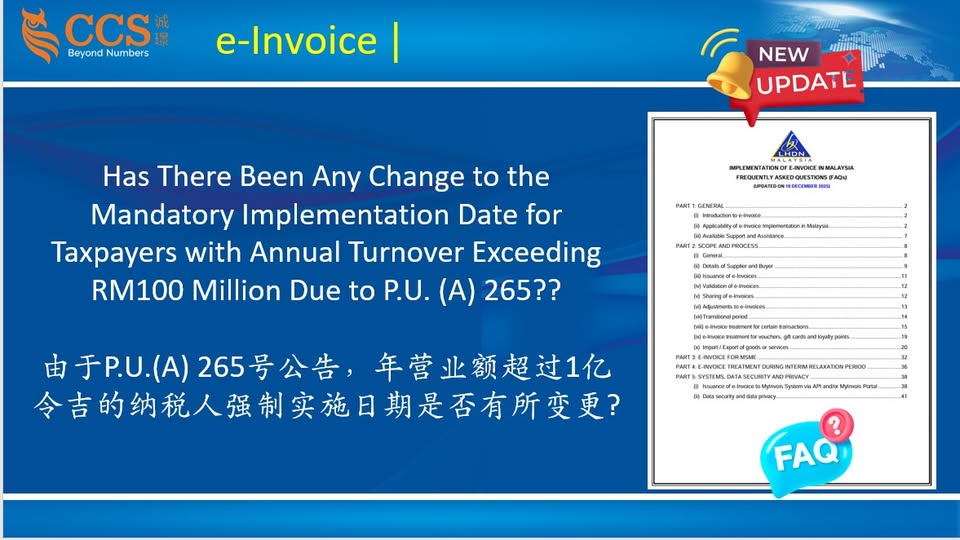
A separate clarification concerns taxpayers with annual turnover or revenue exceeding RM100 million. Their e-Invoice implementation date remained 1 August 2024. The Income Tax (Issuance of Electronic Invoice) Rules 2024 [P.U. (A) 265] were gazetted on 30 September 2024 and took effect on 1 October 2024. HASiL’s FAQ explains that the rules’ effective date did not change the implementation date; enforcement action for non-compliance could begin from 1 October 2024.
Because the timeline, exemption threshold and transitional arrangements have changed, businesses should refer to the current HASiL guidance and assess their own circumstances before determining their implementation obligations.
马来西亚电子发票时间表:第五阶段、RM3 million 豁免门槛与重要日期
马来西亚的电子发票实施时间表曾多次调整。2025年12月10日发布的 FAQ 4.6 版,在豁免门槛从 RM500,000 提高至 RM1 million 后,合并了原先的第四阶段和第五阶段。之后,门槛进一步提高至 RM3 million。根据现行指引,年营业额或收入低于 RM3 million 的合资格纳税人可获豁免,但仍须符合豁免条件。
第五阶段后来如何调整?
根据较早的五阶段时间表,第四阶段适用于年营业额或收入超过 RM1 million、但不超过 RM5 million 的纳税人,实施日期为2026年1月1日。第五阶段原定自2026年7月1日起,适用于年营业额或收入不超过 RM1 million 的纳税人。
豁免门槛从 RM500,000 提高至 RM1 million 后,两个阶段被合并。第五阶段不再作为主要时间表中的独立阶段,而第四阶段涵盖年营业额或收入不超过 RM5 million 的纳税人,实施日期为2026年1月1日。低于豁免门槛且符合条件的纳税人无需实施电子发票。
之后,豁免门槛进一步提高至 RM3 million。现行时间表保留了不超过 RM5 million 类别的2026年1月1日实施日期,同时豁免年营业额或收入低于 RM3 million 的合资格纳税人。若纳税人不符合指定条件,则不能享有豁免;相关情况包括涉及非个人股东、子公司、关联公司或合资企业的部分情形。
为什么仍会看到2026年7月1日?
虽然第五阶段已不再作为独立阶段,但根据过渡规定,2026年7月1日仍是特定情况适用的优惠实施日期。这些情况包括部分在 YA2022 已经营的企业,以及在 YA2023 至 YA2025 开始营业的企业。视个别情况而定,若企业在 YA2023、YA2024 或 YA2025 达到 RM3 million 门槛,或不符合豁免条件,可能须从该日期起实施电子发票。
因此,不能将2026年7月1日视为所有营业额低于 RM3 million 企业的统一实施日期。适用日期须根据纳税人的具体情况及相关过渡规定判断。
实施日期与执法日期并不相同
另一项澄清涉及年营业额或收入超过 RM100 million 的纳税人。他们的电子发票实施日期仍为2024年8月1日。《2024年所得税(电子发票开具)规则》[P.U. (A) 265] 于2024年9月30日刊宪,并于2024年10月1日生效。HASiL 的 FAQ 说明,该规则的生效日期并未改变实施日期;针对不合规情况的执法行动可从2024年10月1日起展开。
由于实施时间表、豁免门槛及过渡安排均曾调整,企业应参照 HASiL 最新指引,并根据自身情况确认电子发票实施义务。