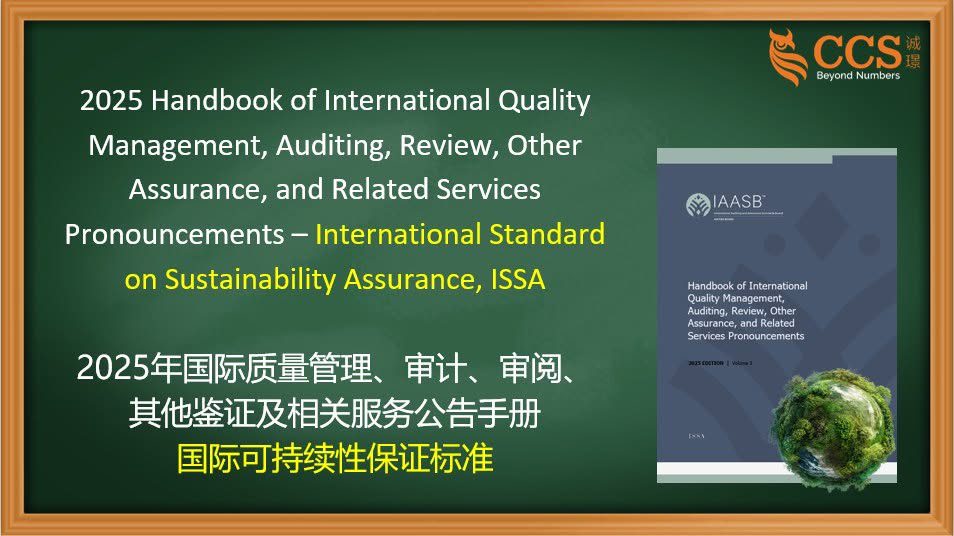
The 2025 Handbook of International Quality Management, Auditing, Review, Other Assurance, and Related Services Pronouncements – Volume 3 (ISSA) is an international guide explaining how professionals provide assurance over sustainability information reported by companies.
In simple terms, it provides a global framework for assessing whether companies’ claims about their environmental and social impact are accurate, complete and reliable.
What Does Volume 3 Cover?
Volume 3 contains the International Standard on Sustainability Assurance (ISSA 5000).
The standard explains how independent professionals should examine sustainability information, including:
- Climate-related disclosures;
- Carbon emissions;
- ESG reports;
- Labour and human rights information;
- Workforce diversity; and
- Social responsibility reporting.
The objective is to enhance confidence in a company’s sustainability statements and related disclosures.
Why Was ISSA 5000 Developed?
In recent years, many companies have published sustainability or ESG reports. They may make statements such as:
- “We have reduced our carbon emissions”;
- “We treat our employees fairly”; or
- “Our operations are environmentally responsible.”
Without independent verification, however, such statements may be:
- Inaccurate;
- Exaggerated; or
- Misleading.
This problem is commonly referred to as greenwashing.
ISSA 5000 was developed to provide a consistent framework for independent assurance over sustainability information and to help address the risk of misleading sustainability claims.
What Does Sustainability Assurance Mean?
The concept can be understood as follows:
- Financial statements are audited under financial auditing standards; while
- Sustainability reports may be subject to assurance under ISSA 5000.
Professionals providing sustainability assurance may consider questions such as:
- Are the reported greenhouse gas emissions accurate?
- Have the ESG metrics been calculated correctly?
- Are the disclosures complete and reliable?
- Have the relevant reporting criteria been applied appropriately?
This process is known as sustainability assurance.
What Does the Standard Require?
The Handbook explains how a practitioner should perform a sustainability assurance engagement, including how to:
- Understand the company’s sustainability information;
- Identify and assess the criteria used, such as ESG reporting frameworks or regulatory requirements;
- Assess the risk that the information contains material misstatements;
- Obtain evidence, including data, documents and information about internal processes;
- Evaluate identified or potential misstatements; and
- Issue an assurance report.
Together, these steps help improve the credibility, consistency and transparency of sustainability disclosures.
Examples of Information Covered
ISSA 5000 may apply to assurance engagements involving:
- Greenhouse gas emissions;
- Environmental impact;
- Workforce diversity;
- Labour practices;
- Climate-related risks; and
- ESG performance metrics.
Sustainability information may cover a wide range of matters, including climate, biodiversity, labour practices and broader social issues.
When Does ISSA 5000 Apply?
ISSA 5000 applies to sustainability assurance engagements for periods beginning on or after 15 December 2026.
Individual countries may adopt the standard into their own regulatory or professional frameworks.
Why Does This Matter to the Public?
ISSA 5000 helps:
- Investors place greater confidence in sustainability disclosures;
- Governments and regulators strengthen ESG reporting requirements;
- Businesses demonstrate greater transparency; and
- Reduce the risk of misleading greenwashing claims.
As sustainability reporting becomes mandatory in more jurisdictions, ISSA 5000 provides a common international framework for evaluating the reliability of the information reported.
Volume 3 of the 2025 IAASB Handbook explains how independent professionals provide assurance over sustainability and ESG information so that users can place greater confidence in its accuracy and reliability.
ISSA 5000:为可持续发展及 ESG 报告提供独立鉴证
**《2025 年国际质量管理、审计、审阅、其他鉴证及相关服务公告手册——第三卷(ISSA)》**是一部国际指南,说明专业人士应如何对企业报告的可持续发展信息提供鉴证。
简单来说,该手册提供了一个全球框架,用于评估企业有关环境及社会影响的声明是否准确、完整及可靠。
第三卷涵盖什么内容?
第三卷包含**《国际可持续性保证准则(ISSA 5000)》**。
该准则说明独立专业人士应如何核查可持续发展信息,包括:
- 气候相关披露;
- 碳排放;
- ESG 报告;
- 劳工及人权资料;
- 员工多元化;以及
- 社会责任报告。
其目标是提升使用者对企业可持续发展声明及相关披露的信心。
为什么制定 ISSA 5000?
近年来,越来越多企业发布可持续发展或 ESG 报告。企业可能作出以下声明:
- “我们已经减少碳排放”;
- “我们公平对待员工”;或
- “我们的经营活动符合环保责任。”
然而,如果没有独立核查,这些声明可能:
- 不准确;
- 被夸大;或
- 对使用者产生误导。
这类问题通常被称为绿色洗白(Greenwashing)。
ISSA 5000 的制定目的,是为可持续性信息提供一致的独立鉴证框架,并降低误导性可持续发展声明所带来的风险。
什么是可持续性鉴证?
可以简单理解为:
- 财务报表根据财务审计准则接受审计;而
- 可持续发展报告则可能根据 ISSA 5000 接受鉴证。
提供可持续性鉴证的专业人士可能会考虑以下问题:
- 所报告的温室气体排放数据是否准确?
- ESG 指标是否正确计算?
- 披露内容是否完整及可靠?
- 企业是否适当地采用相关报告标准?
这个过程称为可持续性鉴证(Sustainability Assurance)。
准则对专业人士有什么要求?
该手册说明执业者应如何执行可持续性鉴证业务,包括如何:
- 了解企业所提供的可持续发展信息;
- 识别及评估所采用的标准,例如 ESG 报告框架或监管要求;
- 评估资料存在重大错报的风险;
- 收集证据,包括数据、文件及内部流程资料;
- 评估已经发现或可能存在的错报;以及
- 出具鉴证报告。
这些步骤共同提升可持续发展披露的可信度、一致性及透明度。
适用的信息范例
ISSA 5000 可能适用于以下可持续发展信息的鉴证业务:
- 温室气体排放;
- 环境影响;
- 员工多元化;
- 劳工实践;
- 气候相关风险;以及
- ESG 绩效指标。
可持续发展信息涵盖的范围十分广泛,包括气候、生物多样性、劳工实践及更广泛的社会议题。
ISSA 5000 何时适用?
ISSA 5000 适用于 2026 年 12 月 15 日或之后开始的期间所涉及的可持续性鉴证业务。
各国可以根据自身需要,将该准则纳入本国的监管或专业框架。
为什么公众需要关注?
ISSA 5000 有助于:
- 提升投资者对可持续发展披露的信心;
- 协助政府及监管机构加强 ESG 报告要求;
- 帮助企业展现更高的透明度;以及
- 降低误导性“绿色洗白”声明的风险。
随着越来越多司法管辖区开始强制要求可持续发展报告,ISSA 5000 为评估相关报告信息的可靠性提供了共同的国际框架。
2025 年 IAASB 手册第三卷说明独立专业人士应如何为可持续发展及 ESG 信息提供鉴证,让使用者能够对相关资料的准确性及可靠性建立更大信心。