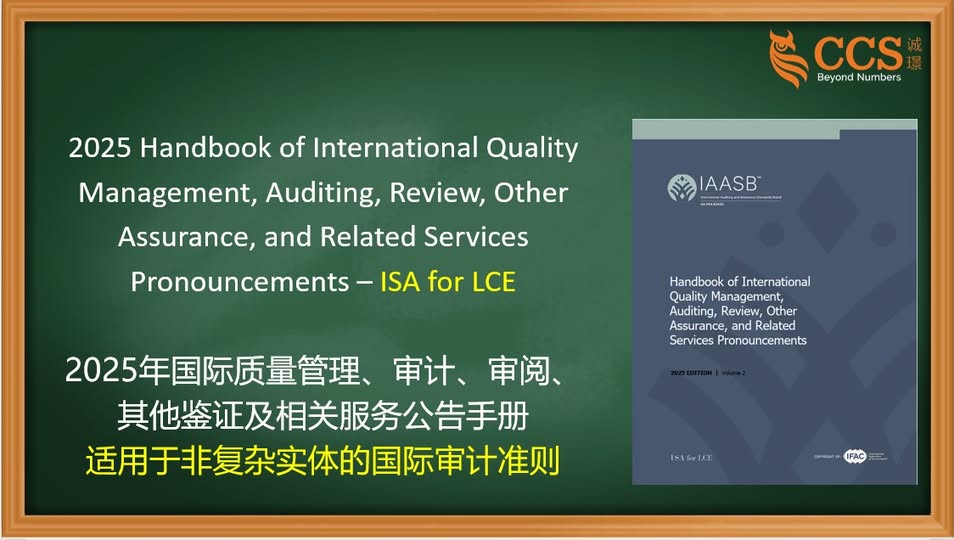
The 2025 Handbook of International Quality Management, Auditing, Review, Other Assurance, and Related Services Pronouncements – ISA for LCE is an official publication issued by the International Auditing and Assurance Standards Board (IAASB) under the International Federation of Accountants (IFAC).
It provides an international framework explaining how auditors should audit companies, particularly smaller and less complex businesses.
A Global Guide for Auditors
When companies prepare financial statements, auditors are engaged to assess whether those statements are reliable and free from material misstatement or fraud.
The ISA for LCE Handbook sets out the international requirements and guidance auditors should follow when performing these audits. It can be understood as a professional rulebook for auditors around the world.
Why Was a Special Standard Created?
Most businesses worldwide are not large multinational corporations. Many are:
- Small and medium-sized enterprises;
- Family businesses;
- Small manufacturing companies; and
- Local service providers.
These businesses may be classified as Less Complex Entities (LCEs).
Traditional auditing standards were generally developed with larger and more complex entities in mind. Applying every requirement to a smaller business may therefore be:
- Too complicated;
- Too costly; and
- Unnecessarily time-consuming.
To address this issue, the IAASB developed the International Standard on Auditing for Less Complex Entities (ISA for LCE).
The standard allows auditors to apply a simpler and more proportionate approach while maintaining audit quality and reliability.
What Does ISA for LCE Cover?
The standard explains how auditors should perform an audit step by step, including:
Audit Planning
- Understanding the nature of the business;
- Understanding the entity’s operations; and
- Identifying areas where material misstatements may arise.
Audit Evidence
- Examining documents;
- Testing transactions; and
- Confirming account balances.
Fraud and Error Risks
The auditor considers the risk of fraud or error and performs appropriate procedures in response to the risks identified.
Communication with Management
The standard also addresses communication between the auditor and management throughout the audit.
Audit Documentation and Quality
Auditors are required to prepare appropriate audit documentation and maintain the quality of their audit work.
When Does the Standard Apply?
ISA for LCE applies to audits of financial statements for periods beginning on or after 15 December 2025.
Individual countries may decide whether to adopt the standard into their own local auditing frameworks.
Practical Example: A Small Manufacturing Company
Consider a company that:
- Has 30 employees;
- Sells its products locally;
- Has simple operations; and
- Does not use complex financial instruments.
Applying the full set of international auditing standards may be excessive for a business with this profile.
Instead, where the entity qualifies and the standard has been adopted in the relevant jurisdiction, the auditor may use ISA for LCE. This approach:
- Maintains audit rigour;
- Removes unnecessary complexity; and
- May reduce the cost and time required to complete the audit.
The objective is not to reduce the credibility of the audit. It is to apply a more appropriate and proportionate auditing approach to the nature and complexity of the entity.
Why Does ISA for LCE Matter?
For businesses and the public, the standard helps support:
- Reliable audits;
- More practical audits for smaller businesses;
- Potentially lower audit costs; and
- Consistent audit quality internationally.
ISA for LCE provides an international framework for auditing smaller and less complex businesses in a simpler and more efficient way, while maintaining the reliability and credibility of the audit.
针对非复杂实体的 ISA for LCE:更实用的中小企业审计准则
**《2025 年国际质量管理、审计、审阅、其他鉴证及相关服务公告手册——适用于非复杂实体的国际审计准则(ISA for LCE)》是由国际会计师联合会(IFAC)下属的国际审计与鉴证准则理事会(IAASB)**发布的官方出版物。
该手册提供一套国际框架,说明审计师应如何审计企业,尤其是规模较小及业务结构较简单的企业。
面向全球审计师的专业指南
企业编制财务报表后,通常会聘请审计师评估这些报表是否可靠,以及是否存在重大错报或舞弊。
ISA for LCE 手册列明了审计师执行相关审计时应遵循的国际要求及指引。它可以理解为一套面向全球审计师的专业规则手册。
为什么需要专项审计准则?
全球大多数企业并不是大型跨国公司。许多企业属于:
- 中小型企业;
- 家族企业;
- 小型制造企业;以及
- 本地服务企业。
这些企业可能属于非复杂实体(Less Complex Entities,LCE)。
传统审计准则通常是以规模较大、业务较复杂的企业为主要对象制定的。对小型企业而言,完整采用所有审计要求可能:
- 过于复杂;
- 成本过高;以及
- 耗时过长。
因此,IAASB 制定了适用于非复杂实体的国际审计准则(ISA for LCE)。
该准则允许审计师采用更简单且更符合比例原则的审计方法,同时维持审计工作的质量及可靠性。
ISA for LCE 涵盖哪些内容?
该准则分步骤说明审计师应如何执行审计工作,包括以下方面:
审计规划
- 了解企业的业务性质;
- 了解企业的经营活动;以及
- 识别可能产生重大错报的领域。
审计证据
- 核查文件;
- 测试交易;以及
- 确认账户余额。
舞弊及错误风险
审计师需要考虑舞弊或错误的风险,并针对所识别的风险执行适当的审计程序。
与管理层沟通
准则也涵盖审计过程中审计师与管理层之间的沟通。
审计文件及质量
审计师必须编制适当的审计文件,并维持审计工作的质量。
该准则何时适用?
ISA for LCE 适用于 2025 年 12 月 15 日或之后开始的期间的财务报表审计。
各国可以自行决定是否将该准则纳入本国的审计框架。
实际例子:小型制造企业
假设一家企业:
- 拥有 30 名员工;
- 只在本地销售产品;
- 业务流程简单;以及
- 没有使用复杂金融工具。
对于这类企业而言,采用完整的国际审计准则可能过于繁琐。
如果企业符合相关资格,而且所在司法管辖区已经采用该准则,审计师便可以采用 ISA for LCE。这种方法:
- 维持审计工作的严谨性;
- 减少不必要的复杂程序;以及
- 可能降低完成审计所需的成本及时间。
其目的并不是降低审计的可信度,而是根据企业的规模及复杂程度,采用更适当且符合比例原则的审计方法。
为什么 ISA for LCE 重要?
对企业及公众而言,该准则有助于支持:
- 可靠的审计结果;
- 更适合中小企业的审计方式;
- 可能较低的审计成本;以及
- 国际上较一致的审计质量。
ISA for LCE 为规模较小及复杂程度较低的企业提供一套国际审计框架,让审计工作更简洁及高效,同时维持审计的可靠性与可信度。