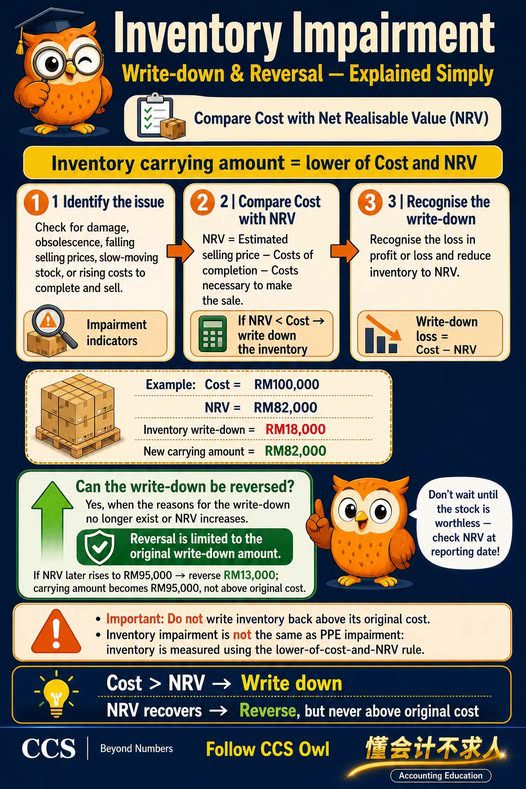
Inventory impairment is not an automatic write-off, and an impairment loss may sometimes be reversed.
Under the applicable accounting requirements, inventory is measured at the lower of:
Cost and Net Realisable Value (NRV)
Net realisable value is the estimated selling price in the ordinary course of business, less the estimated costs of completion and the costs necessary to make the sale.
A Simple Three-Step Process
1. Identify Indicators of Impairment
Check whether the inventory shows signs of having lost value, such as:
- Physical damage;
- Obsolescence;
- Falling selling prices;
- Slow-moving stock; or
- Higher-than-expected costs to complete or sell the goods.
2. Compare Cost with NRV
Compare the inventory’s carrying amount or cost with its NRV.
- If cost is lower than NRV, inventory remains measured at cost;
- If NRV is lower than cost, the inventory must be written down to NRV.
3. Recognise the Write-Down
The difference between cost and NRV is recognised as an expense or loss in profit or loss.
Example
Assume:
- Inventory cost: RM100,000
- NRV: RM82,000
The required write-down is:
RM100,000 − RM82,000 = RM18,000
The inventory’s new carrying amount becomes:
RM82,000
Can an Inventory Write-Down Be Reversed?
Yes.
If conditions subsequently improve and the NRV increases, a previous write-down may be reversed, subject to the applicable requirements.
However:
- The reversal must not exceed the amount of the original write-down; and
- The revised carrying amount must not exceed the inventory’s original cost.
For example, if inventory originally costing RM100,000 was written down to RM82,000, any subsequent reversal cannot increase its carrying amount above RM100,000.
Inventory Impairment Is Different from PPE Impairment
Inventory is assessed using the lower-of-cost-and-NRV rule.
This is different from the impairment model applied to property, plant and equipment, which generally involves comparing the asset’s carrying amount with its recoverable amount.
Businesses should assess NRV at every reporting date rather than waiting until inventory becomes worthless.
Do not wait until the stock is unsaleable. Review its NRV regularly and recognise losses promptly when required.
This article is for general accounting education only and does not constitute professional advice. Actual accounting treatment should be determined with reference to the applicable accounting standards and relevant professional judgement.
CCS | Beyond Numbers
存货减值:应用“成本与可变现净值孰低”原则
存货减值不是随便把存货写掉,而且在某些情况下,之前确认的减值损失也可以回转。
根据适用的会计要求,存货应按照以下两者中的较低者计量:
成本与可变现净值(Net Realisable Value,NRV)
可变现净值,是企业在正常经营过程中预计可以取得的售价,减去预计完成成本及出售所必需的成本。
简单三步法
第一步:找出减值迹象
首先检查存货是否出现价值下降的迹象,例如:
- 存货损坏;
- 存货过时;
- 销售价下跌;
- 存货周转缓慢;或
- 完成或出售存货所需的成本高于预期。
第二步:比较成本与 NRV
将存货的账面金额或成本,与可变现净值进行比较。
- 如果成本低于 NRV,存货继续按成本计量;
- 如果 NRV 低于成本,就必须把存货调低至 NRV。
第三步:确认减值损失
成本与 NRV 之间的差额,应在损益中确认为费用或损失。
例子
假设:
- 存货成本:RM100,000
- 可变现净值:RM82,000
所需确认的减值金额为:
RM100,000 − RM82,000 = RM18,000
存货调整后的账面金额为:
RM82,000
存货减值可以回转吗?
可以。
如果之后情况好转,可变现净值回升,之前确认的存货减值损失可以在符合适用要求的情况下回转。
不过:
- 回转金额不能超过原先确认的减值金额;以及
- 回转后的账面金额不能高于存货原始成本。
例如,原本成本为 RM100,000 的存货,如果之前已经减值至 RM82,000,之后即使情况好转,回转后的账面金额也不能超过 RM100,000。
存货减值与固定资产减值不同
存货采用的是:
“成本与可变现净值孰低”原则。
这与不动产、厂房及设备的减值模式不同。固定资产减值通常涉及将资产账面金额与可收回金额进行比较。
企业应在每个报告日检查存货的 NRV,不要等到存货完全卖不出去或变成废品后才处理。
不要等到存货一文不值才检查。应定期检讨 NRV,并在需要时及时确认减值损失。
本文仅作一般会计教育说明,不构成专业意见。实际会计处理应参考适用的会计准则,并结合相关专业判断确定。
CCS | Beyond Numbers