The latest developments relating to the third edition of the IFRS for SMEs Accounting Standard can be summarised in three areas.
1. Section 9: Consolidated Financial Statements
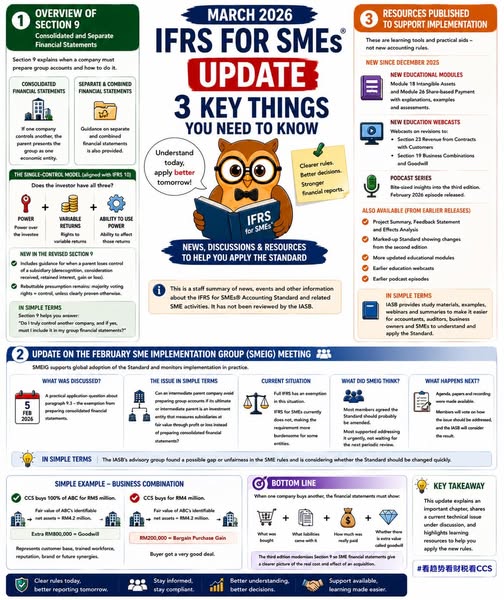
The revised Section 9 focuses on control, rather than shareholding percentage alone, when determining whether an entity must prepare consolidated financial statements.
The updated requirements adopt a single control model aligned with IFRS 10, providing a clearer basis for assessing whether a parent controls a subsidiary.
The assessment is not limited to ownership. It also considers whether the parent has:
- Power over the investee;
- Exposure, or rights, to variable returns; and
- The ability to use its power to affect those returns.
When a parent loses control of a subsidiary, the accounting treatment must also reflect the end of the consolidation relationship and deal appropriately with the remaining interest.
2. SMEIG Meeting Discussions
The SME Implementation Group (SMEIG) has discussed whether an intermediate parent should be permitted to obtain an exemption from preparing consolidated financial statements.
The existing requirements may produce outcomes that are viewed as unfair in certain group structures. As a result, the advisory group has recommended that the requirements be reviewed and amended as soon as possible.
The matter remains under consideration, with the IASB evaluating the next steps and the relevant voting process.
3. New Learning Resources
Additional learning materials have also been made available to support the application of the IFRS for SMEs Accounting Standard.
These include:
- Module 18 on intangible assets;
- Module 26 on share-based payment;
- Webcasts on Section 19, Business Combinations;
- Webcasts on Section 23, Revenue;
- Podcasts;
- Marked-up versions of the standard; and
- Educational modules.
These resources are intended to help accountants and other users understand the requirements in a more practical and step-by-step manner.
Key Takeaway
The ongoing development of IFRS for SMEs involves more than new requirements. It also includes technical discussions and practical learning resources to support consistent application.
New rules, new discussions and new learning materials are making the IFRS for SMEs framework easier to understand and apply.
IFRS for SMEs 第三版最新进展:合并报表、SMEIG 讨论与学习资源
关于 IFRS for SMEs 会计准则第三版的最新进展,主要可以分为三个方面。
1. 第 9 节:合并财务报表
修订后的 第 9 节在判断企业是否需要编制合并财务报表时,重点放在控制权,而不只是持股比例。
新版采用与 IFRS 10 接轨的单一控制模型,为判断母公司是否控制子公司提供更清晰的基础。
相关判断并不只看股权比例,也需要考虑母公司是否具备:
- 对被投资方相关活动的权力;
- 承担或享有变动回报的风险或权利;以及
- 运用权力影响这些回报的能力。
当母公司失去对子公司的控制时,会计处理也必须反映合并关系的终止,并妥善处理母公司保留的权益。
2. SMEIG 会议讨论
**中小型实体实施小组(SME Implementation Group,SMEIG)**曾讨论中间层母公司是否应获准豁免编制合并财务报表。
在某些集团架构下,现有要求可能产生被认为不公平的结果。因此,顾问小组建议尽快检讨及修订相关规定。
目前这项议题仍在考虑当中。IASB 正评估下一步处理方式,相关投票程序也在进行中。
3. 新增学习资源
为协助使用者应用 IFRS for SMEs 会计准则,目前也推出了更多学习材料,包括:
- 第 18 模块:无形资产;
- 第 26 模块:以股份为基础的支付;
- 第 19 节:企业合并的网络讲座;
- 第 23 节:收入的网络讲座;
- 播客;
- 附有修订标记的准则版本;以及
- 教学模块。
这些资源旨在以更实际、循序渐进的方式,帮助会计人员及其他使用者理解相关要求。
重点总结
IFRS for SMEs 的持续发展,不只是推出新的准则要求,也包括技术讨论及实务学习资源,以协助企业更一致地应用相关规定。
新规则、新讨论及新教材,让 IFRS for SMEs 更容易理解与应用。