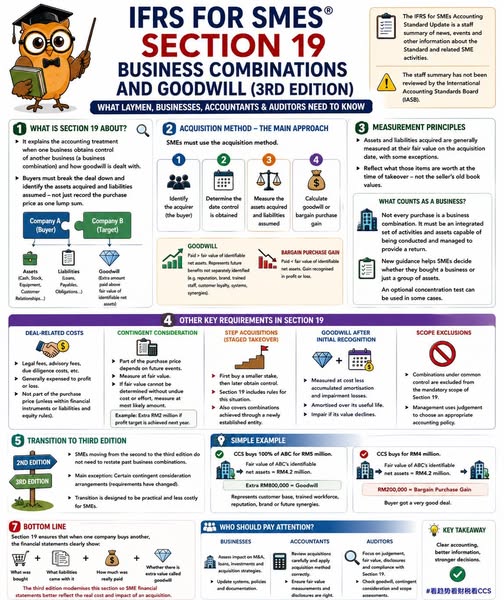
When Company A acquires Company B, the accounting treatment is not simply a matter of recording one lump-sum purchase price. The transaction must be analysed carefully using the acquisition method.
Four Steps under the Acquisition Method
1. Identify the Acquirer
The first step is to determine which entity is the actual acquirer in the business combination.
2. Determine the Acquisition Date
The acquisition date is the date on which the acquirer obtains control of the acquiree.
3. Identify and Measure the Assets and Liabilities Acquired
The acquirer must identify the assets acquired and liabilities assumed. These items are measured at their fair values in accordance with the applicable requirements.
4. Calculate Goodwill
Goodwill is generally calculated as the difference between:
- The consideration transferred; and
- The fair value of the identifiable net assets acquired.
What Is Goodwill?
Goodwill represents the additional amount paid for value that may not be separately recognised as an identifiable asset.
This may include value arising from:
- Brand reputation;
- An experienced workforce;
- Customer loyalty;
- Established management systems; and
- Expected future synergies.
Goodwill therefore reflects part of the overall value of the acquired business beyond the fair value of its identifiable net assets.
Important Updates in the Third Edition
The third edition includes several important requirements:
- Acquisition-related costs, such as legal and advisory fees, are recognised directly in profit or loss rather than added to the acquisition cost;
- Contingent consideration, such as an amount payable only if specified targets are achieved, is measured at fair value or the most likely amount, as applicable; and
- Goodwill is amortised over its useful life and is also subject to impairment testing.
Simple Example
Assume that CCS acquires ABC for RM5 million.
The fair value of ABC’s identifiable net assets is RM4.2 million.
The difference is:
RM5 million − RM4.2 million = RM800,000
Accordingly, the resulting goodwill is RM800,000, subject to the applicable accounting requirements.
Acquiring a business is not only about the assets on the balance sheet. Goodwill reflects the broader value of the business as a whole.
IFRS for SMEs 第 19 节:企业合并与商誉的会计处理
当 A 公司收购 B 公司时,会计处理并不是简单地把收购价作为一笔总额入账,而是必须按照**收购法(Acquisition Method)**仔细分析整个交易。
收购法的四个步骤
1. 确定收购方
首先,必须判断在这项企业合并中,哪一家企业是真正的收购方。
2. 确定收购日
收购日是收购方取得被收购方控制权的日期。
3. 识别及计量所取得的资产与承担的负债
收购方必须识别所取得的资产以及所承担的负债,并根据适用的会计要求,以公允价值进行计量。
4. 计算商誉
商誉一般是以下两者之间的差额:
- 已转让的对价;以及
- 所取得可辨认净资产的公允价值。
什么是商誉?
商誉代表收购方为了取得一些无法单独确认为可辨认资产的价值而支付的额外金额。
这些价值可能来自:
- 品牌声誉;
- 经验丰富的员工团队;
- 客户忠诚度;
- 已建立的管理系统;以及
- 预期的未来协同效应。
因此,商誉反映的是被收购企业整体价值中,超出其可辨认净资产公允价值的部分。
第三版的重要更新
第三版包括几项重要要求:
- 与收购有关的费用,例如律师费及顾问费,应直接计入损益,而不是加进收购成本;
- 或有对价,例如只有在达到特定目标后才需要支付的款项,应按照适用情况,以公允价值或最可能金额计量;以及
- 商誉应在其使用年限内进行摊销,同时还必须进行减值测试。
简单例子
假设 CCS 以 500万令吉收购 ABC。
ABC 可辨认净资产的公允价值为 420万令吉。
差额为:
500万令吉 − 420万令吉 = 80万令吉
因此,所产生的商誉为 80万令吉,但仍须遵守适用的会计要求。
收购一家公司,不只是取得资产负债表上的资产。商誉反映的是企业作为一个整体所具有的更广泛价值。