How should a business account for payments made using shares?
When employees receive share options or consultants accept shares as payment, the arrangement is not free. It is a form of share-based payment and must be properly recognised in the financial statements.
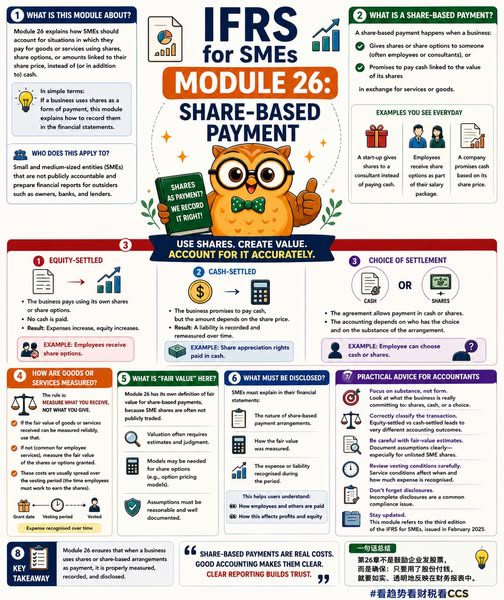
Three Types of Share-Based Payment
1. Equity-Settled Transactions
The entity provides shares or share options in exchange for goods or services.
Accounting effect:
- Recognise an expense for the services received; and
- Recognise a corresponding increase in equity.
2. Cash-Settled Transactions
The entity pays cash, but the amount is linked to the entity’s share price or the value of its shares.
Accounting effect:
- Recognise a liability; and
- Remeasure the liability continuously until settlement.
3. Arrangements with a Choice of Settlement
Some arrangements allow either the entity or the recipient to choose whether the payment will be settled in shares or cash.
The accounting treatment depends on who has the settlement choice and the terms of the arrangement.
How Is the Amount Measured?
The entity should first measure the fair value of the goods or services received, provided that this value can be measured reliably.
When the value of services provided by employees cannot be measured reliably, the entity generally measures the transaction by reference to the fair value of the shares or share options granted.
Practical Reminders for Accountants
When accounting for share-based payments, accountants should:
- Assess the substance of the arrangement rather than relying only on its legal form;
- Distinguish between equity-settled and cash-settled arrangements;
- Keep clear records of valuation assumptions and estimates; and
- Provide complete and appropriate disclosures.
When a business pays with shares, the accounting records must clearly explain the value and nature of the arrangement.
IFRS for SMEs 第 26 章:以股份为基础的支付如何入账?
企业用股份支付,应该如何进行会计处理?
员工获得期权,或顾问以股份作为报酬,这并不是“免费支付”,而是属于以股份为基础的支付(Share-Based Payment),必须在财务报表中适当确认。
三种以股份为基础的支付类型
1. 权益结算
企业以股份或股份期权换取员工或其他人士提供的商品或服务。
会计影响:
- 确认所取得服务的费用;以及
- 同时确认权益增加。
2. 现金结算
企业最终支付现金,但支付金额与公司的股价或股份价值挂钩。
会计影响:
- 确认一项负债;以及
- 持续重新计量该负债,直至结算为止。
3. 可选择结算的安排
有些安排允许企业或收款方选择以股份或现金结算。
会计处理取决于谁拥有结算选择权,以及相关安排的具体条款。
如何计量金额?
企业应优先计量所收到商品或服务的公允价值,前提是该价值能够可靠计量。
如果员工所提供服务的价值无法可靠计量,企业通常会参考所授予股份或股份期权的公允价值来计量这项交易。
给会计人员的实务提醒
处理以股份为基础的支付时,会计人员应当:
- 关注交易的经济实质,而不是只看法律形式;
- 清楚区分权益结算与现金结算;
- 保存完整的估值假设及估计依据;以及
- 作出完整且适当的披露。
企业用股份支付,账上也必须清楚说明这项安排的性质与价值。