IFRS for SMEs Module 2: The Principles Behind Sound Accounting Judgement
5
Share the Post:
What is the most difficult part of accounting for small and medium-sized entities?
It is not necessarily applying a rule that clearly exists. The greater challenge may arise when no specific requirement directly addresses a transaction.
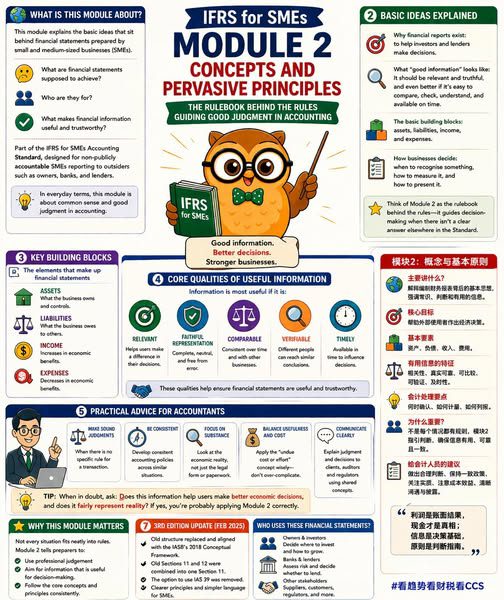
IFRS for SMEs Module 2 provides guidance for making appropriate accounting decisions in such situations. It is not simply a list of fixed rules. Instead, it explains the principles underlying financial reporting, including:
Who financial statements are prepared for and what they are intended to achieve;
What makes financial information useful; and
When an item should be recognised and how it should be measured.
When an accountant encounters a transaction that is not directly addressed in the standard, Module 2 provides a basis for applying professional judgement.
The accountant should consider:
The substance of the transaction rather than only its legal form;
Whether the information is relevant to users’ decisions; and
Whether the accounting treatment provides a faithful representation of the underlying economic reality.
Module 2 does not teach accountants merely to memorise rules. It teaches them to understand the reasoning behind the rules and apply sound judgement when dealing with transactions that require interpretation.
Good accounting is not only about knowing the rules. It is also about knowing how to reason when the rules do not provide a direct answer.
IFRS for SMEs 第 2 模块:会计的原则说明书
中小企业会计最困难的地方是什么?
不一定是面对已有明确规定的交易,而是在准则没有直接说明某项交易时,仍然要作出正确的会计处理。
IFRS for SMEs 第 2 模块,就是帮助企业在缺乏具体规定时,作出合理会计判断的指导框架。