Does your business have cash, loans, amounts due from customers or amounts owed to suppliers?
If so, it already has financial instruments.
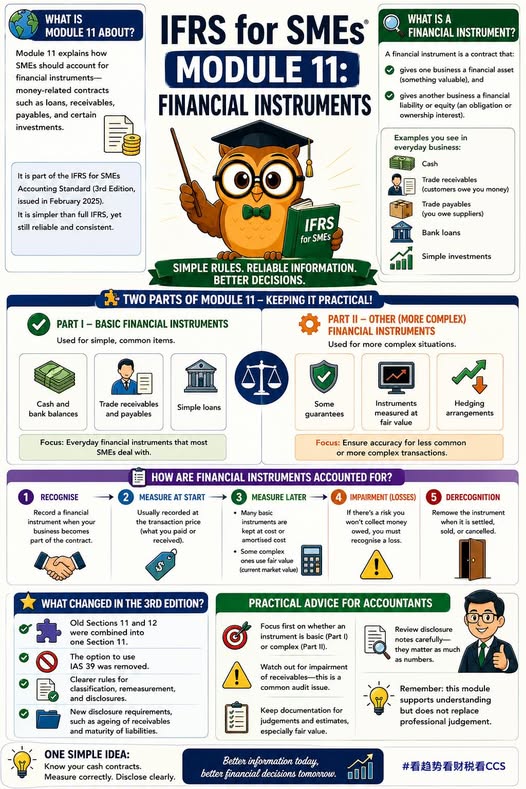
IFRS for SMEs Module 11 explains how these financial instruments should be accounted for. The framework is simpler than full IFRS, while still providing a robust basis for recognition, measurement and disclosure.
Two Main Areas
1. Basic Financial Instruments
These include:
- Cash;
- Trade receivables;
- Trade payables; and
- Ordinary loans.
They are generally measured at cost or amortised cost, making the accounting treatment more straightforward.
2. More Complex Financial Instruments
This area may involve:
- Fair value measurement;
- Financial guarantees; and
- Hedge accounting.
These arrangements require more careful analysis and professional judgement.
Key Changes in the Third Edition
The third edition introduces several important changes:
- The previous Modules 11 and 12 have been combined;
- The option to apply IAS 39 has been removed;
- The impairment requirements have been clarified, particularly for trade receivables; and
- Additional disclosure requirements have been introduced, including information about receivables ageing and the maturity of liabilities.
The basic message is clear:
Classify financial instruments correctly, assess impairment accurately and provide complete disclosures. The documentation behind the numbers must also keep pace.
IFRS for SMEs 第 11 模块:专门处理金融工具
你的企业有没有现金、贷款、客户欠款或供应商欠款?
如果有,恭喜你,企业已经拥有**金融工具(Financial Instruments)**了。
IFRS for SMEs 第 11 模块说明企业应如何处理这些金融工具。相比完整 IFRS,这套框架较为简化,但仍然为金融工具的确认、计量及披露提供扎实的基础。
两大主要部分
1. 基本金融工具
包括:
- 现金;
- 应收账款;
- 应付账款;以及
- 普通贷款。
这些项目通常按照成本或摊余成本计量,处理方式相对直接。
2. 较复杂的金融工具
这一部分可能涉及:
- 公允价值计量;
- 金融担保;以及
- 套期会计。
这些安排需要进行更仔细的分析及专业判断。
第三版的主要变化
第三版带来几项重要变化:
- 原本的第 11 模块与第 12 模块合并;
- 不再允许选择采用 IAS 39;
- 减值要求更加清晰,尤其是应收账款的减值处理;以及
- 新增披露要求,包括应收账款账龄及负债到期情况等资料。
核心信息很简单:
金融工具要正确分类,减值要准确评估,披露要完整。数字背后的文件记录,也必须同步跟上。