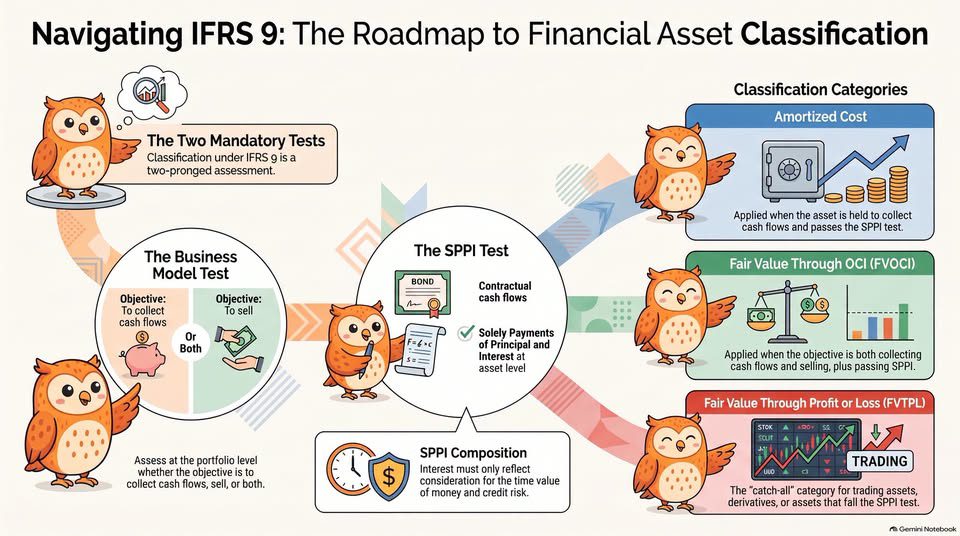
Correctly classifying a financial asset under IFRS 9 is essential because its subsequent measurement, presentation and accounting entries depend on the classification.
For debt financial assets, classification is determined primarily by two core tests:
- The Business Model Test; and
- The Contractual Cash Flow Characteristics Test, commonly known as the SPPI Test.
1. The Business Model Test
The Business Model Test asks:
Why does the entity hold the financial asset?
This test applies to debt instruments such as:
- Loans;
- Trade receivables; and
- Bonds.
It does not apply in the same way to equity instruments or derivatives.
Portfolio-Level Assessment
The business model is assessed at the portfolio level, rather than separately for each individual financial asset.
The assessment should be based on evidence of how management actually manages the portfolio and on historical patterns of activity, rather than management’s stated intentions alone.
The main business models include:
Hold to Collect
The entity holds the financial assets primarily to collect the contractual cash flows, such as:
- Coupon or interest payments; and
- Principal repayment at maturity.
Minor or infrequent sales, such as sales made because of an urgent cash requirement, do not automatically invalidate the hold-to-collect business model.
Hold to Collect and Sell
The entity holds the financial assets both to:
- Collect the contractual cash flows; and
- Sell the assets when appropriate.
For example, the entity may collect interest and principal but also sell assets when market conditions, liquidity needs or portfolio management considerations make a sale appropriate.
Trading
The entity holds the financial assets primarily for short-term trading or managing them on a fair-value basis.
2. The SPPI Test
The second test examines the nature of the contractual cash flows generated by the financial asset.
SPPI stands for:
Solely Payments of Principal and Interest
Unlike the Business Model Test, the SPPI Test is assessed asset by asset and in the currency in which the asset is denominated.
What Does “Interest” Mean?
Under IFRS 9, interest is not simply any amount described as interest.
It generally represents compensation for:
- The time value of money; and
- Credit risk associated with the debtor.
Other factors may also be relevant when assessing the contractual cash-flow characteristics of an instrument.
Instruments That May Pass the SPPI Test
Examples may include:
- Standard fixed-rate loans;
- Standard floating-rate loans, provided they are not leveraged; and
- Zero-coupon bonds, where the interest is reflected in the discount between the purchase price and the amount repaid at maturity.
Instruments That May Fail the SPPI Test
Complex instruments may fail the SPPI test.
Examples include:
- Convertible bonds, because they expose the holder to equity risk; and
- Inverse floating-rate loans, where the interest rate moves in the opposite direction to the relevant market benchmark.
The Three Main Classification Categories
The results of the Business Model Test and SPPI Test determine the classification of the financial asset.
Amortised Cost
A debt financial asset is generally measured at amortised cost when:
- The entity’s business model is to hold the asset to collect contractual cash flows; and
- The contractual cash flows pass the SPPI Test.
Examples may include qualifying loans, receivables and bonds.
Fair Value through Other Comprehensive Income (FVOCI)
A debt financial asset is generally measured at FVOCI when:
- The entity’s business model is both to collect contractual cash flows and to sell financial assets; and
- The contractual cash flows pass the SPPI Test.
Equity instruments generally do not qualify for amortised cost measurement and are normally measured at fair value through profit or loss.
However, at initial recognition, an entity may make an irrevocable election to present subsequent fair value changes of a qualifying equity investment in other comprehensive income.
Fair Value through Profit or Loss (FVTPL)
FVTPL is the default category for other financial assets that do not qualify for amortised cost or FVOCI.
This may include:
- Derivatives;
- Financial assets that fail the SPPI Test; and
- Other instruments with contractual features inconsistent with basic lending arrangements.
An entity may also designate a financial asset as FVTPL at initial recognition where the applicable IFRS 9 requirements are met.
A Simple Summary
| Test or category | Key question or requirement |
|---|---|
| Business Model Test | Why does the entity hold the asset? |
| SPPI Test | Are the contractual cash flows solely payments of principal and interest? |
| Amortised Cost | Hold to collect + SPPI passed |
| FVOCI for debt assets | Hold to collect and sell + SPPI passed |
| FVTPL | Default category for other financial assets, including derivatives and assets that fail SPPI |
In simple terms:
Business Model asks how the asset is managed. SPPI asks what the contractual cash flows represent.
The correct classification should be assessed using the specific contractual terms, the entity’s actual portfolio management practices and the applicable IFRS 9 requirements.
CCS | Beyond Numbers
IFRS 9:如何分类金融资产?
根据 IFRS 9,正确分类金融资产非常重要,因为金融资产之后的计量、列报及会计分录,都取决于它的分类。
对于债务类金融资产,分类主要取决于两个核心测试:
- Business Model Test(业务模式测试);以及
- Contractual Cash Flow Characteristics Test(合同现金流特征测试),通常称为 SPPI Test。
一、Business Model Test:业务模式测试
业务模式测试主要问:
企业为什么持有这项金融资产?
这项测试主要适用于债务工具,例如:
- 贷款;
- 应收账款;以及
- 债券。
它并不是以同样的方式适用于权益工具或衍生工具。
按投资组合层面评估
业务模式是在投资组合层面进行评估,而不是逐项金融资产单独评估。
评估时,应根据管理层实际如何管理这组金融资产,以及过去的实际交易和管理记录,而不是只看管理层口头表达的意图。
主要业务模式包括:
Hold to Collect:持有以收取合同现金流
企业主要持有金融资产,以收取合同约定的现金流,例如:
- 票息或利息;以及
- 到期时收回本金。
如果企业只是因为临时资金紧张等原因,偶尔或不频繁地出售少量资产,并不一定会自动否定 Hold to Collect 的业务模式。
Hold to Collect and Sell:持有以收取并出售
企业持有金融资产的目的,同时包括:
- 收取合同现金流;以及
- 在适当情况下出售相关资产。
例如,企业可能一方面收取利息和本金,另一方面也会根据市场情况、流动性需求或投资组合管理需要出售部分资产。
Trading:交易目的
企业主要为了短期交易而持有金融资产,或主要以公允价值的变化来管理这些资产。
二、SPPI Test:合同现金流特征测试
第二项测试,是检查金融资产所产生的合同现金流属于什么性质。
SPPI 是:
Solely Payments of Principal and Interest
意思是:
合同现金流是否仅仅包括本金和利息的支付。
与 Business Model Test 不同,SPPI Test 必须按照单项金融资产进行评估,并以该资产所计价的货币为基础进行分析。
“Interest”到底是什么意思?
根据 IFRS 9,Interest 并不是任何被称为“利息”的金额都可以直接算作利息。
一般来说,利息主要是对以下因素的补偿:
- 货币的时间价值;以及
- 债务人的信用风险。
在评估金融工具的合同现金流特征时,其他相关因素也可能需要一并考虑。
可能通过 SPPI Test 的工具
可能通过 SPPI Test 的例子包括:
- 标准固定利率贷款;
- 标准浮动利率贷款,前提是没有杠杆成分;以及
- 零息债券,其利息已经反映在购买价格与到期偿还金额之间的折价中。
可能无法通过 SPPI Test 的工具
一些具有复杂特征的金融工具,可能无法通过 SPPI Test。
例子包括:
- 可转换债券,因为持有人承担了权益风险;以及
- 反向浮动利率贷款,其利率走势与相关市场基准相反。
三个主要分类类别
Business Model Test 和 SPPI Test 的结果,会决定金融资产的分类。
Amortised Cost:摊余成本
当以下两个条件同时满足时,债务类金融资产一般可以按摊余成本计量:
- 企业的业务模式是持有资产以收取合同现金流;以及
- 合同现金流通过 SPPI Test。
可能符合条件的例子包括部分贷款、应收账款及债券。
Fair Value through Other Comprehensive Income(FVOCI):公允价值计入其他综合收益
当以下两个条件同时满足时,债务类金融资产一般可以按 FVOCI 计量:
- 企业的业务模式是同时收取合同现金流及出售金融资产;以及
- 合同现金流通过 SPPI Test。
权益工具一般不能按摊余成本计量,通常会按公允价值计入损益。
不过,在初始确认时,对于符合条件的权益投资,企业可以作出一项不可撤销的选择,将之后的公允价值变动列入其他综合收益。
Fair Value through Profit or Loss(FVTPL):公允价值计入损益
FVTPL 是其他金融资产的默认分类,适用于不符合摊余成本或 FVOCI 条件的金融资产。
这可能包括:
- 衍生工具;
- 无法通过 SPPI Test 的金融资产;以及
- 合同特征不符合基本借贷安排的其他金融工具。
在符合 IFRS 9 相关要求的情况下,企业也可以在初始确认时,将某项金融资产指定为 FVTPL。
简单对照表
| 测试或分类 | 重点问题或条件 |
|---|---|
| Business Model Test | 企业为什么持有这项资产? |
| SPPI Test | 合同现金流是否仅仅包括本金和利息? |
| Amortised Cost | Hold to Collect + 通过 SPPI Test |
| 债务资产 FVOCI | Hold to Collect and Sell + 通过 SPPI Test |
| FVTPL | 其他金融资产的默认类别,包括衍生工具及无法通过 SPPI 的资产 |
简单来说:
Business Model 关注资产是怎样被管理的;SPPI 关注合同现金流到底代表什么。
正确分类时,必须结合具体合同条款、企业实际管理投资组合的方式,以及 IFRS 9 的适用要求进行评估。
CCS | Beyond Numbers