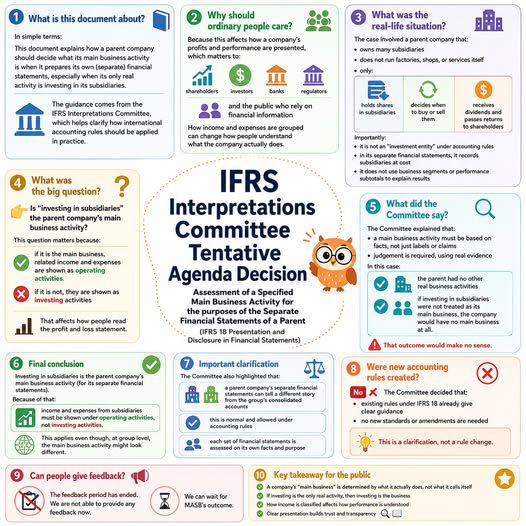
The IFRS Interpretations Committee’s Tentative Agenda Decision on “Assessment of a Specified Main Business Activity for the Purposes of the Separate Financial Statements of a Parent” addresses an important question under IFRS 18 Presentation and Disclosure in Financial Statements:
When a parent company’s only substantive activity is investing in its subsidiaries, does that investment activity constitute its main business activity?
Why This Matters
The answer affects how income and expenses are classified in the parent company’s separate financial statements.
If investing in subsidiaries is the parent company’s main business activity, related income and expenses are presented as operating activities.
If it is not the main business activity, they are presented as investing activities.
This classification can influence how shareholders, investors, lenders, regulators and other users understand the company’s performance.
The Facts of the Case
The case involved a parent company that:
- Owned a number of subsidiaries;
- Did not operate factories, shops or service businesses itself;
- Held shares in its subsidiaries;
- Decided when to acquire or dispose of those investments; and
- Received dividends and distributed returns to its shareholders.
The parent company was not an “investment entity” under the applicable accounting requirements. In its separate financial statements, it measured its investments in subsidiaries at cost.
It also did not use business segments or performance subtotals to explain its results.
The Main Question
The central question was whether investing in subsidiaries was the parent company’s main business activity.
The Committee explained that a main business activity must be assessed based on the facts and circumstances, rather than simply on management’s labels or descriptions. The assessment requires judgement supported by actual evidence.
In this case, the parent company did not have any other substantive business activity. If investing in subsidiaries were not regarded as its main business activity, the company would effectively have no main business activity at all.
The Committee considered that outcome illogical.
Conclusion
The Committee concluded that investing in subsidiaries was the parent company’s main business activity for the purposes of its separate financial statements.
Accordingly, the related income and expenses should be presented as operating activities, rather than investing activities.
This conclusion applies even if the group’s main business activity appears different at the consolidated level.
Separate Financial Statements and Consolidated Financial Statements
The Committee also highlighted that a parent company’s separate financial statements may present a different picture from the group’s consolidated financial statements.
This is normal and permitted under the accounting requirements.
Separate and consolidated financial statements serve different purposes and must each be assessed based on their own facts, circumstances and reporting objectives.
Was a New Accounting Rule Created?
No.
The Committee determined that the existing requirements in IFRS 18 already provide an adequate basis for addressing the issue.
No new standard or amendment was required. The agenda decision is intended to clarify the application of the existing requirements rather than change the accounting rules.
Key Takeaways
The main lessons are:
- A company’s main business activity is determined by what it actually does, not merely by what it calls itself.
- If investing in subsidiaries is the only substantive activity, that investment activity may constitute the parent company’s main business activity.
- The classification of income and expenses affects how users interpret the company’s performance.
- Separate financial statements may tell a different story from consolidated financial statements.
- Clear and faithful presentation supports transparency and builds confidence in financial reporting.
Financial reporting should reflect the company’s actual economic activities, not merely its labels.
IFRS 18:评估母公司在单独财务报表中的主要经营活动
国际财务报告准则解释委员会(IFRS Interpretations Committee)发布的暂定议程决定(Tentative Agenda Decision),针对 **IFRS 18《财务报表的列报与披露》**下的一个重要问题作出说明:
如果母公司的唯一实质性活动是投资子公司,这项投资活动是否构成母公司的主要经营活动?
为什么这项问题重要?
答案会影响母公司在单独财务报表中如何分类收入与费用。
如果投资子公司是母公司的主要经营活动,相关收入与费用应归类为经营活动。
如果投资子公司并非主要经营活动,相关收入与费用则应归类为投资活动。
这项分类会影响股东、投资者、贷款人、监管机构及其他财务报表使用者对企业经营表现的理解。
案例涉及的情况
该案例涉及一家母公司,该公司:
- 拥有多家子公司;
- 自身不经营工厂、商店或服务业务;
- 持有子公司的股份;
- 决定何时收购或出售相关投资;以及
- 收取股息,并将回报分配给股东。
根据适用的会计要求,该母公司并不属于“投资实体(Investment Entity)”。
在单独财务报表中,该母公司按照成本计量对子公司的投资。
此外,该公司也没有采用业务分部或业绩小计来进一步解释其经营结果。
核心问题
核心问题是:
“投资子公司”是否属于该母公司的主要经营活动?
委员会说明,主要经营活动必须根据实际事实与情况进行判断,而不能只依赖管理层所使用的标签或主观描述。相关判断必须以实际证据为基础,并需要运用专业判断。
在本案例中,母公司并没有其他实质性的经营活动。如果投资子公司不被视为其主要经营活动,该公司实际上就完全没有主要经营活动。
委员会认为,这样的结果并不合乎逻辑。
最终结论
委员会的结论是:
就母公司的单独财务报表而言,投资子公司构成该母公司的主要经营活动。
因此,相关收入与费用应列为经营活动,而不是投资活动。
即使该集团在合并层面的主要经营活动看起来有所不同,这项结论仍适用于母公司的单独财务报表。
单独财务报表与合并财务报表
委员会同时强调,母公司的单独财务报表,可能会呈现出与集团合并财务报表不同的情况。
这在会计准则下属于正常且允许的情况。
单独财务报表与合并财务报表具有不同的目的,因此必须根据各自的事实、情况及报告目标分别进行评估。
是否制定了新的会计规则?
没有。
委员会认为,现行的 IFRS 18 已经提供了处理这项问题的充分依据。
因此,无需制定新的准则或修订现有准则。这项暂定议程决定的作用,是澄清现有要求的应用方式,而不是改变会计规则。
重点总结
这项议程决定带来的主要启示包括:
- 企业的主要经营活动,应根据实际经营内容判断,而不是只看企业如何称呼自己。
- 如果投资子公司是企业唯一的实质性活动,该投资活动可能构成母公司的主要经营活动。
- 收入与费用的分类方式,会影响使用者对企业经营表现的理解。
- 母公司的单独财务报表,可以与集团合并财务报表呈现不同的情况。
- 清晰及如实的列报,有助于提升财务报告的透明度与可信度。
财务报告应反映企业真实的经济活动,而不只是反映企业使用的标签。