What Is IFRS 18?
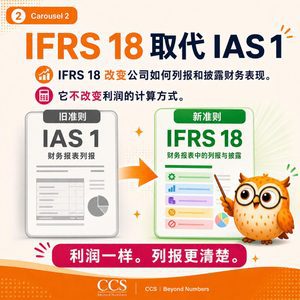
IFRS 18 Presentation and Disclosure in Financial Statements is a new accounting standard issued by the International Accounting Standards Board (IASB) in April 2024. It replaces IAS 1 Presentation of Financial Statements.
The main purpose of IFRS 18 is to improve how companies present and explain their financial performance, particularly in the statement of profit or loss.
Importantly:
IFRS 18 does not change how profit is measured. It changes how profit is presented and disclosed.
For example, a company’s profit after tax may still be RM1 million. IFRS 18 does not change that final profit figure, but it may change how income and expenses are structured and classified before arriving at that figure.
IFRS 18 and MFRS 18 in Malaysia
For Malaysian companies applying the MFRS Framework, the local equivalent is MFRS 18 Presentation and Disclosure in Financial Statements.
MFRS 18 is issued by the Malaysian Accounting Standards Board (MASB) and is word-for-word IFRS 18. Accordingly, Malaysian companies applying the MFRS Framework will apply the requirements through MFRS 18.
MFRS 18 applies to annual reporting periods beginning on or after 1 January 2027, with earlier application permitted.
Although the requirements are technically the same, Malaysian financial statements should generally refer to MFRS 18, as MFRS is the MASB-approved accounting framework applicable in Malaysia.
MFRS 18 Does Not Automatically Apply to MPERS Entities
The position is different for entities applying MPERS.
MPERS 2025 is aligned with the third edition of the IFRS for SMEs Accounting Standard, rather than the full IFRS 18 framework. MPERS 2025 applies to annual periods beginning on or after 1 January 2027, with earlier application permitted.
The IFRS for SMEs framework is a stand-alone standard. Changes to full IFRS do not automatically apply to SMEs unless they are incorporated into the IFRS for SMEs Accounting Standard or MPERS.
Therefore:
- Entities applying MFRS should prepare for MFRS 18; and
- Entities applying MPERS 2025 should follow the presentation requirements in MPERS 2025 rather than automatically applying the full MFRS 18 model.
MPERS 2025 still requires material items to be presented separately and dissimilar items not to be grouped together unless they are immaterial. It also requires expenses to be analysed by nature or by function, whichever provides reliable and more relevant information.
Examples include:
- By nature: Salaries, depreciation and advertising expenses; and
- By function: Cost of sales, selling expenses and administrative expenses.
The first question for a Malaysian entity is therefore:
Does the entity apply MFRS or MPERS?
The answer determines whether it should prepare for MFRS 18 or apply MPERS 2025.
Effective Date and Retrospective Application
IFRS 18 is effective for annual reporting periods beginning on or after 1 January 2027, with earlier application permitted.
Companies must apply the standard retrospectively. This means that comparative information for the previous year may need to be restated.
For example, if a company begins applying IFRS 18 in 2027, its 2026 comparative statement of profit or loss may need to be presented again using the same format so that users can make a meaningful comparison between 2027 and 2026.
IFRS 18 Applies Across All Industries
IFRS 18 applies to companies across all industries, although the impact may be more significant for entities with:
- Complex financial statements;
- Multiple business segments;
- Diverse sources of income;
- Numerous non-IFRS performance measures; or
- Extensive investor communications.
A simple trading company may mainly need to revise the structure of its statement of profit or loss.
A listed group may require more extensive work, including a review of:
- Operating businesses;
- Investment and financing activities;
- Adjusted EBITDA;
- Adjusted profit;
- Investor presentations;
- Interim reporting; and
- Note disclosures.
Three Main Changes Introduced by IFRS 18
IFRS 18 introduces three major areas of change:
- New defined subtotals in the statement of profit or loss;
- Disclosure requirements for management-defined performance measures (MPMs); and
- Clearer principles for the grouping and separation of information, known as aggregation and disaggregation.
The overall objective is to make financial statements more structured, more comparable and easier to understand.
New Categories in the Statement of Profit or Loss
Under IFRS 18, income and expenses are classified into categories including:
- Operating;
- Investing;
- Financing;
- Income taxes; and
- Discontinued operations.
For a normal manufacturing company:
- Sales revenue, cost of sales, salaries, selling expenses and administrative expenses will generally be operating items;
- Dividends from investment shares may be investing income;
- Interest expense on bank loans will generally be a financing item;
- Income tax expense will be included in the income tax category; and
- Losses from a discontinued business segment will be presented under discontinued operations.
This structure helps users understand how different activities contribute to the company’s results.
Operating Profit
One of the most important new subtotals is operating profit.
Operating profit shows the company’s operating performance before separately presenting the effects of investing, financing, income taxes and discontinued operations.
For example, for a retail company, the following would generally relate to operating activities:
- Sales revenue;
- Cost of goods sold;
- Shop rental;
- Staff salaries;
- Advertising; and
- Delivery costs.
If the company earns RM200,000 from selling goods and incurs RM150,000 in operating expenses, its operating profit is RM50,000 before considering financing, tax and other categories.
Operating profit helps investors assess whether the company’s core business is generating results, rather than looking only at the final profit after all other items.
Operating Is the Default Category
The operating category is broad.
Income and expenses may remain in the operating category even if they are unusual, volatile or non-recurring, provided that they relate to the company’s operating activities and do not belong in another category.
Operating profit is therefore not intended to represent only “normal” or recurring profit.
For example, a goodwill impairment loss arising from the company’s operating business may still be classified as operating, even if it is unusual or one-off.
Similarly, a major restructuring expense may remain in the operating category if it relates to the company’s operations and does not fall within investing, financing, income taxes or discontinued operations.
Investing Category
The investing category separates returns from stand-alone investments from the company’s main operating activities.
Examples may include:
- Rental income from an investment property owned by a manufacturing company;
- Dividend income from shares held in another company; and
- The company’s share of profit from an associate or joint venture.
The classification depends on the nature of the company’s activities and the source of the income.
Financing Category
The financing category reflects the effects of financing decisions and includes income and expenses arising from financing liabilities such as:
- Bank loans;
- Bonds; and
- Lease liabilities.
For example, interest expense on a RM5 million bank loan would generally be classified as financing.
Similarly, the interest component of a lease liability relating to an office or factory would generally be classified in the financing category.
This helps investors distinguish between weak operating performance and a high financing burden caused by significant borrowings.
Profit Before Financing and Income Taxes
IFRS 18 requires the presentation of profit before financing and income taxes.
This subtotal shows profit before the effects of financing and income tax.
For example:
- Operating profit: RM800,000;
- Investing income: RM100,000.
Profit before financing and income taxes would therefore be RM900,000 before deducting bank interest and income tax.
This allows users to ask:
How is the company performing before considering its financing structure and tax position?
Foreign Exchange Differences
Foreign exchange differences are generally classified in the same category as the item that gave rise to them.
For example:
- Foreign exchange gains or losses on a foreign currency bank loan will generally be classified as financing; and
- Foreign exchange differences on foreign currency trade receivables may be classified as operating because they relate to operating sales.
However, where applying this approach would involve undue cost or effort, IFRS 18 permits foreign exchange differences to be classified in the operating category.
Banks and Insurers
IFRS 18 is not applied mechanically. The company’s business model matters.
For a normal company, interest expense on borrowings is generally a financing item.
For a bank, however, lending and borrowing are part of its main business. Interest income from customer loans and interest expense on deposits may therefore form part of operating performance.
For an insurer, investment income and insurance finance income or expenses may also be part of operating performance because they are closely connected with the insurance business.
Management-Defined Performance Measures
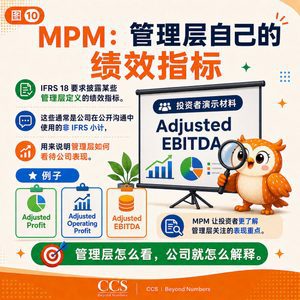
IFRS 18 introduces disclosure requirements for Management-Defined Performance Measures (MPMs).
An MPM is generally a subtotal of income and expenses that:
- Is not defined by IFRS Standards;
- Is used in public communications outside the financial statements; and
- Communicates management’s view of the company’s financial performance.
Examples may include:
- Adjusted Operating Profit; and
- Adjusted EBITDA.
For example, if a company presents “Adjusted Operating Profit” of RM10 million in an investor presentation and the measure is not defined by IFRS, it may qualify as an MPM.
What Is Not an MPM?
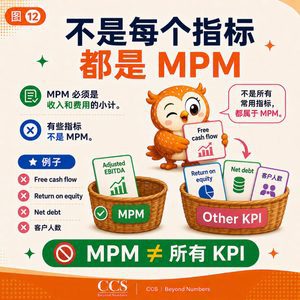
Not every performance measure is an MPM.
A measure must be a subtotal of income and expenses to qualify. Therefore:
- Free cash flow is not an MPM because it is a cash-flow measure;
- Return on equity is not an MPM because it is a ratio;
- Net debt is not an MPM because it is a financial position measure; and
- The number of customers is not an MPM because it is an operating metric.
Public Communications Relevant to MPMs
MPMs are identified from public communications outside the financial statements, such as:
- Management commentary;
- Press releases; and
- Investor presentations.
For this purpose, IFRS 18 excludes:
- Oral communications;
- Written transcripts of oral communications; and
- Social media posts.
For example, an “Adjusted Profit” measure in an investor presentation may be an MPM. However, a figure mentioned casually by a chief executive officer during a live interview would not, by itself, be treated in the same way for identifying an MPM.
MPM Disclosure Requirements
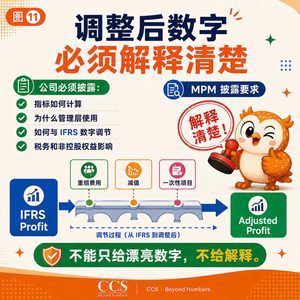
If an entity has MPMs, IFRS 18 requires the relevant information to be disclosed in a single note.
The entity must explain:
- How the MPM is calculated;
- Why it reflects management’s view of performance; and
- How it reconciles to the nearest IFRS-defined subtotal or total.
For example, a company reports:
- Adjusted profit: RM12 million;
- IFRS profit before tax: RM9 million.
The company must explain the RM3 million difference, such as an add-back for restructuring costs.
It must also disclose the tax effect and the effect on non-controlling interests for each reconciling item.
These requirements make adjusted performance measures more transparent and reduce the risk of presenting attractive but unexplained numbers.
Aggregation and Disaggregation of Information
IFRS 18 introduces clearer principles for grouping information.
In simple terms:
- Similar items may be grouped together; and
- Dissimilar or material items should be presented separately.
Material information should not be hidden under vague labels such as “Other”.
For example, if a company reports RM5 million of “Other expenses”, but the amount includes material impairment losses, legal settlements, foreign exchange losses or restructuring costs, those items may require further explanation or separate presentation.
Users should be given enough information to understand what is included in the amount.
Primary Financial Statements and Notes
The primary financial statements and the notes have different roles.
- The primary financial statements provide structured summaries and the overall picture; and
- The notes provide additional material details.
For example, the statement of profit or loss may show one line for administrative expenses, while the notes explain that the amount includes:
- Staff salaries;
- Depreciation;
- Professional fees; and
- Office expenses.
The primary statements provide the big picture. The notes explain the details.
Expenses by Nature or by Function
IFRS 18 requires operating expenses to be presented in the manner that provides the most useful structured summary.
By Nature
This classifies expenses according to the resources consumed.
Examples include:
- Salaries;
- Raw materials;
- Depreciation;
- Advertising; and
- Utilities.
By Function
This classifies expenses according to the activity they support.
Examples include:
- Cost of sales;
- Selling expenses; and
- Administrative expenses.
A company may use a mixed presentation if that provides the most useful information.
For example, a manufacturing company may present cost of sales, selling expenses and administrative expenses by function while separately presenting a significant impairment loss by nature.
Additional Note Disclosure for Functional Presentation
If a company presents expenses by function, IFRS 18 requires additional disclosure in the notes of certain expenses by nature, including:
- Depreciation;
- Amortisation;
- Employee benefits;
- Impairment losses; and
- Inventory write-downs.
For example, if the statement of profit or loss shows cost of sales and administrative expenses by function, the notes may need to disclose the amount of depreciation, employee costs and impairment included in those line items.
This helps users understand the cost structure and forecast future cash flows.
Changes to the Statement of Cash Flows
IFRS 18 also introduces limited amendments to IAS 7 Statement of Cash Flows.
For companies using the indirect method, operating profit will generally be used as the starting point for cash flows from operating activities.
Previously, a company might have started with profit before tax. Under the new requirements, it may need to start with operating profit.
IFRS 18 also reduces the presentation alternatives for interest and dividends for most companies. Generally:
- Interest paid and dividends paid are classified as financing cash flows; and
- Interest received and dividends received are classified as investing cash flows.
This should reduce diversity in practice.
Earnings Per Share
IFRS 18 also affects additional earnings-per-share disclosures.
An entity may disclose additional EPS only if the numerator is:
- A total or subtotal identified in IFRS 18; or
- An MPM.
A company cannot create an adjusted earnings figure and use it to calculate adjusted EPS unless the figure qualifies under the IFRS 18 framework.
This introduces greater discipline around alternative EPS measures.
Interim Financial Reporting
IAS 34 Interim Financial Reporting is also amended.
Companies may need to disclose relevant MPM information in interim financial statements.
For example, if a listed company presents Adjusted Operating Profit in its half-year investor presentation and the measure qualifies as an MPM, the interim financial statements may also need to include the relevant MPM disclosure and reconciliation.
How Should Companies Prepare?
Companies should begin preparing before 2027.
Key areas to review include:
- Chart of accounts;
- Statement of profit or loss structure;
- Internal management reporting;
- Investor presentations and press releases;
- Adjusted EBITDA, Core Profit, Normalised Profit and similar measures;
- Cash-flow statement classifications;
- Note disclosures; and
- Methods used to aggregate and disaggregate expenses.
A listed company should assess whether measures such as “Adjusted EBITDA”, “Core Profit”, “Normalised Profit” or “Profit Before Exceptional Items” qualify as MPMs.
A company that regularly presents a large “Other expenses” balance should assess whether greater disaggregation is required.
A group with bank loans, lease liabilities and foreign-currency exposures should also review whether financing costs and foreign exchange differences are classified correctly.
Key Message
The central message of IFRS 18 is:
Financial statements should not only be technically correct. They should also communicate financial performance clearly.
IFRS 18 aims to:
- Improve comparability through common subtotals;
- Increase transparency through MPM disclosures; and
- Improve usefulness through better aggregation and disaggregation of information.
For a Malaysian company, the first practical step is to determine whether it applies MFRS or MPERS. That decision determines whether it should prepare for MFRS 18 or follow MPERS 2025.
CCS | Beyond Numbers
IFRS 18 与 MFRS 18:财务报表列报与披露的主要变化
什么是 IFRS 18?
**IFRS 18《财务报表的列报与披露》**是国际会计准则理事会(IASB)于 2024 年 4 月发布的新会计准则,取代 IAS 1《财务报表的列报》。
IFRS 18 的主要目的是改善企业在财务报表中呈报及解释财务表现的方式,尤其是损益表的呈报方式。
必须先理解一点:
IFRS 18 不改变利润的计算方式,而是改变利润的列报和披露方式。
例如,一家公司的税后利润仍然可能是 RM1,000,000。IFRS 18 不会改变这个最终利润数字,但可能改变损益表在到达最终利润之前的分类、结构及呈现方式。
IFRS 18 与马来西亚的 MFRS 18
对于采用 MFRS Framework 的马来西亚企业,本地对应的准则是:
MFRS 18《财务报表的列报与披露》
MFRS 18 由**马来西亚会计准则委员会(MASB)**发布,并且与 IFRS 18 逐字一致。因此,采用 MFRS Framework 的马来西亚企业,会通过 MFRS 18 应用相关要求。
MFRS 18 适用于 2027 年 1 月 1 日或之后开始的年度报告期间,企业也可以选择提早采用。
虽然 MFRS 18 与 IFRS 18 的技术要求一致,但马来西亚财务报表一般应引用 MFRS 18,因为 MFRS 是 MASB 批准并在马来西亚适用的财务报告准则框架。
MFRS 18 不会自动适用于 MPERS 企业
对于采用 MPERS 的企业,情况有所不同。
MPERS 2025 是与第三版 IFRS for SMEs Accounting Standard 对齐,而不是直接采用完整的 IFRS 18 框架。MPERS 2025 适用于 2027 年 1 月 1 日或之后开始的年度期间,企业也可以选择提早采用。
IFRS for SMEs 是一份独立的准则文件。完整 IFRS 的变化不会自动适用于中小型企业,除非有关变化已经被纳入 IFRS for SMEs 或 MPERS。
因此:
- 采用 MFRS 的企业,应准备 MFRS 18 的完整列报变化;以及
- 采用 MPERS 2025 的企业,应遵循 MPERS 2025 的列报要求,而不是自动套用完整的 MFRS 18 模式。
MPERS 2025 仍然要求:
- 重大项目必须分开列示;
- 性质不同的项目不应随意合并,除非金额不重大;以及
- 费用应按性质或按功能进行分析,选择能够提供可靠及更相关信息的方法。
例子包括:
- **按性质:**薪金、折旧及广告费;以及
- **按功能:**销售成本、销售费用及行政费用。
因此,马来西亚企业首先应问:
这家公司采用 MFRS,还是 MPERS?
答案将决定企业应准备 MFRS 18,还是按照 MPERS 2025 处理。
生效日期与追溯应用
IFRS 18 适用于 2027 年 1 月 1 日或之后开始的年度报告期间,企业也可以选择提早采用。
企业需要追溯应用 IFRS 18。这表示,上一年度的比较资料可能需要重列。
例如,如果公司从 2027 年开始采用 IFRS 18,2026 年的比较损益表可能需要重新列报,让使用者可以用相同的格式比较 2027 年和 2026 年的财务表现。
IFRS 18 影响所有行业
IFRS 18 适用于所有行业的企业,但以下企业受到的影响可能更加明显:
- 财务报表结构复杂的企业;
- 拥有多个业务分部的企业;
- 拥有多种收入来源的集团;
- 经常使用非 IFRS 绩效指标的企业;以及
- 对投资者进行大量财务沟通的上市公司。
一家普通贸易公司,可能主要需要调整损益表的结构。
一家上市集团则可能需要进一步检讨:
- 经营业务;
- 投资及融资活动;
- 调整后 EBITDA;
- 调整后利润;
- 投资者简报;
- 中期报告;以及
- 附注披露。
IFRS 18 的三项主要改变
IFRS 18 主要带来三个方面的变化:
- 损益表需要呈现新的定义小计;
- 需要披露管理层定义的绩效指标(Management-defined Performance Measures,MPMs);以及
- 需要更清楚地处理资料的汇总与拆分,也就是 Aggregation and Disaggregation。
整体目标是让财务报表:
- 更有结构;
- 更容易比较;以及
- 更容易理解。
损益表的新分类
根据 IFRS 18,收入和费用需要归入以下类别:
- 经营;
- 投资;
- 融资;
- 所得税;以及
- 终止经营业务。
例如,对一家普通制造公司来说:
- 销售收入、销售成本、员工薪金、销售费用及行政费用,一般属于经营项目;
- 持有投资股票所收到的股息,可能属于投资收入;
- 银行贷款利息,一般属于融资项目;
- 所得税费用属于所得税项目;以及
- 已终止业务所产生的亏损,属于终止经营业务。
这样的结构有助于使用者了解不同活动如何影响公司的业绩。
经营利润(Operating Profit)
IFRS 18 最重要的新小计之一,是经营利润(Operating Profit)。
经营利润显示企业经营活动的表现,不包括投资、融资、所得税及终止经营业务的单独影响。
例如,一家零售公司的以下项目通常属于经营活动:
- 销售收入;
- 销售成本;
- 店铺租金;
- 员工薪金;
- 广告费;以及
- 送货费。
如果公司销售商品取得 RM200,000,并产生 RM150,000 的经营费用,那么在考虑融资、税务及其他类别之前,经营利润就是 RM50,000。
经营利润有助于投资者判断公司的核心业务是否产生良好表现,而不只是看最终利润。
经营类别是默认类别
经营类别的范围相当广。
只要某项收入或费用与企业经营有关,即使它:
- 不寻常;
- 波动较大;或
- 只发生一次,
也可能仍然属于经营类别,前提是它不应归入其他类别。
因此,经营利润并不是只显示“正常”或经常性利润。
例如,公司因为经营业务表现恶化而确认商誉减值。虽然这项减值可能是一次性项目,但如果它与经营业务有关,仍可能归入经营类别。
同样地,如果一项重组费用与企业经营有关,而且不属于投资、融资、所得税或终止经营业务,也可能属于经营项目。
投资类别
投资类别的作用,是把独立投资所产生的回报,与公司的主要经营活动分开列示。
例子包括:
- 制造企业拥有投资物业并收取租金;
- 公司持有其他企业的股份并收到股息;以及
- 公司持有关联公司或合营企业,并确认应占利润。
相关分类仍然需要根据企业的业务模式及收入来源进行判断。
融资类别
融资类别反映公司融资安排所带来的影响,包括银行贷款、债券及租赁负债等融资负债产生的收入和费用。
例如:
- 公司向银行借款 RM5,000,000,相关利息费用一般属于融资项目;以及
- 公司拥有办公室或工厂的租赁负债,租赁负债中的利息部分一般属于融资类别。
这样,投资者就可以区分:
- 公司经营能力较弱;还是
- 公司因为借贷较多而承担较高融资成本。
融资和所得税前利润
IFRS 18 要求列示:
Profit Before Financing and Income Taxes(融资和所得税前利润)
这个小计反映公司在扣除融资影响及所得税之前的利润。
例如:
- 经营利润:RM800,000;
- 投资收入:RM100,000。
在扣除银行利息及所得税之前,融资和所得税前利润就是 RM900,000。
这有助于投资者思考:
在不考虑融资结构及税务之前,公司本身的表现如何?
外汇差额的分类
外汇差额一般跟随产生该差额的项目进行分类。
例如:
- 外币银行贷款产生的外汇收益或亏损,通常属于融资类别;以及
- 外币应收账款产生的外汇差额,可能属于经营类别,因为它与销售业务有关。
不过,如果按照相关项目分类会产生过度的成本或工作量,IFRS 18 允许企业将外汇差额列入经营类别。
银行与保险公司的处理
IFRS 18 不能机械式应用,企业的业务模式非常重要。
对于普通公司,贷款利息费用一般是融资项目。
但对银行而言,贷款及借款本身就是主要业务。因此:
- 向客户贷款所取得的利息收入;以及
- 支付给存款人的利息费用,
可能属于银行经营表现的一部分。
对于保险公司,投资收入以及保险财务收入或费用,也可能属于经营项目,因为这些项目与保险业务密切相关。
管理层定义的绩效指标(MPM)
IFRS 18 引入了 Management-defined Performance Measures(MPM) 的披露要求。
MPM 通常是:
- 收入和费用的小计;
- 不是 IFRS 准则本身定义的指标;
- 企业在财务报表以外的公开沟通中使用;以及
- 反映管理层对企业财务表现的看法。
例如,公司在投资者简报中说明:
“Adjusted Operating Profit 为 RM10,000,000。”
如果这个指标不是 IFRS 所定义,而且反映管理层看待公司表现的方式,就可能属于 MPM。
公司在新闻稿中使用 “Adjusted EBITDA” 来说明业绩时,也可能产生相同问题。
什么不是 MPM?
不是所有绩效指标都是 MPM。
MPM 必须是收入和费用的小计,因此:
- Free Cash Flow 不是 MPM,因为它是现金流指标;
- Return on Equity 不是 MPM,因为它是比率;
- Net Debt 不是 MPM,因为它是财务状况指标;以及
- 客户人数不是 MPM,因为它是营运数据。
哪些公开沟通会影响 MPM 判断?
MPM 是从财务报表以外的公开沟通中识别出来的,例如:
- 管理层评论;
- 新闻稿;以及
- 投资者简报。
不过,IFRS 18 在这方面不把以下内容纳入同样的识别范围:
- 口头沟通;
- 口头沟通的文字记录;以及
- 社交媒体贴文。
例如,如果公司在投资者简报中列出 “Adjusted Profit”,它可能是 MPM。
但如果 CEO 在直播访问中随口提到一个调整后利润数字,单靠该口头沟通本身,不会以同样方式成为识别 MPM 的来源。
MPM 需要披露什么?
如果企业有 MPM,IFRS 18 要求企业在同一个附注中披露相关资料。
企业需要说明:
- 该指标如何计算;
- 为什么该指标反映管理层的观点;以及
- 如何与最接近的 IFRS 定义小计或总额进行调节。
例如:
- Adjusted Profit:RM12,000,000;
- IFRS 下的税前利润:RM9,000,000。
企业必须解释 RM3,000,000 的差额来自哪里,例如这是加回重组费用的结果。
企业也必须披露每个调节项目的:
- 税务影响;以及
- 非控股权益影响。
这让调整后数字更透明,也减少企业使用漂亮但缺乏解释的绩效指标。
资料的汇总与拆分
IFRS 18 对资料如何汇总和拆分提出更清楚的原则。
简单来说:
- 性质相似的项目可以汇总;以及
- 性质不同或金额重大的项目应分开列示。
重要资料不应隐藏在模糊的 “Other(其他)” 标签下。
例如,公司有 RM5,000,000 的 “Other Expenses”。如果当中包括重大减值亏损、法律赔偿、外汇亏损或重组费用,公司就不应只是简单列出“其他费用”,而应提供足够细节,让使用者了解其中包含什么。
主要财务报表与附注的角色
主要财务报表与附注承担不同的功能:
- 主要财务报表提供结构化总结及整体情况;以及
- 附注提供额外的重要细节。
例如,损益表可能只显示一行“行政费用”,而附注则说明当中包括:
- 员工薪金;
- 折旧;
- 专业费用;以及
- 办公室费用。
简单来说:
主要财务报表提供大图像,附注解释细节。
费用按性质或按功能列报
IFRS 18 要求企业以能够提供最有用结构化资料的方式列报经营费用。
按性质列报
按性质,是根据企业消耗了什么资源来分类。
例子包括:
- 员工薪金;
- 原材料;
- 折旧;
- 广告费;以及
- 水电费。
按功能列报
按功能,是根据费用支持什么活动来分类。
例子包括:
- 销售成本;
- 销售费用;以及
- 行政费用。
如果能提供最有用的信息,企业也可以采用混合呈报方式。
例如,制造企业可以按功能列示销售成本、销售费用及行政费用,同时将重大减值亏损按性质单独列示。
按功能列报时,附注需要进一步拆分
如果企业在损益表中按功能列报费用,IFRS 18 要求企业在附注中披露某些按性质分类的费用,包括:
- 折旧;
- 摊销;
- 员工福利;
- 减值亏损;以及
- 存货减记。
例如,企业在损益表中列示销售成本和行政费用,附注可能需要说明这些项目中包含多少折旧、员工成本及减值损失。
这样,投资者可以更好地了解成本结构,并预测未来现金流。
现金流量表的变化
IFRS 18 也对 **IAS 7《现金流量表》**作出有限修改。
如果企业采用间接法编制经营活动现金流量,未来一般需要以经营利润作为起点。
过去,企业可能从税前利润开始编制间接法现金流量表;新要求下,则可能需要从经营利润开始。
此外,对大多数企业而言,利息及股息现金流的列报选择将减少。一般来说:
- 支付的利息及支付的股息列为融资现金流;以及
- 收到的利息及收到的股息列为投资现金流。
这有助于减少不同企业之间的列报差异。
每股收益(EPS)
IFRS 18 也会影响额外每股收益的披露。
企业只有在计算额外 EPS 时,所采用的分子是:
- IFRS 18 所识别的总额或小计;或
- MPM,
才可以披露相关额外 EPS。
企业不能随意创造一个调整后盈利数字,再用它计算调整后 EPS,除非该调整后盈利符合 IFRS 18 的框架。
这有助于提高替代 EPS 指标的纪律性。
中期财务报告
**IAS 34《中期财务报告》**也会作出相应修订。
企业可能需要在中期财务报表中披露 MPM 相关信息。
例如,一家上市公司在半年投资者简报中使用 “Adjusted Operating Profit”。如果该指标符合 MPM 的定义,中期财务报表可能也需要披露相关的 MPM 调节及说明。
企业应该如何准备?
企业不应等到 2027 年才开始处理。
应提早检讨:
- 会计科目表;
- 损益表结构;
- 内部管理报表;
- 投资者简报及新闻稿;
- Adjusted EBITDA、Core Profit、Normalised Profit 等指标;
- 现金流量表分类;
- 附注披露;以及
- 费用的汇总及拆分方式。
上市公司应检查 “Adjusted EBITDA”、“Core Profit”、“Normalised Profit” 或 “Profit Before Exceptional Items” 是否属于 MPM。
如果企业长期使用大额 “Other Expenses” 项目,也应评估是否需要进一步拆分。
如果集团拥有银行贷款、租赁负债及外汇风险,则应检查融资成本和外汇差额是否正确分类。
最重要的信息
IFRS 18 的核心信息是:
财务报表不只是要符合技术要求,也要让使用者清楚理解企业的财务表现。
IFRS 18 通过:
- 统一及规范小计;
- 提高 MPM 的透明度;以及
- 改善资料的汇总和拆分,
让不同企业之间的财务表现更容易比较,也让投资者更容易作出判断。
对于马来西亚企业而言,第一步是确认自身采用 MFRS 还是 MPERS。这个决定将决定企业应准备 MFRS 18,还是按照 MPERS 2025 处理。
CCS | Beyond Numbers