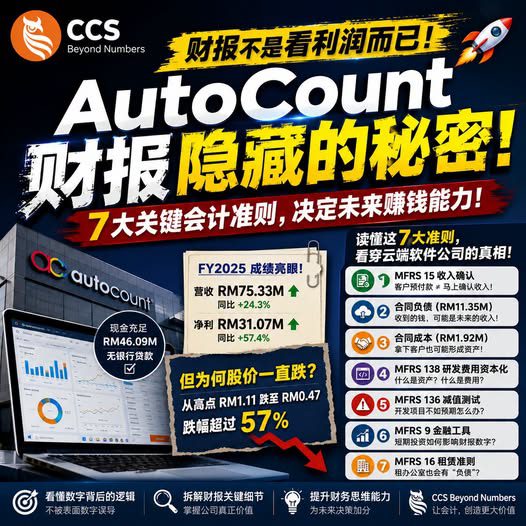
AutoCount provides a useful case study for understanding how to read the financial statements of a software company.
Its business model is relatively clear. The company develops business software such as accounting, point-of-sale, payroll, cloud accounting, cloud payroll, OneSales and e-Invoice solutions, with small and medium-sized enterprises forming its main customer base.
AutoCount was listed on the ACE Market in 2023 and transferred to the Main Market on 26 February 2026. According to its website, its products are currently used by more than 240,000 businesses.
The Share Price Is Only One Part of the Story
AutoCount closed at RM0.47 on 2 September 2026, compared with a 52-week high of RM1.11. This represents a decline of more than half from its 52-week high. The share price had also weakened significantly since the beginning of 2026.
However, it is important to distinguish between the factors that may have occurred alongside the share price decline and the broader reasons that determine market prices. Valuation, fund flows, shareholding structure and market sentiment may also affect a company’s share price.
The more important question is therefore not simply why the share price has fallen, but what has changed in the company’s earnings outlook.
From the E-Invoice Boom to Normalisation
The most obvious change is that 2025 was an e-Invoice boom year, while 2026 entered a period of normalisation.
FY2025 was an unusually strong year for AutoCount:
- Revenue increased from RM60.60 million in FY2024 to RM75.33 million in FY2025.
- Net profit increased from RM19.73 million to RM31.07 million.
The first half of FY2025 was particularly strong. As businesses prepared to meet Malaysia’s e-Invoice implementation deadlines, many upgraded their software and purchased e-Invoicing modules.
As a result, 1H FY2025 revenue reached RM45.73 million, while profit after tax reached RM22.27 million.
However, part of this demand was driven by a regulatory upgrade cycle. Customers would not normally purchase or install an e-Invoice module for the first time every year.
By 1H FY2026:
- Revenue had declined to RM26.21 million, representing a year-on-year decrease of 42.7%.
- Profit after tax had declined to RM7.69 million, representing a year-on-year decrease of 65.5%.
For Q2 FY2026 alone:
- Revenue declined from RM20.17 million to RM11.74 million, a decrease of 41.8%.
- Profit after tax declined from RM8.61 million to RM2.82 million, a decrease of 67.2%.
The company itself explained that FY2025 had benefited from unusually strong e-Invoicing upgrade demand, while demand began to normalise in FY2026.
The market may therefore be asking a different question now. It is no longer simply:
“Can AutoCount benefit from e-Invoice?”
FY2025 has already provided an answer to that question.
The more important question is:
“After the e-Invoice boom, what will be the company’s next growth curve?”
Why Did Profit Fall Faster Than Revenue?
This is an especially useful financial analysis lesson.
In Q2 FY2026:
- Revenue declined by 41.8%;
- Profit before tax declined by 68.7%; and
- Profit after tax declined by 67.2%.
One reason given by the company was its operating cost base. Employee costs and development expenses are, to a significant extent, fixed costs.
When revenue declines, fixed costs do not automatically decline at the same rate. As a result, profit may fall faster than revenue.
This is the effect of operating leverage.
A simple example would be a software business with:
- Revenue of RM20 million; and
- Fixed employee and development costs of RM8 million.
If revenue falls to RM12 million, employee salaries do not automatically fall by 40%. The business therefore experiences a disproportionate decline in profit.
This is not an accounting standard, but it is an important financial concept for understanding AutoCount’s FY2026 results.
A Weaker Earnings Period Does Not Automatically Mean a Liquidity Crisis
It is also important to assess the company fairly.
As at 30 June 2026, AutoCount:
- Had no bank borrowings; and
- Held approximately RM46.09 million in cash, bank balances and short-term investments.
Its contract liabilities had also increased to approximately RM11.35 million, an increase of around 9.9% from the end of 2025.
The financial statements therefore appear to indicate that earnings had declined from the unusually high e-Invoice peak, rather than that the company was experiencing a liquidity crisis.
These are two different matters.
What Can AutoCount Teach Us About Accounting Standards?
AutoCount’s financial statements provide several practical lessons that are more useful than textbook examples.
Lesson 1: MFRS 15 — Why Is a Three-Year Maintenance Contract Not Recognised as Revenue Immediately?
This may be one of the most relevant accounting lessons from AutoCount because the company is gradually moving from traditional perpetual or on-premise software towards cloud, subscription and SaaS models.
One of the key accounting issues in a SaaS business is revenue timing.
AutoCount reported FY2025 revenue of RM75.33 million, comprising:
- Sale of goods: RM60.11 million; and
- Services rendered: RM15.22 million.
Under its accounting policy, on-premise software is generally recognised at a point in time when control of the software has been transferred to the customer, normally upon the customer’s acceptance of delivery.
Subscriptions, technical support and maintenance services are different.
An Example
Assume that on 1 January, a customer pays RM3,600 for a one-year AutoCount Cloud subscription.
The company receives the cash immediately. Does it simply record:
Dr Cash RM3,600
Cr Revenue RM3,600
Usually, it cannot recognise the entire amount as revenue immediately because the company still owes the customer 12 months of services.
The amount received may therefore initially be recorded as a contract liability. Revenue is then recognised as the company satisfies its performance obligations over the subscription period.
This is consistent with the contract liabilities disclosed by AutoCount:
- FY2025: RM10.33 million;
- FY2024: RM6.09 million.
The company explained that these amounts mainly related to customers who had paid or been billed for services where the relevant performance obligations had not yet been satisfied. The amounts were expected to be recognised as revenue over the following one to 36 months.
This is an important point for beginners. An increase in liabilities does not automatically mean that the company has taken on a bank loan or is in financial difficulty.
A contract liability broadly means:
“The customer’s money has been received, but the company still owes the customer goods or services.”
For a subscription-based software business:
Cash does not equal revenue, and an invoice does not automatically equal revenue.
The key question is whether the relevant performance obligation has been satisfied.
Lesson 2: Why Are Contract Liabilities Important for a SaaS Business?
AutoCount has stated that it is developing its cloud, subscription and recurring income businesses.
For example, Cloud Payroll has moved to a 100% cloud subscription model, while Q2 FY2026 Cloud Payroll revenue increased by 35.6% year on year to RM2.23 million.
As subscription revenue becomes a larger part of the business, users should not look only at revenue. They should also consider contract liabilities.
Cash received today may partly relate to services that will be provided in the future and therefore recognised as revenue later.
This is why MFRS 15 is particularly useful for understanding a SaaS business. It helps users distinguish between:
- Cash received;
- Amounts billed;
- Contract liabilities; and
- Revenue recognised after performance obligations are satisfied.
Lesson 3: MFRS 15 — Contract Costs Can Become an Asset
AutoCount also reported contract costs of:
- RM1.923 million in FY2025; and
- RM0.915 million in FY2024.
Why can a cost become an asset?
Obtaining a customer contract may involve incremental costs of obtaining that contract. If the company expects to recover those costs and the relevant requirements under MFRS 15 are satisfied, some costs may not be recognised immediately as expenses.
Instead, they may initially be recognised as a contract cost asset and amortised as the related revenue is recognised.
AutoCount also applies the practical expedient under MFRS 15. Where the amortisation period of an asset that would otherwise be recognised is one year or less, the relevant incremental contract acquisition costs may be expensed directly.
This is a useful real-world example showing that MFRS 15 does not only determine revenue. It may also affect:
- Assets;
- Expenses;
- Contract liabilities; and
- Deferred tax.
Lesson 4: MFRS 138 — When Can Internally Developed Software Be Recognised as an Asset?
AutoCount’s development costs provide a practical example of MFRS 138 Intangible Assets.
The carrying amount of development costs was:
- RM1.549 million in FY2025; and
- RM1.778 million in FY2024.
AutoCount explained that these development costs mainly related to internally generated major projects, and that the company reasonably expected the costs to be recovered through future commercial activities.
The accounting distinction is generally as follows:
- Costs incurred during the research phase are normally recognised as expenses.
- Costs incurred during the development phase may be capitalised if the relevant recognition criteria are satisfied.
These criteria include matters such as:
- Technical feasibility;
- The intention to complete the asset;
- The availability of resources;
- The probability of future economic benefits; and
- The ability to measure the costs reliably.
Impairment as a Practical Example
AutoCount also provides a practical example of impairment.
In FY2024, the company recognised an impairment loss of RM100,000 on development costs because the outcome had not met expectations. No impairment was recognised in FY2025.
This illustrates the basic principle under MFRS 136 Impairment of Assets.
When the software was initially developed, management may have believed that it would generate future economic benefits. The related costs could therefore qualify for recognition as an asset.
If actual results later fall short of expectations, the company cannot simply ignore the change. It must reassess whether the asset’s recoverable amount remains sufficient.
If the recoverable amount is lower than the carrying amount, an impairment loss may be required.
Lesson 5: Why Is the Useful Life of Development Costs Ten Years?
AutoCount’s FY2025 accounting policy states that development costs have a useful life of 10 years and are amortised on a straight-line basis.
The figure itself cannot be labelled simply as right or wrong without considering the facts and circumstances. However, it raises an important accounting question:
Why does management believe that the software development costs will generate economic benefits for 10 years?
Technology can change quickly. The useful life of development costs is therefore an important accounting estimate for users of the financial statements to understand.
The useful life has a direct effect on annual amortisation.
For example, for an asset costing RM10 million:
- Over 10 years: annual amortisation would be RM1 million.
- Over five years: annual amortisation would be RM2 million.
The resulting profit would therefore be different.
For a technology company, useful life may appear to be only one number in the notes to the financial statements. In reality, it may affect profit over many future years.
Lesson 6: MFRS 9 — Why Does AutoCount Have So Many Short-Term Investments?
AutoCount is a cash-rich company.
Its FY2025 statement of financial position included:
- Short-term investments of RM34.69 million; compared with
- RM21.84 million in FY2024.
The FY2025 statement of cash flows also showed:
- Purchases of short-term investments: RM53.48 million; and
- Proceeds from sales of short-term investments: RM40.59 million.
This brings us to MFRS 9 Financial Instruments, including:
- Classification;
- Measurement;
- Fair value;
- Amortised cost; and
- Recognition of related gains and losses.
The FY2025 statement of profit or loss included a fair value loss on other investments of RM5,378. The cash flow reconciliation also showed a net fair value gain on short-term investments of RM8,505.
Although these amounts were not large, they provide a useful teaching example.
When a company has significant excess cash, the question of where to place the money is also an accounting question. The classification and measurement of those investments can affect both the statement of financial position and the reported profit or loss.
Lesson 7: MFRS 16 — No Bank Debt Does Not Mean There Are No Liabilities
As at FY2025, AutoCount had very little traditional borrowing. However, its statement of financial position still included a lease liability because the company leases office premises.
Under MFRS 16, a qualifying lease generally results in the recognition of:
Dr Right-of-use asset
Cr Lease liability
Therefore:
No bank loan does not mean that the statement of financial position contains no financing-type liability.
For FY2025, AutoCount reported approximately:
- Right-of-use assets: RM101,000; and
- Lease liabilities: RM102,000.
The amounts were not significant, but they provide a useful example of how a company can have liabilities arising from leases even when it has no material bank borrowings.
Why Might the Market Not Value FY2025 Earnings at the Same Level?
This question takes us beyond accounting standards and into earnings sustainability.
AutoCount reported:
- FY2025 revenue of RM75.33 million; and
- FY2025 net profit of RM31.07 million.
However, 1H FY2026 reported:
- Revenue of RM26.21 million; and
- Profit after tax of RM7.69 million.
The key market question may therefore not be:
“Is AutoCount profitable?”
It remains profitable.
The more important question may be:
“How much of the RM31 million earned in FY2025 represents normalised earnings that can be repeated over the long term?”
FY2025 was clearly supported by the special upgrade cycle arising from mandatory e-Invoice implementation.
If the market had previously assumed that FY2025’s high profit level would continue growing every year, the subsequent normalisation in FY2026 could result in a valuation re-rating.
This helps explain why a company can:
- Remain profitable;
- Have no bank borrowings;
- Hold substantial cash; and
- Transfer to the Main Market,
yet still experience a decline in its share price.
The stock market often looks beyond whether a company made a profit this year. It also considers whether the company’s future earnings capacity has changed relative to previous market expectations.
AutoCount’s Next Transition: From Licence Revenue to SaaS Revenue
An important development to watch is AutoCount’s transition from a more traditional business model based on one-off software licences and upgrades towards:
- Cloud services;
- SaaS; and
- Recurring subscription revenue.
This transition also creates an interesting accounting effect.
Under the traditional model, a customer may purchase a software licence for RM1,200, with a significant portion of the revenue recognised relatively quickly.
Under a subscription model, the same customer may instead pay RM100 per month for 12 months. Although the long-term customer value may be similar, revenue would be recognised month by month as the services are provided.
During the early stage of a SaaS transition, a company may therefore experience:
- More recurring characteristics in cash flow;
- Higher contract liabilities;
- A more recurring customer base; and
- Short-term revenue growth that appears less dramatic than one-off licence revenue.
This is why MFRS 15 is particularly important for understanding AutoCount’s future business model.
Six Numbers to Study in AutoCount’s Financial Statements
If AutoCount’s financial statements were used as an accounting lesson, the following six numbers would provide a useful starting point.
1. Revenue
- FY2025: RM75.33 million;
- 1H FY2026: RM26.21 million.
Lesson: Earnings normalisation.
2. Contract Liabilities
- FY2025: RM10.33 million;
- June 2026: approximately RM11.35 million.
Lesson: Under MFRS 15, cash does not equal revenue.
3. Contract Costs
- FY2025: RM1.92 million.
Lesson: Obtaining a customer contract may result in an asset rather than an immediate expense.
4. Development Costs
- Approximately RM1.55 million.
Lesson: Under MFRS 138, when can research and development costs be capitalised?
5. Development Costs’ Useful Life
- 10 years.
Lesson: An accounting estimate can affect reported profit over many future periods.
6. Impairment Loss
- RM100,000 recognised in FY2024.
Lesson: Under MFRS 136, accounting must respond when a technology project does not perform as expected.
How Should AutoCount’s Financial Statements Be Read?
The correct conclusion is not:
“The share price has fallen, so the company must be performing badly.”
It is also not:
“The company has RM46 million in cash, so the share price must rise.”
Both conclusions are too simplistic.
From an accounting perspective, AutoCount is experiencing an interesting transition:
- From e-Invoice-driven growth to post-e-Invoice normalisation; and
- From a licence and upgrade business towards cloud, SaaS and recurring revenue.
FY2025 showed the impact of strong e-Invoice-related demand.
FY2026 is beginning to answer a different question:
After the one-off e-Invoice upgrade cycle, what is the company’s underlying recurring earnings power?
For accounting professionals, the more valuable questions include:
- Why is cash received from cloud services initially recognised as a contract liability?
- Why can contract acquisition costs become an asset?
- When can software development costs be capitalised?
- How is a 10-year useful life determined?
- When should an underperforming software project be impaired?
These questions are all reflected in the financial statements.
That is why the most interesting information in a company’s financial statements is often not on the first page showing profit. It is in the notes to the financial statements.
This article discusses publicly available financial information, accounting standards and business models. It does not constitute securities valuation, trading or investment advice. AutoCount’s FY2026 quarterly figures are unaudited.
AutoCount:e-Invoice 热潮退了以后,财报真正该看什么?
AutoCount 很适合作为学习如何阅读软件公司财报的案例。
公司的商业模式相对清晰,主要提供会计软件、POS、Payroll、Cloud Accounting、Cloud Payroll、OneSales 及 e-Invoice 等商业软件,客户以中小企业为主。
AutoCount 于 2023 年在 ACE Market 上市,并于 2026 年 2 月 26 日转至 Main Market。根据公司官网,目前其产品已被超过 240,000 家企业使用。
股价只是故事的一部分
AutoCount 于 2026 年 9 月 2 日收于 RM0.47,52 周高点为 RM1.11,意味着股价较高位回落超过一半。单看 2026 年以来,股价也已经明显走弱。
不过,我们必须把基本面因素与影响市场价格的其他因素区分开来。估值、资金流、持仓结构及市场情绪,都可能影响股价。
因此,更重要的问题不只是股价为什么下跌,而是公司的盈利前景发生了什么变化。
从 e-Invoice 热潮进入正常化
最直观的变化是:
2025 年是 e-Invoice boom,2026 年开始进入 normalisation。
FY2025 对 AutoCount 来说是非常特殊的一年:
- Revenue 从 FY2024 的 RM60.60 million 增加至 FY2025 的 RM75.33 million;
- Net Profit 从 RM19.73 million 增加至 RM31.07 million。
其中,1H FY2025 的表现尤其强劲。为了赶上马来西亚 e-Invoice 的实施期限,许多企业升级软件,并购买 e-Invoicing module。
因此,1H FY2025:
- Revenue 达到 RM45.73 million;
- Profit After Tax 达到 RM22.27 million。
不过,这部分需求有相当一部分属于由监管推动的升级周期。客户不可能每年都第一次安装 e-Invoice module。
来到 1H FY2026:
- Revenue 降至 RM26.21 million,同比下降 42.7%;
- Profit After Tax 降至 RM7.69 million,同比下降 65.5%。
单看 Q2 FY2026:
- Revenue 从 RM20.17 million 降至 RM11.74 million,下降 41.8%;
- Profit After Tax 从 RM8.61 million 降至 RM2.82 million,下降 67.2%。
公司也解释,FY2025 受益于异常强劲的 e-Invoicing upgrade demand,而到了 FY2026,相关需求开始 normalise。
因此,市场现在可能已经在问另一个问题。
市场过去问的是:
“AutoCount 能不能受惠于 e-Invoice?”
FY2025 已经回答了这个问题。
市场现在更可能问:
“e-Invoice 热潮过后,AutoCount 的下一条增长曲线是什么?”
为什么 Profit 跌得比 Revenue 更快?
这也是一个非常好的财务分析教材。
Q2 FY2026:
- Revenue 下降 41.8%;
- Profit Before Tax 下降 68.7%;以及
- Profit After Tax 下降 67.2%。
公司其中一个解释是 operating cost base。Employee costs 和 development expenses 当中,有相当部分属于固定成本。
当 Revenue 下降时,固定成本不会同步下降相同的幅度,因此 Profit 可能跌得比 Revenue 更快。
这就是 **Operating Leverage(经营杠杆)**的影响。
可以用一个简单例子来理解:
假设一家软件公司有:
- Revenue:RM20 million;
- 固定员工及开发成本:RM8 million。
如果 Revenue 下跌至 RM12 million,程序员的工资不会因为 Sales 跌了 40% 就自动减少 40%。
因此,公司的 Profit 可能出现不成比例的收缩。
这本身不是会计准则,但却是理解 AutoCount FY2026 数字的重要财务概念。
盈利回落,不等于流动性危机
公平地说,截至 2026 年 6 月 30 日,AutoCount:
- 没有 bank borrowings;以及
- 持有约 RM46.09 million 的现金、银行结余及短期投资。
与此同时,Contract Liabilities 已增加至约 RM11.35 million,较 2025 年末增加约 9.9%。
因此,目前财报所反映的更像是:盈利从非常高的 e-Invoice peak 回落,而不是公司出现 liquidity crisis。
这两件事完全不同。
AutoCount 可以教我们哪些会计准则?
AutoCount 的财报至少可以带出几项非常实际的会计课题,而且比教科书案例更贴近现实。
第一课:MFRS 15——买了三年 Maintenance,为什么不能今天全部确认 Revenue?
这可能是 AutoCount 最值得讨论的会计课题之一,因为公司正在从传统的 perpetual 或 on-premise software,逐渐转向 Cloud、Subscription 及 SaaS 模式。
SaaS business 最大的会计课题之一,就是收入确认时间(Revenue Timing)。
AutoCount FY2025 的 Revenue 为 RM75.33 million,包括:
- Sale of goods:RM60.11 million;
- Services rendered:RM15.22 million。
根据公司的会计政策,on-premise software 一般在软件控制权已经转移给客户、通常是客户接受交付时,按某一个时间点确认收入。
但 Subscription、Technical Support 及 Maintenance 就没有这么简单。
一个现实例子
假设客户在 1 月 1 日一次性支付 RM3,600,购买一年的 AutoCount Cloud subscription。
公司已经收到现金。是不是可以直接记录:
Dr Cash RM3,600
Cr Revenue RM3,600
通常不能这样简单处理。
因为公司仍然欠客户未来 12 个月的服务。收到现金,并不代表所有服务已经完成,Revenue 也不代表已经全部 earned。
因此,相关金额可能会先确认为 Contract Liability(合同负债),再随着公司在订阅期间履行履约义务,逐步确认 Revenue。
这与 AutoCount 披露的 Contract Liabilities 一致:
- FY2025:RM10.33 million;
- FY2024:RM6.09 million。
公司明确解释,这些金额主要是客户已经付款或已经被 Billing,但相关 Performance Obligations 尚未满足的部分。预计会在未来一至 36 个月内转为 Revenue。
很多会计初学者看到 Liability 增加,第一反应是:
“公司是不是欠了很多钱?”
但 Contract Liability 很特别。它不是普通的 Bank Loan,而是在某种程度上表示:
“客户的钱已经进来了,但公司还欠客户商品或服务。”
因此,对于订阅型软件公司:
Cash 不等于 Revenue,Invoice 也不等于 Revenue。
真正关键的问题是:
Performance Obligation 是否已经满足?
第二课:为什么 Contract Liability 对 SaaS 公司特别重要?
AutoCount 已公开表示,公司正在推动 Cloud、Subscription 及 Recurring Income。
例如,Cloud Payroll 已经转为 100% cloud subscription model,而 Q2 FY2026 的 Cloud Payroll Revenue 同比增加 35.6% 至 RM2.23 million。
因此,如果 Subscription Business 在未来占比越来越高,投资者不能只看 Revenue,也应该同时关注 Contract Liabilities。
今天收到的 Cash,有一部分可能是未来才会确认的 Revenue。
这就是为什么 MFRS 15 对理解 SaaS business 特别重要。它帮助财报使用者分辨:
- 已收到的现金;
- 已开出的账单;
- 合同负债;以及
- 在履约义务满足后确认的收入。
第三课:MFRS 15——Contract Costs 为什么可以成为 Asset?
AutoCount FY2025 的 Contract Costs 为:
- FY2025:RM1.923 million;
- FY2024:RM0.915 million。
为什么 Cost 也可以变成 Asset?
取得客户合同时,企业可能产生一些 incremental cost of obtaining a contract。如果公司预计可以收回这些成本,并且符合 MFRS 15 的相关要求,那么部分成本不一定需要立即确认为 Expense。
这些成本可以先确认为 Contract Cost Asset(合同成本资产),然后随着相关 Revenue 确认而进行 Amortisation。
AutoCount 也采用了 MFRS 15 的 practical expedient:如果原本需要确认的 Asset,其 Amortisation Period 为一年或以下,相关的 incremental contract acquisition costs 可以直接计入 Expense。
这是一个非常好的现实例子:
MFRS 15 不只是决定 Revenue,也可能影响:
- Asset;
- Expense;
- Contract Liability;以及
- Deferred Tax。
第四课:MFRS 138——Software 公司自行开发的软件,什么时候可以成为 Asset?
AutoCount 的 Development Costs 是理解 MFRS 138《无形资产》的实际案例。
Development Costs 的账面金额为:
- FY2025:RM1.549 million;
- FY2024:RM1.778 million。
AutoCount 说明,这些 Development Costs 主要与内部产生的重大项目有关,而公司合理预期相关成本可以通过未来商业活动收回。
一般来说:
- **Research Phase(研究阶段)**的成本,通常确认为 Expense;
- **Development Phase(开发阶段)**的成本,如果符合相关确认条件,才可以资本化。
相关条件包括:
- Technical Feasibility;
- 完成该资产的意图;
- 是否拥有足够资源;
- 是否可能产生未来经济利益;以及
- 成本能否可靠计量。
Impairment 是一个很现实的例子
AutoCount 也提供了一个 Impairment 的实际案例。
FY2024,公司对 Development Costs 确认了 RM100,000 的 Impairment Loss,理由是项目结果没有达到预期。FY2025 则没有再次确认 Impairment。
这就是 MFRS 136 Impairment of Assets 最简单的现实版本。
最初,公司认为这个 Software Project 可以带来未来经济利益,因此相关成本可能可以确认为 Asset。
后来如果实际结果不如预期,会计就不能假装什么都没有发生,而必须重新评估:
这个 Asset 的 Recoverable Amount 还剩多少?
如果 Recoverable Amount 低于 Carrying Amount,就可能需要确认 Impairment Loss。
第五课:为什么 Development Costs 是十年 Amortisation?
AutoCount FY2025 的会计政策披露:
- Development Costs Useful Life:10 年;
- Amortisation Method:Straight-line。
这个数字本身不能脱离事实简单判断为“对”或“错”。但它提供了一个非常值得讨论的问题:
为什么管理层判断这些软件开发成本可以产生 10 年的经济利益?
科技行业通常变化很快,因此 Useful Life 是财报使用者需要理解的一项 Accounting Estimate。
Useful Life 会直接影响每年的 Amortisation。
例如,一项 RM10 million 的 Asset:
- 10 年摊销:每年 RM1 million;
- 5 年摊销:每年 RM2 million。
因此,最终确认的 Profit 会不同。
对科技公司来说,Useful Life 看起来可能只是财报附注中的一个数字,但实际上会影响未来很多年的 Profit。
第六课:MFRS 9——AutoCount 为什么有这么多 Short-term Investments?
AutoCount 是一家 Cash-rich Company。
FY2025 资产负债表包括:
- Short-term Investments:RM34.69 million;
- FY2024:RM21.84 million。
FY2025 Cash Flow Statement 也显示:
- Purchase of short-term investments:RM53.48 million;
- Sale of short-term investments:RM40.59 million。
这就进入 MFRS 9 Financial Instruments 的范围,包括:
- Classification;
- Measurement;
- Fair Value;
- Amortised Cost;以及
- Gain 或 Loss 的确认。
FY2025 损益表中甚至包括:
- Fair value loss on other investments:RM5,378。
Cash Flow Reconciliation 也显示:
- Net fair value gain on short-term investments:RM8,505。
这些金额目前并不大,但教学价值很高。
当公司拥有大量 Excess Cash 时,“钱应该放在哪里”本身也是一个会计问题。相关投资的 Classification 和 Measurement,可能影响财务状况表及损益表。
第七课:MFRS 16——没有什么 Bank Loan,不代表没有 Liability
截至 FY2025,AutoCount 几乎没有传统借款,但资产负债表上仍然有 Lease Liability,因为公司租用了办公室。
根据 MFRS 16,符合条件的 Lease 一般需要确认:
Dr Right-of-use Asset
Cr Lease Liability
因此:
没有 Bank Loan,不等于资产负债表没有 Financing-type Liability。
AutoCount FY2025 的相关金额约为:
- Right-of-use Asset:RM101,000;
- Lease Liability:RM102,000。
金额虽然不大,但这是一个很好的例子,说明即使公司没有重大的银行借款,也可能因为租赁而确认负债。
为什么市场可能没有给 FY2025 同样高的估值?
这里就要离开会计准则,进入 Earnings Sustainability(盈利持续性)。
AutoCount FY2025:
- Revenue:RM75.33 million;
- Net Profit:RM31.07 million。
但 1H FY2026:
- Revenue:RM26.21 million;
- Profit After Tax:RM7.69 million。
市场面对的最大问题,可能不是:
“AutoCount 有没有赚钱?”
公司仍然是赚钱的。
更重要的问题可能是:
FY2025 的 RM31 million earnings,有多少属于可以长期重复的 Normalised Earnings?
FY2025 很明显受到 Mandatory e-Invoicing Implementation 所带来的特殊 Upgrade Cycle 支持。
如果市场之前把 FY2025 的高利润理解为:
“以后每一年都会继续这样增长。”
那么 FY2026 出现 Normalisation 后,就可能发生 Valuation Re-rating。
这也解释了为什么一家公司即使:
- 仍然盈利;
- 没有 Bank Loan;
- 拥有大量 Cash;以及
- 甚至已经转至 Main Market,
股价仍然可能下跌。
股票市场通常不只是交易:
“公司今年有没有赚钱?”
市场也会看:
公司未来的盈利能力,与过去市场预期相比有没有改变?
AutoCount 还在进行另一个重要转型
AutoCount 目前正在从较传统的:
- 一次性 Software Licence;
- Upgrade Revenue;
逐步转向:
- Cloud;
- SaaS;以及
- Recurring Subscription Revenue。
这会产生一个很有意思的会计效果。
在旧模式下,客户一次购买 RM1,200 的 Software Licence,较大部分 Revenue 可能较快确认。
如果转成:
RM100 × 12 months subscription
同一个客户的长期价值可能差不多,但 Revenue Recognition 会变成每个月随着服务提供而逐步确认。
因此,在 SaaS 转型初期,公司可能出现:
- Cash Flow 更有 Recurring 特征;
- Contract Liabilities 增加;
- Customer Base 更有 Recurring 特征;以及
- 短期 Revenue Growth 看起来没有一次性 Licence Revenue 那么爆发。
这就是为什么 MFRS 15 对理解 AutoCount 未来的 Business Model 非常关键。
如果把 AutoCount 财报变成一堂课
可以用以下六个数字作为起点。
1|Revenue
- FY2025:RM75.33 million;
- 1H FY2026:RM26.21 million。
学习重点:Earnings Normalisation。
2|Contract Liabilities
- FY2025:RM10.33 million;
- June 2026:约 RM11.35 million。
学习重点:MFRS 15 下,Cash 不等于 Revenue。
3|Contract Costs
- FY2025:RM1.92 million。
学习重点:取得客户也可能形成 Asset。
4|Development Costs
- 约 RM1.55 million。
学习重点:MFRS 138 下,Research and Development 什么时候可以资本化?
5|Development Costs Useful Life
- 10 年。
学习重点:Accounting Estimate 怎样影响未来 Profit。
6|Impairment Loss
- FY2024:RM100,000。
学习重点:MFRS 136 下,当科技产品不如预期时,会计如何面对现实?
最后,应该怎样看 AutoCount 这份财报?
不能简单地说:
“股价跌,所以公司一定不好。”
也不能简单地说:
“公司有 RM46 million Cash,所以股价一定应该上涨。”
这两个结论都太快了。
从会计角度看,AutoCount 正在经历一个很有意思的阶段:
- 从 e-Invoice-driven Growth 进入 Post-e-Invoice Normalisation;
- 同时从 Licence/Upgrade Business,继续转向 Cloud、SaaS 及 Recurring Revenue。
FY2025 让我们看到的是爆发式的需求。
FY2026 开始回答的是另一个问题:
没有 e-Invoice 一次性升级潮以后,这家公司真正的 Recurring Earnings Power 是多少?
对会计人来说,更有价值的问题则包括:
- Cloud 收到的钱,为什么先变成 Contract Liability?
- Contract Cost 为什么可以成为 Asset?
- Software Development 在什么情况下可以资本化?
- 10 年 Useful Life 是怎样决定的?
- 一个 Software Project 没有达到预期,什么时候需要确认 Impairment?
这些问题,其实全部藏在 AutoCount 的 Financial Statements 里面。
这就是为什么财报最精彩的地方,通常不在第一页的 Profit,而在:
Notes to the Financial Statements。
本文仅讨论公开财务资料、会计准则及商业模式,不构成任何证券估值、买卖或投资建议。AutoCount FY2026 季度数据为未经审计数据。