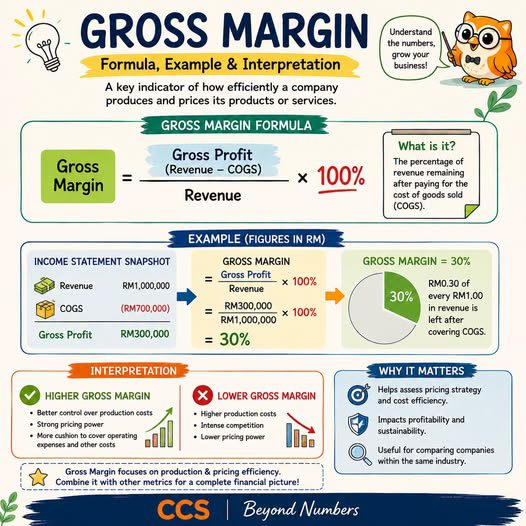
Gross Margin is a key indicator of how efficiently a company produces and prices its products or services.
Formula
Gross Margin = (Gross Profit ÷ Revenue) × 100%
Where:
Gross Profit = Revenue − Cost of Goods Sold (COGS)
Quick Example
Assume:
- Revenue: RM1,000,000
- COGS: RM700,000
- Gross Profit: RM300,000
Therefore:
Gross Margin = (RM300,000 ÷ RM1,000,000) × 100% = 30%
This means that for every RM1 of revenue, the company retains RM0.30 after covering the cost of goods sold.
How Should Gross Margin Be Interpreted?
A higher gross margin generally indicates stronger cost control or greater pricing power.
A lower gross margin may indicate:
- Higher production or purchasing costs; or
- More intense competition, which may limit the company’s ability to increase prices.
Gross margin should be analysed together with other financial indicators to obtain a more complete understanding of the company’s financial and operating performance.
CCS | Beyond Numbers
毛利率(Gross Margin):公式、例子与解读
**毛利率(Gross Margin)**是衡量公司生产及定价效率的重要指标。
计算公式
毛利率 =(毛利 ÷ 营业收入)× 100%
其中:
毛利 = 营业收入 − 销售成本(COGS)
一个简单例子
假设:
- 营业收入:RM1,000,000
- 销售成本:RM700,000
- 毛利:RM300,000
因此:
毛利率 =(RM300,000 ÷ RM1,000,000)× 100% = 30%
这表示公司每赚取 RM1 的营业收入,在扣除销售成本后,还剩下 RM0.30。
应该如何解读毛利率?
较高的毛利率通常代表公司拥有较好的成本控制能力,或具备较强的定价能力。
较低的毛利率则可能反映:
- 生产成本或采购成本较高;或
- 市场竞争较为激烈,限制了公司的加价能力。
分析毛利率时,建议结合其他财务指标一起评估,才能更完整地了解公司的财务及经营表现。
CCS | Beyond Numbers