Is goodwill still being carried in the financial statements as though it were automatically worth its original amount?
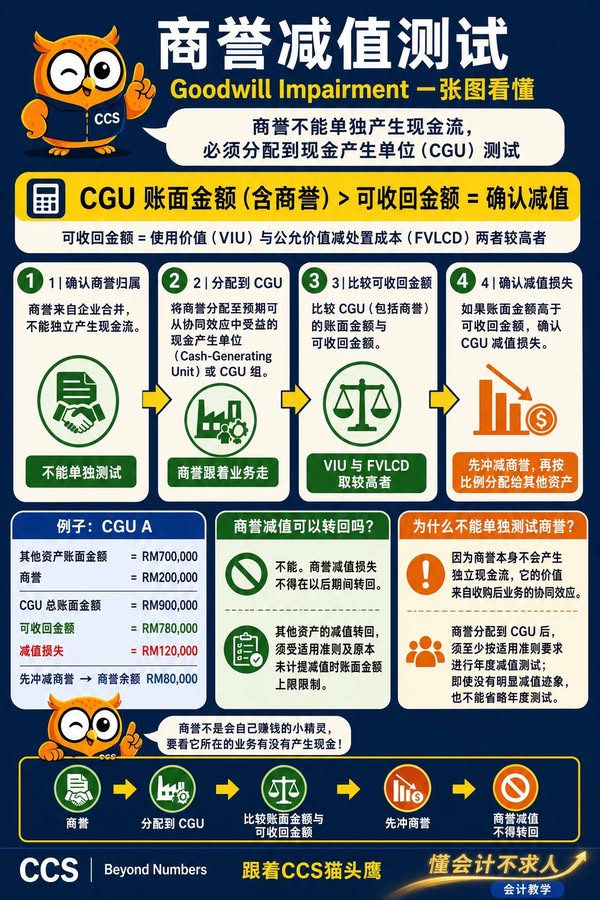
Goodwill cannot generate cash flows independently. It must be allocated to a Cash-Generating Unit (CGU), or a group of CGUs expected to benefit from the synergies of the business combination, and tested together with that CGU.
How Is Goodwill Impairment Tested?
The process is generally as follows:
- Include goodwill in the carrying amount of the relevant CGU;
- Compare the CGU’s carrying amount with its recoverable amount;
- If the carrying amount exceeds the recoverable amount, recognise an impairment loss;
- Allocate the impairment loss first to goodwill; and
- Allocate any remaining impairment loss pro rata to the other assets in the CGU.
However, no asset should be reduced below the applicable minimum carrying amount, such as its fair value less costs of disposal, value in use or zero, where relevant.
Goodwill Impairment Cannot Be Reversed
An impairment loss recognised for goodwill is not reversed in a later period, even if the business subsequently performs better.
This makes the initial assessment particularly important.
Goodwill may lose value when:
- Expected synergies fail to materialise;
- The business underperforms;
- Customer relationships weaken;
- The market changes significantly; or
- The relevant CGU generates lower cash flows than expected.
Goodwill does not generate cash by itself. Its value depends on the performance of the business to which it relates.
Annual Testing Is Not the Only Consideration
Goodwill must be tested for impairment at least annually. However, management should not wait until the annual testing date if there are indications that the CGU may be impaired.
The assessment should consider whether the business is still generating the cash flows and benefits that originally supported the recognition of goodwill.
Goodwill is not a self-generating source of wealth. Test the business that holds it and assess whether that business is still generating cash.
This article is for general reference only. Actual accounting treatment should be determined with reference to the applicable accounting standards and relevant professional judgement.
CCS | Beyond Numbers
商誉减值:为什么必须结合现金产生单位进行测试?
商誉还留在账上,你确定它真的还值原来的金额吗?
商誉本身不会独立产生现金流,因此不能单独进行减值测试。企业必须把商誉分配至相关的现金产生单位(Cash-Generating Unit,CGU),或预期能够受益于企业合并协同效应的一组现金产生单位,并与相关 CGU 一起进行测试。
商誉减值如何测试?
一般流程如下:
- 将商誉计入相关 CGU 的账面金额;
- 将 CGU 的账面金额与可收回金额进行比较;
- 如果账面金额高于可收回金额,就确认减值损失;
- 减值损失首先冲减商誉;以及
- 如仍有剩余减值损失,再按比例分配至 CGU 内的其他资产。
不过,任何单项资产的账面金额,都不能被减至低于适用的最低金额,例如其公允价值减处置成本、使用价值或零,具体须视相关情况而定。
商誉减值不能转回
商誉一旦确认减值损失,即使相关业务之后表现好转,也不能在未来期间转回。
因此,商誉减值测试及相关判断非常重要。
商誉可能在以下情况下失去价值:
- 预期协同效应未能实现;
- 业务表现不如预期;
- 客户关系减弱;
- 市场环境发生重大变化;或
- 相关 CGU 产生的现金流低于预期。
商誉不会自己产生现金。它的价值取决于所属业务的实际表现。
不要只想到每年测试一次
商誉至少必须每年进行一次减值测试。不过,如果出现迹象显示相关 CGU 可能已经发生减值,管理层不应等到年度测试日才进行评估。
企业应检讨相关业务是否仍然能够产生当初支持确认商誉的现金流及经济利益。
商誉不是会自动生钱的资产。必须检验它所属的业务,并评估该业务是否仍然能够真正产生现金。
本文仅供一般参考。实际会计处理应根据适用的会计准则,并结合相关专业判断确定。
CCS | Beyond Numbers