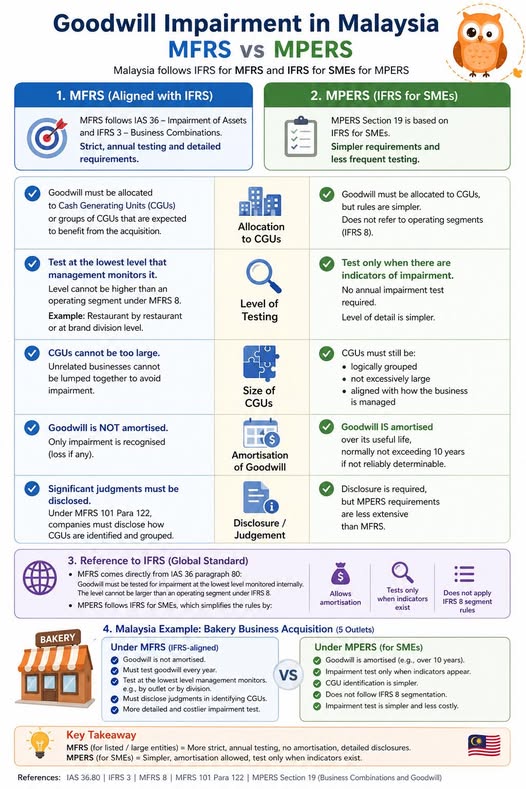
In Malaysia, the accounting treatment for goodwill depends on the financial reporting framework adopted by the entity:
- MFRS, generally applicable to entities with public accountability, is aligned with IFRS; while
- MPERS, intended for eligible private entities, is based on IFRS for SMEs and contains simpler requirements.
The key differences are particularly relevant to the allocation, amortisation and impairment testing of goodwill.
1. Goodwill under MFRS
MFRS follows the principles in IAS 36 Impairment of Assets and IFRS 3 Business Combinations.
Goodwill must be allocated to cash-generating units
Goodwill acquired in a business combination must be allocated to the cash-generating units (CGUs), or groups of CGUs, that are expected to benefit from the synergies of the acquisition.
Testing must be performed at the lowest level monitored by management
Goodwill must be tested for impairment at the lowest level within the entity at which management monitors it.
However, this level cannot be higher than an operating segment under MFRS 8 Operating Segments.
Example
Assume that a listed food and beverage group acquires a chain of ten restaurants.
- If management monitors the performance of each restaurant separately, goodwill should be tested at the individual restaurant level.
- If management monitors the restaurants as a single brand division, goodwill may be tested at the division level.
CGUs must not be excessively broad
Even if management monitors goodwill at a relatively high level, the CGUs must still be appropriately identified and disaggregated.
Unrelated businesses should not be combined into one large CGU simply to avoid or delay recognising an impairment loss.
Significant judgements must be disclosed
Under MFRS 101 paragraph 122, entities should disclose the significant judgements made in identifying CGUs and determining how they are grouped.
2. Goodwill under MPERS
MPERS Section 19 provides simpler requirements than MFRS and IFRS.
Goodwill is amortised
Under MPERS, goodwill is amortised over its useful life.
If the useful life cannot be estimated reliably, it must not exceed 10 years.
This is a significant difference from MFRS and IFRS, which do not permit goodwill to be amortised.
Impairment testing is required when indicators exist
Unlike MFRS and IFRS, MPERS does not require goodwill to be tested for impairment every year.
Instead, impairment testing is required when there are indicators that goodwill may be impaired.
CGUs still apply, but the requirements are simpler
Goodwill must still be allocated to CGUs. However, MPERS does not apply the operating segment requirements under IFRS 8.
Management should still ensure that CGUs are:
- Logically grouped;
- Not excessively broad; and
- Consistent with how the business is managed.
3. IFRS as the International Reference
The MFRS requirements are based on the principles in IAS 36 paragraph 80, which requires goodwill to be tested for impairment at the lowest level monitored internally by management.
That level cannot be larger than an operating segment under IFRS 8.
MPERS, on the other hand, is based on IFRS for SMEs and simplifies the requirements by:
- Allowing goodwill to be amortised;
- Requiring impairment testing only when impairment indicators exist; and
- Not applying the IFRS 8 operating segment requirements.
4. Comparison: A Malaysian Bakery Acquisition
Assume that a Malaysian company acquires a bakery business with five outlets.
Under MFRS
- Goodwill is not amortised;
- Goodwill must be tested for impairment annually;
- If management monitors each outlet separately, testing is performed at the outlet level;
- If management monitors the business at division level, testing is performed at the division level; and
- Significant judgements in identifying CGUs must be disclosed.
Under MPERS
- Goodwill is amortised, for example, over 10 years where the useful life cannot be reliably estimated;
- Impairment testing is performed when indicators of impairment arise;
- CGUs do not have to follow the operating segment requirements under IFRS 8; and
- The impairment assessment is generally simpler and less costly.
Key Takeaway
The accounting framework adopted by an entity has a direct effect on how goodwill is accounted for.
Under MFRS and IFRS, goodwill is not amortised and is tested at the appropriate CGU level, including annual impairment testing. Under MPERS, goodwill is amortised and tested for impairment when indicators arise.
Companies should therefore confirm the applicable reporting framework before deciding how goodwill should be measured, allocated and tested for impairment.
马来西亚商誉减值:比较 MFRS、MPERS 与 IFRS 的要求
在马来西亚,商誉的会计处理方式取决于企业所采用的财务报告框架:
- MFRS一般适用于具有公众问责的企业,并与 IFRS 接轨;而
- MPERS适用于符合资格的私人实体,其基础来自 IFRS for SMEs,相关要求较为简化。
两者在商誉的分配、摊销及减值测试方面存在重要差异。
1. MFRS 下的商誉处理
MFRS 遵循 **IAS 36《资产减值》**及 **IFRS 3《企业合并》**的原则。
商誉必须分配至现金产生单位
企业合并所产生的商誉,必须分配至预期能够从收购协同效应中受益的**现金产生单位(Cash-Generating Units,CGUs)**或 CGU 组合。
必须按照管理层监控的最低层级进行测试
商誉必须在企业内部管理层实际监控的最低层级进行减值测试。
不过,该层级不得高于 **MFRS 8《经营分部》**所定义的营运分部。
例子
假设一家上市食品与饮料集团收购了一个拥有十家餐厅的连锁企业。
- 如果管理层分别监控每家餐厅的经营表现,商誉应在每家餐厅层面进行测试。
- 如果管理层将所有餐厅作为一个品牌部门进行监控,商誉则可以在该部门层面进行测试。
CGU 不得划分得过于宽泛
即使管理层在相对较高的层级监控商誉,企业仍必须合理识别及细分 CGU。
企业不应为了避免或延迟确认减值损失,而将互不相关的业务合并为一个过大的 CGU。
重大判断必须披露
根据 MFRS 101 第 122 段,企业应披露在识别 CGU 以及决定如何将 CGU 分组时所作出的重大判断。
2. MPERS 下的商誉处理
MPERS 第 19 节的要求,相比 MFRS 及 IFRS 更为简化。
商誉需要摊销
根据 MPERS,商誉应在其使用年限内进行摊销。
如果商誉的使用年限无法可靠估计,则摊销期限不得超过10年。
这是 MPERS 与 MFRS、IFRS 之间的一项重大差异,因为 MFRS 与 IFRS 不允许对商誉进行摊销。
出现减值迹象时才需要进行减值测试
不同于 MFRS 及 IFRS,MPERS 不要求企业每年对商誉进行减值测试。
只有在出现商誉可能发生减值的迹象时,企业才需要进行减值测试。
仍然适用 CGU 概念,但要求较为简单
商誉仍然必须分配至 CGU。不过,MPERS 不采用 IFRS 8 的营运分部要求。
管理层仍需确保 CGU:
- 具备合理及有逻辑的分组方式;
- 没有划分得过于宽泛;以及
- 与企业实际管理业务的方式一致。
3. IFRS 如何作为国际参考?
MFRS 的相关要求,是根据 IAS 36 第 80 段的原则制定。该段要求企业在管理层内部实际监控商誉的最低层级,对商誉进行减值测试。
该层级不得大于 IFRS 8所定义的营运分部。
另一方面,MPERS 是以 IFRS for SMEs 为基础,并通过以下方式简化相关要求:
- 允许对商誉进行摊销;
- 只有在出现减值迹象时才需要进行减值测试;以及
- 不采用 IFRS 8 的营运分部要求。
4. 例子:马来西亚面包店收购案
假设一家马来西亚公司收购了一项拥有五家分店的面包店业务。
根据 MFRS
- 商誉不得摊销;
- 商誉必须每年进行减值测试;
- 如果管理层分别监控每家分店,测试应在各分店层面进行;
- 如果管理层在部门层面监控业务,测试应在该部门层面进行;以及
- 企业必须披露识别 CGU 时所作出的重大判断。
根据 MPERS
- 商誉需要摊销,例如在使用年限无法可靠估计时,最长可按10年摊销;
- 当出现减值迹象时,才需要进行减值测试;
- CGU 不必遵循 IFRS 8 的营运分部要求;以及
- 减值评估通常较为简单,成本也相对较低。
重点总结
企业采用的财务报告框架,会直接影响商誉的会计处理方式。
根据 MFRS 及 IFRS,商誉不得摊销,并必须在适当的 CGU 层级进行测试,包括每年进行减值测试。根据 MPERS,商誉需要摊销,并在出现减值迹象时进行测试。
因此,企业在决定如何计量、分配及测试商誉减值之前,应先确认适用的财务报告框架。