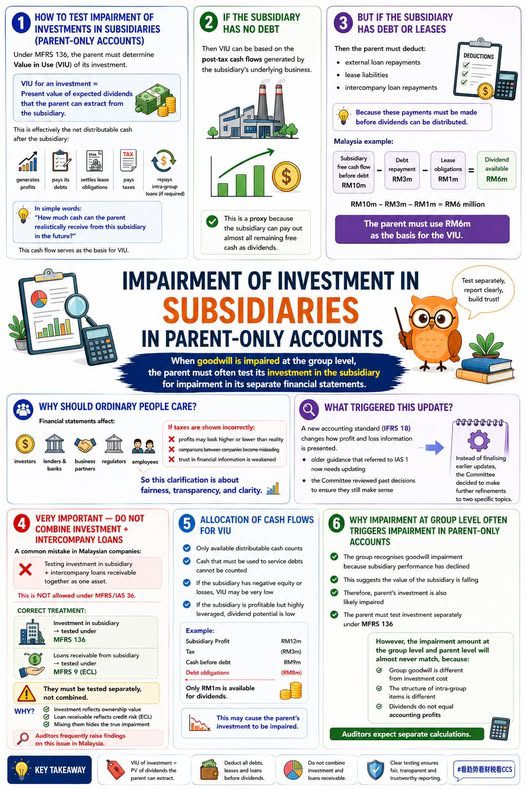
When goodwill is impaired at the group level, this often triggers a requirement to test the parent company’s investment in its subsidiary for impairment in the parent’s separate financial statements.
This is because the two assets are presented differently:
- Goodwill is recognised in the group’s consolidated financial statements; while
- The parent’s investment in the subsidiary is presented as a separate line item in the parent-only financial statements.
They are not the same asset, and both may require separate impairment testing.
1. Testing the Investment in a Subsidiary
Under MFRS 136, the parent company must determine the Value in Use (VIU) of its investment in the subsidiary.
For an investment in a subsidiary, VIU is generally based on:
The present value of the future dividends that the parent can realistically receive from the subsidiary.
This represents the cash that remains available for distribution after the subsidiary:
- Generates profits;
- Pays its debts;
- Settles lease obligations;
- Pays taxes; and
- Repays intra-group loans, where required.
In simple terms, the question is:
How much cash can the parent realistically receive from the subsidiary in the future?
That expected cash flow forms the basis for determining VIU.
2. When the Subsidiary Has No Debt
If the subsidiary has no debt or significant lease obligations, VIU may be based on the subsidiary’s post-tax cash flows from its underlying business.
This serves as a reasonable proxy because the subsidiary may be able to distribute most of its remaining free cash as dividends.
3. When the Subsidiary Has Debt or Lease Obligations
If the subsidiary has debt or lease obligations, the parent must deduct the payments that have to be made before dividends can be distributed.
These may include:
- External loan repayments;
- Lease liabilities; and
- Repayments of intercompany loans.
Example
Assume that a subsidiary has:
- Free cash flow before debt repayments: RM10 million;
- Debt repayments: RM3 million; and
- Lease obligations: RM1 million.
The cash available for dividends would be:
RM10 million − RM3 million − RM1 million = RM6 million
The parent should therefore use the RM6 million available for distribution as the basis for assessing VIU.
4. Do Not Combine the Investment and Intercompany Loans
A common mistake among Malaysian companies is to test the following as one combined asset:
- The investment in the subsidiary; and
- Loans receivable from the subsidiary.
This treatment is not permitted under MFRS 136 and MFRS 9.
The correct approach is:
- Investment in the subsidiary — tested under MFRS 136; and
- Loans receivable from the subsidiary — tested under MFRS 9 using the Expected Credit Loss (ECL) requirements.
These assets must be tested separately because they represent different economic interests:
- The investment reflects the value of ownership; while
- The loan receivable reflects credit risk and the subsidiary’s ability to repay the loan.
Combining them may conceal the actual impairment. This is also an area that auditors frequently highlight in Malaysia.
5. Only Distributable Cash Should Be Included in VIU
When determining VIU at the parent company level:
- Only cash that is available for distribution should be included;
- Cash that must be used to service debt should not be counted as dividend cash flow;
- If the subsidiary has accumulated losses or negative equity, VIU may be very low; and
- Even if the subsidiary is profitable, high leverage may significantly reduce its dividend capacity.
Example
Assume that a subsidiary has:
- Profit: RM12 million;
- Tax expense: RM3 million;
- Cash available before debt obligations: RM9 million; and
- Debt obligations: RM8 million.
Only RM1 million would be available for dividends.
As a result, the parent company’s investment in the subsidiary may require impairment, even though the subsidiary remains profitable.
6. Why Group-Level Goodwill Impairment May Trigger a Parent-Level Test
A typical situation may develop as follows:
- The group recognises impairment of goodwill because the subsidiary’s performance has declined;
- The decline suggests that the value of the subsidiary may have fallen;
- The parent’s investment in the subsidiary may therefore also be impaired; and
- The parent must test that investment separately under MFRS 136.
However, the impairment amount recognised at group level and the impairment amount recognised at parent level will rarely be the same. This is because:
- Group goodwill is different from the parent’s investment cost;
- The structure of intra-group balances and transactions differs; and
- Dividends do not necessarily equal accounting profits.
Separate calculations are therefore required.
Group-level goodwill impairment and parent-level investment impairment are related, but they are not the same assessment. Each must be tested separately using the appropriate accounting requirements.
集团层面商誉减值与母公司单独财务报表中的子公司投资减值
当集团层面确认商誉减值时,通常会触发一项重要要求:母公司必须在其单独财务报表中,对持有的子公司投资进行减值测试。
这是因为两项资产在财务报表中的呈现方式不同:
- 商誉列示在集团合并财务报表中;而
- 母公司对子公司的投资,则作为单独项目列示在母公司的单独财务报表中。
这两者并不是同一项资产,因此可能需要分别进行减值测试。
1. 如何测试母公司对子公司的投资减值?
根据 MFRS 136,母公司必须确定其对子公司投资的使用价值(Value in Use,VIU)。
对子公司投资而言,VIU 通常是根据以下项目计算:
母公司未来能够实际从子公司收取的股息的现值。
这代表子公司在完成以下付款后,可以分配给母公司的现金:
- 经营并产生利润;
- 偿还债务;
- 履行租赁义务;
- 缴付税务;以及
- 在需要时偿还集团内部贷款。
简单来说,问题是:
母公司未来实际上能够从这家子公司取得多少现金?
这项预期现金流,就是计算 VIU 的基础。
2. 子公司没有债务时
如果子公司没有债务或重大租赁义务,VIU 可以根据子公司核心业务产生的税后现金流进行估算。
这可以作为合理的代理指标,因为子公司可能能够将大部分剩余自由现金作为股息分配给母公司。
3. 子公司有债务或租赁义务时
如果子公司拥有债务或租赁义务,母公司必须先扣除那些在派发股息之前必须支付的款项。
这些款项可能包括:
- 外部贷款偿还;
- 租赁负债;以及
- 集团内部贷款偿还。
例子
假设一家子公司拥有:
- 偿还债务前的自由现金流:1,000万令吉;
- 偿还债务:300万令吉;以及
- 租赁义务:100万令吉。
可用于派发股息的现金为:
1,000万令吉 − 300万令吉 − 100万令吉 = 600万令吉
因此,母公司应以可分配的 600万令吉作为评估 VIU 的基础。
4. 不要把子公司投资与集团内部贷款合并测试
马来西亚企业常见的一项错误,是将以下两项作为一项合并资产进行减值测试:
- 对子公司的投资;以及
- 应收子公司的集团内部贷款。
根据 MFRS 136及 MFRS 9,这种处理方式并不恰当。
正确的处理方法是:
- 对子公司的投资——根据 MFRS 136进行测试;以及
- 应收子公司的贷款——根据 MFRS 9,按照**预期信用损失(Expected Credit Loss,ECL)**要求进行测试。
这两项资产必须分开测试,因为它们代表不同的经济利益:
- 投资反映的是母公司的所有权价值;而
- 应收贷款反映的是信用风险以及子公司的偿还能力。
将两者合并,可能掩盖真正的减值情况。这也是马来西亚审计工作中经常被提出的问题之一。
5. VIU 只应包括可分配现金
在母公司层面确定 VIU 时:
- 只能计入可以分配给母公司的现金;
- 必须用于偿还债务的现金,不应计入股息现金流;
- 如果子公司存在累计亏损或负权益,VIU 可能会非常低;以及
- 即使子公司能够盈利,高度杠杆化也可能大幅降低其派发股息的能力。
例子
假设一家子公司拥有:
- 利润:1,200万令吉;
- 税务支出:300万令吉;
- 偿还债务前可用现金:900万令吉;以及
- 债务义务:800万令吉。
最终只有 100万令吉可用于派发股息。
因此,即使子公司仍然盈利,母公司对子公司的投资仍可能需要确认减值。
6. 为什么集团层面的商誉减值可能触发母公司层面的测试?
典型情况可能如下:
- 由于子公司经营表现下滑,集团确认商誉减值;
- 经营表现下滑显示子公司的价值可能已经下降;
- 因此,母公司对子公司的投资也可能出现减值;以及
- 母公司必须根据 MFRS 136,单独测试该项投资。
不过,集团层面确认的减值金额,与母公司层面确认的减值金额通常不会相同。这是因为:
- 集团商誉与母公司的投资成本并不是同一项目;
- 集团内部余额及交易的结构不同;以及
- 股息金额不一定等于会计利润。
因此,企业必须分别进行计算。
集团层面的商誉减值与母公司层面的子公司投资减值虽然有关联,但并不是同一项评估。两者必须根据适用的会计要求分别进行测试。