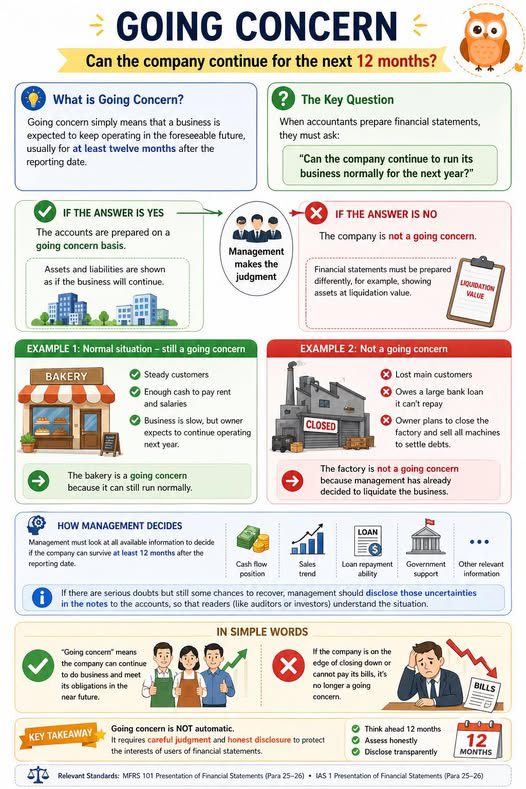
Going concern means that a business is expected to continue operating in the foreseeable future, usually for at least twelve months after the reporting date.
When preparing financial statements, management must consider a fundamental question:
Can the company continue operating normally for the next year?
If the answer is yes, the financial statements are prepared on a going concern basis. This means that assets and liabilities are measured and presented on the assumption that the business will continue operating in the ordinary course.
However, if management has decided to close the business, sell its assets or liquidate the company—or if there is no realistic way for the business to survive—the entity may no longer be a going concern. In such circumstances, the financial statements must be prepared on a different basis. For example, assets may need to be presented based on their expected liquidation values.
Example 1: A Business That Remains a Going Concern
A small bakery has stable customers and sufficient cash to pay its rent and employees. Although business is currently slow, the owner expects the bakery to continue operating next year.
The bakery remains a going concern because it is still able to operate normally and meet its obligations.
Example 2: A Business That Is No Longer a Going Concern
A furniture factory has lost its main customers and is unable to repay a significant bank loan.
The owner has decided to close the factory and sell its machinery to settle the debts.
The factory is no longer a going concern because management has decided to liquidate the business.
How Does Management Make the Assessment?
Management must consider all relevant information when assessing whether the company can continue operating for at least twelve months after the reporting date.
This may include:
- Cash flow forecasts;
- Sales trends;
- The ability to repay loans;
- Available financing;
- Future operating plans; and
- Government support, where relevant.
If the company is facing serious difficulties but there remains a realistic possibility of recovery, management should disclose the material uncertainties in the notes to the financial statements.
This allows users, including auditors, investors, lenders and other stakeholders, to understand the circumstances that may affect the company’s ability to continue operating.
Going concern means that a company is expected to remain in business and meet its obligations in the foreseeable future. If the company is close to closure, unable to pay its debts or has decided to cease operations, the going concern assumption may no longer be appropriate.
持续经营:评估企业能否继续营运
所谓持续经营(Going Concern),是指企业预计能够在可预见的未来继续经营,而不是即将结束营业或进行清算。
在编制财务报表时,管理层必须先考虑一个基本问题:
这家公司能否在未来一年继续正常运作?
如果答案是可以,财务报表就按照持续经营基础编制。这意味着资产与负债的计量及列报,是以企业将继续以正常方式经营为前提。
但是,如果管理层已经决定结束业务、出售资产或清算公司,或者企业已经没有现实可行的生存办法,该企业可能不再属于持续经营。
在这种情况下,财务报表必须采用不同的编制基础。例如,资产可能需要按照预期清算价值列报。
例子一:仍然属于持续经营
一家小型面包店拥有稳定的顾客,也有足够的现金支付租金及员工薪金。虽然目前生意比较缓慢,但老板预计明年仍会继续营业。
这家面包店仍然属于持续经营企业,因为它仍然能够正常经营并履行应付的责任。
例子二:不再属于持续经营
一家家具厂失去了主要客户,也无法偿还一笔大额银行贷款。
老板已经决定关闭工厂,并出售机器以偿还债务。
这家家具厂不再属于持续经营企业,因为管理层已经决定将企业清算。
管理层如何进行判断?
管理层必须考虑所有相关资料,以评估企业能否在报表日后至少十二个月内继续营运。
相关因素可能包括:
- 现金流预测;
- 销售趋势;
- 偿还贷款的能力;
- 可获得的融资;
- 未来经营计划;以及
- 在适用情况下,政府援助。
如果公司虽然面对严重困难,但仍然存在现实可行的复苏机会,管理层就应当在财务报表附注中披露重大不确定性。
这能够帮助审计师、投资者、贷款人及其他利益相关者了解可能影响企业持续经营能力的情况。
持续经营代表企业预计能够在可预见的未来继续经营并履行责任。如果企业濒临关闭、无法偿还债务,或已经决定停止营业,持续经营假设可能就不再适用。