Emrail is a railway engineering company established in 1973, with business activities covering railway engineering, construction and maintenance.
In discussing the political debate surrounding the term “sakau”, it is important to maintain a clear distinction. The RCI is not a criminal court, and an investment loss does not automatically establish that anyone committed corruption.
The RCI’s role was to identify issues relating to governance, investment and approval procedures, and to recommend forensic audits of 14 problematic investments, including Emrail.
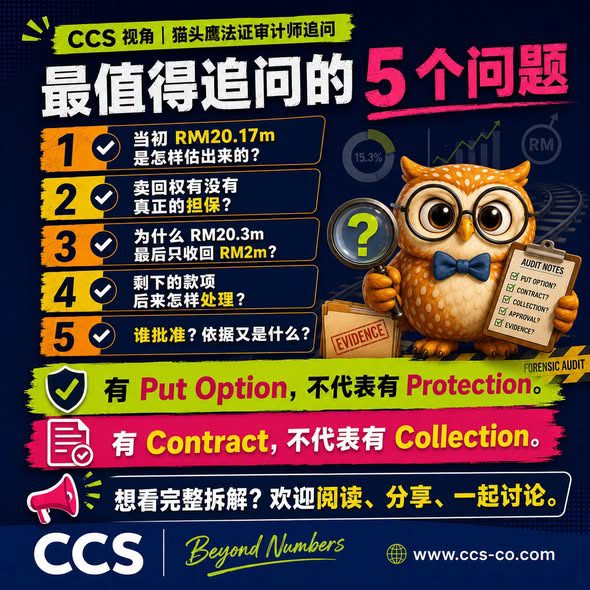
The relevant forensic audit questions are therefore:
- Why did the money leave in this manner?
- Why did the protection mechanisms fail?
- Who approved the investment?
- Who was responsible for the relevant decisions?
The RCI also observed that TH’s previous investment process involved multiple levels of approval but did not produce the expected investment quality. The Investment Panel was also considered to have relied excessively on management’s recommendations.
The Emrail Investment
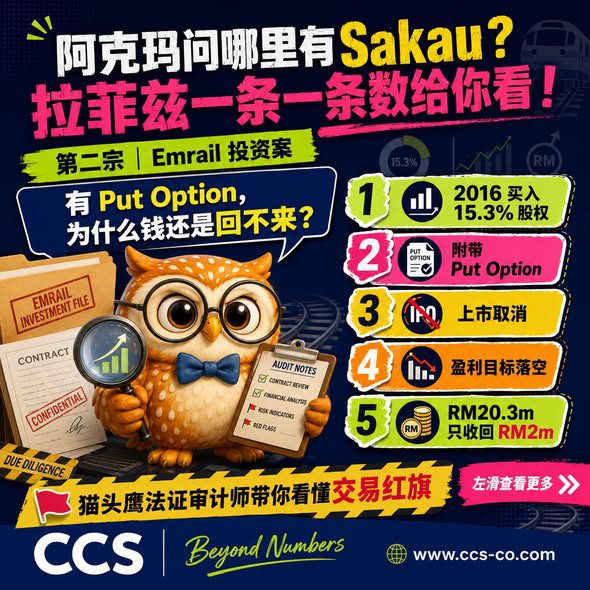
On 7 June 2016, TH acquired a 15.3% interest in Emrail from Lingkaran Hartaniaga Sdn Bhd (LHSB) for approximately RM20.17 million.
The investment was based mainly on two expectations:
- Emrail would proceed with a listing; and
- Emrail would achieve a profit target of approximately RM36.1 million for the financial year ending in 2016.
This type of investment structure is not unusual in private equity and pre-IPO transactions:
“The company is not listed yet, but invest now. If the IPO takes place, the shares may increase in value.”
However, TH did not ignore the downside risk entirely. The agreement included a Put Option, or sell-back right.
If the proposed listing did not take place, or if the specified profit condition was not met, TH could require the original seller to repurchase its Emrail shares.
According to publicly available information, the Put Option required LHSB to repurchase TH’s interest for approximately RM20.3 million.
When Emrail’s proposed listing was cancelled and the RM36.1 million profit target was not achieved, TH exercised the Put Option.
At first glance, this may appear to provide significant downside protection.
The important question, however, is whether the protection could actually be enforced in economic terms.
A Put Option Is Not an ATM
Many people see a contractual clause stating that:
“The seller shall repurchase the shares.”
and assume:
“There is a contract, so the money will definitely come back.”
That is one of the most common misunderstandings in commercial transactions.
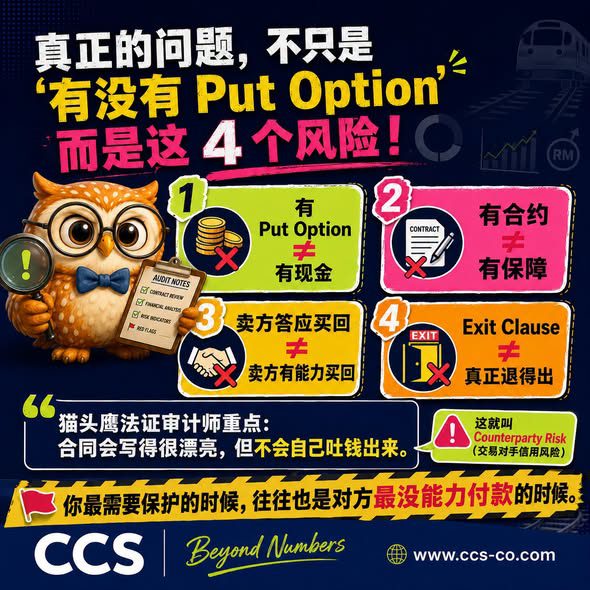
Contractual right does not equal cash.
A Put Option gives the holder a legal right to demand payment from another party. It does not mean that the money has already been received or that the counterparty has sufficient funds to make the payment.
Consider a simple example.
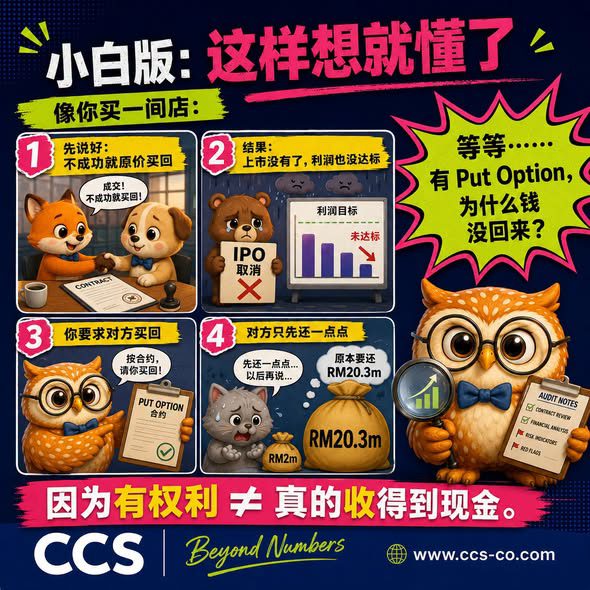
Suppose you pay RM200,000 for a 10% interest in a friend’s coffee shop. Your friend says that the business will be listed within two years. You ask what happens if the listing does not take place.
Your friend agrees to buy back the interest for RM200,000 if the listing fails.
Two years later, there is no listing. You exercise the Put Option and request your RM200,000.
Your friend replies:
“I do not have RM200,000 at the moment.”
The contract may prove that the money is owed. However, the contract does not produce the money by itself.
Who Supports the Put Option?
The more important question is not simply:
“Was there a Put Option?”
It is:
“Who stood behind the Put Option?”
A Put Option with genuine economic value requires more than well-drafted contractual wording. The investor should also assess:
- Whether the seller has sufficient financial resources;
- Whether there is a bank guarantee;
- Whether funds are held in an escrow account;
- Whether collateral has been provided;
- Whether the shares are pledged;
- Whether there is a parent company guarantee; and
- How quickly the obligation can be enforced in the event of default.
If the arrangement is merely:
“Mr A promises to pay RM20 million in the future,”
the economic value of that promise depends on whether Mr A will have RM20 million when the payment becomes due.
The value of a Put Option ultimately depends on counterparty creditworthiness.
This is counterparty risk.
Wrong-Way Risk
The Emrail case also illustrates a more advanced concept: wrong-way risk.
When is the Put Option most needed?
Usually when:
- The proposed listing has failed;
- The profit target has not been achieved; and
- The company’s performance is weaker than expected.
In other words, the worse the company performs, the more important the Put Option becomes.
However, when the company’s performance deteriorates, the financial position of the original shareholder or other economically connected counterparty may also deteriorate.
This creates a difficult situation:
- In good weather, the umbrella appears to work;
- When the heavy rain arrives, the umbrella may also begin to leak.
Wrong-way risk arises when the investor’s exposure increases at the same time as the ability of the party providing protection decreases.
This is one reason why Emrail is more valuable as a business-school case study than a simple statement that an RM20 million investment was unsuccessful.
What Happened in Practice?
Reports following the publication of the RCI indicated that LHSB was required under the Put Option to acquire TH’s Emrail shares for approximately RM20.3 million.
However, public reports stated that LHSB paid only RM2 million, with the balance remaining unresolved. TH subsequently recognised an impairment provision of RM19.3 million on 31 December 2020 in relation to the remaining Put Option amount.
The dispute proceeded to arbitration.
The intended investment sequence was:
Invest approximately RM20 million
↓
Emrail is listed
↓
The shares increase in value
↓
TH exits successfully
The backup plan was:
No listing
↓
Exercise the Put Option
↓
Sell the shares back
↓
Recover approximately RM20 million
The actual sequence was closer to:
No listing
↓
Profit target not achieved
↓
Put Option exercised
↓
Counterparty does not pay in full
↓
TH continues pursuing the balance
↓
RM19.3 million impairment recognised
The irony is clear:
An exit plan existed, but the exit was not successfully completed.
A Contract Is Not the Same as Effective Protection
It may be rhetorically powerful to say:
“A signed contract is the same as having no contract.”
However, that is not technically precise.
The contract was not necessarily ineffective. It provided an enforceable right, and TH had a basis to pursue arbitration.
The more accurate distinction is:
Having an enforceable right does not guarantee the timely recovery of cash.
The real question is not simply whether contractual protection exists, but whether the protection provides genuine risk mitigation.
A useful analogy is a seat belt. The seat belt may be fastened properly. The question is whether it can withstand the impact when an accident actually occurs.
Three Figures Requiring Reconciliation
Three figures appearing in public reports require particular attention:
- Put Option amount: approximately RM20.3 million;
- Amount paid: RM2 million; and
- Impairment recognised in 2020 in relation to the remaining Put Option amount: RM19.3 million.
A simple calculation would suggest:
RM20.3 million − RM2 million = RM18.3 million
It would therefore be inappropriate to assume automatically that the RM19.3 million impairment represents only this simple balance.
The difference may involve:
- Timing differences in payment;
- Interest;
- Other receivable amounts;
- The Put Option settlement structure;
- Costs;
- Different reporting dates; or
- Simplification in media reports.
A forensic audit should therefore reconcile the figures using the original:
- Share Sale and Purchase Agreement;
- Put Option Agreement;
- Bank statements;
- General ledger; and
- Settlement schedules.
When three figures do not agree, the appropriate response is not “approximately”.
It is:
“Please provide the schedule.”
The Shares Were Still Held Years Later
According to information from the Companies Commission of Malaysia cited by The Edge, as at its 2025 report, TH still held approximately 15.28% of Emrail, while LHSB still held approximately 6.3%.
This is significant.
If the original exit mechanism had been completed successfully:
TH would have sold the shares, received payment and exited.
The fact that the shares remained held years later illustrates a basic principle:
A Put Option is not an exit. It is only a right to seek an exit.
Whether the investor can actually exit is a separate question.
Emrail’s Subsequent Performance
According to company information cited by The Edge:
- Emrail recorded a net loss of approximately RM57.15 million in 2018;
- A net loss of approximately RM25.99 million in 2019;
- A profit of approximately RM2.36 million in 2020; and
- Net profit declined again to approximately RM869,120 in 2021.
However, subsequent losses do not automatically establish that the 2016 investment decision was unreasonable. That would be hindsight bias.
To assess whether the investment decision was appropriate at the time, the relevant contemporaneous documents would need to be reviewed, including:
- Audited financial statements available in 2016;
- Order book;
- Cash-flow forecasts;
- IPO plans;
- Listing adviser information;
- Valuation reports;
- Profit forecasts;
- Due diligence;
- Risk assessments; and
- LHSB’s financial capacity at the time.
These original investment documents are what a forensic audit should examine.
Questions the Investment Panel Should Have Asked
The Investment Panel should not have asked only:
“Is there a Put Option?”
It should also have asked:
- How was the RM20.17 million investment price determined?
- What overall valuation of Emrail did the 15.3% interest imply?
- What was the basis for the RM36.1 million profit forecast?
- Was it supported by signed contracts and an order book, or only by management forecasts?
- How far had the IPO progressed?
- Had an investment bank been appointed?
- Had due diligence begun?
- Was “Target IPO” merely a statement in a presentation?
- If the IPO failed, could LHSB actually produce RM20.3 million to repurchase the shares?
- Had a credit assessment been performed?
- Was security available?
- What rapid enforcement mechanism would TH have if the seller failed to pay?
A proper worst-case analysis does not ask only:
“Could the investment fail?”
It asks:
“If it fails, what can we actually recover?”
Similar Investment Structures
During a special parliamentary debate on 11 August 2026, the Second Finance Minister, Amir Hamzah, reportedly highlighted similarities among the investment structures involving Emrail, Wellspring Worldwide and Putrajaya Perdana.
The similarities included:
- Investing in unlisted companies;
- Relying on a future listing;
- Setting profit targets; and
- Including Put Options as protection.
However, all three companies reportedly failed to list according to plan, and the relevant counterparties did not make the required payments when TH exercised the Put Options.
One similar case may be bad luck.
Two cases require closer attention.
Three cases with similar structures suggest that the sample size for audit review may need to be expanded.
This also helps explain why the RCI did not simply conclude that investment performance was poor. It recommended forensic audits of 14 problematic investments and identified serious weaknesses in the investment decision-making and governance process.
Final Observations
The lesson from Emrail is not that companies should never invest in private businesses.
Private equity investments can generate significant returns, and pre-IPO investments can be worthwhile. A Put Option is not inherently problematic.
The issue is that:
A Put Option written into a contract does not mean that investment risk has disappeared.
Consider lending RM20 million to a friend who provides an IOU.
You may think:
“The risk is mitigated.”
But an auditor would ask:
- How much money is in the borrower’s bank account?
- Is there collateral?
- Is there a bank guarantee?
- Can the obligation actually be enforced?
If none of these questions has been answered, the risk may not have been mitigated at all.
The Emrail investment can therefore be summarised as follows:
- TH acquired a 15.3% equity interest in Emrail;
- It treated the Put Option as a form of safety net;
- When the IPO and profit conditions failed, the Put Option was exercised;
- The counterparty did not fully perform its payment obligation; and
- The issue became not only how much Emrail was worth, but why the exit protection had been considered sufficiently reliable.
As for the question of whether anyone had misappropriated funds, it would be inappropriate to move directly from the RM19.3 million impairment to a conclusion of corruption.
That would require an evidence chain involving matters such as:
- The flow of funds;
- Beneficial ownership;
- Related-party relationships;
- Approval documents;
- Unusual payments; and
- The findings of enforcement investigations.
The RCI provides significant red flags requiring further examination. It does not replace a criminal court’s finding of guilt.
The Government has indicated publicly that investigations would continue, with decisions on prosecution to be made by the relevant enforcement and prosecuting authorities based on the evidence.
From an audit and governance perspective, however, the key lessons are clear:
A Put Option does not automatically provide protection.
A contract does not automatically result in collection.
An exit clause does not guarantee a successful exit.
In plain language:
The greatest danger of a Put Option is not that it was omitted from the contract. It is that it was drafted beautifully, but when payment was due, the counterparty said: “Boss, please wait.”
If several investments produce the same response, the issue is no longer whether the auditor should be concerned.
It is time to open the forensic audit file.
CCS | Beyond Numbers
Emrail:Put Option、交易对手风险与合同保护的局限
Emrail 是一家成立于 1973 年的铁路工程公司,业务涵盖铁路工程、建设及维修。
在讨论“sakau”这一政治争议时,必须先保持清楚的界线。RCI 不是刑事法庭,也不会因为某一项投资亏损,就自动裁定某人涉及贪污。
RCI 真正做的是指出投资治理、投资审批及决策程序上的问题,并建议对包括 Emrail 在内的 14 项问题投资进行法证审计。
因此,法证审计师真正要问的是:
- 钱为什么会这样出去?
- 保护机制为什么失效?
- 谁批准了这项投资?
- 谁应该为相关决定负责?
RCI 也指出,TH 过去的投资程序虽然设有多个审批层级,却没有产生应有的投资质量,而 Investment Panel 过度依赖管理层的建议。
Emrail 投资经过
2016 年 6 月 7 日,TH 以约 RM20.17 million 向 Lingkaran Hartaniaga Sdn Bhd(LHSB)购买 Emrail 15.3% 的股权。
这项投资主要建立在两个期待之上:
- Emrail 将会上市;以及
- Emrail 在截至 2016 年的财政年度达到约 RM36.1 million 的利润目标。
这种投资结构在 Private Equity 和 Pre-IPO Investment 中并不罕见:
“公司现在还没有上市,但你可以先投资。如果未来 IPO 成功,手上的股份可能升值。”
不过,TH 也不是完全没有考虑风险。
合同里加入了一个 Put Option(卖回权)。
如果预定的上市没有发生,或者指定的盈利条件没有达到,TH 可以要求原本的卖方买回 TH 持有的 Emrail 股份。
根据公开资料,这项 Put Option 要求 LHSB 以约 RM20.3 million 买回 TH 的股份。
后来,Emrail 的上市计划取消,RM36.1 million 的盈利目标也没有达到,于是 TH 启动了这项卖回权。
看到这里,很多人可能会说:
“很好啊!有 Put Option,就不怕亏了。”
但真正的问题是:
这项保护在经济上到底能不能实现?
Put Option 不是提款机
很多人看到合同写着:
“Seller shall repurchase the shares.”
就会以为:
“有合同,所以钱一定会回来。”
这是商业交易中最常见的误解之一。
Contractual Right 不等于 Cash。
Put Option 给你的,是向另一方要求付款的法律权利,并不代表你已经收到钱,也不代表对方在付款到期时一定有足够的资金。
举一个简单例子。
假设你用 RM200,000 买下朋友咖啡店的 10%。朋友很有信心地说,两年内一定上市。
你比较谨慎,于是问:
“如果没有上市怎么办?”
朋友答应:
“如果没有上市,我用 RM200,000 买回你的股份。”
两年后,咖啡店没有上市。你行使 Put Option,要求拿回 RM200,000。
朋友却回答:
“Err……我现在没有 RM200,000。”
合同可以证明他欠你钱,但合同不会自己吐钱出来。
谁在为 Put Option 提供支持?
所以,最重要的问题并不是:
“有没有 Put Option?”
而是:
“谁在这个 Put Option 后面提供支持?”
一项真正具有经济价值的 Put Option,除了漂亮的合同文字,还应该评估:
- 卖方是否拥有足够的财务资源;
- 有没有 Bank Guarantee;
- 有没有 Escrow Account;
- 有没有抵押资产;
- 有没有 Share Pledge;
- 有没有 Parent Company Guarantee;以及
- 如果发生违约,相关义务可以多快被执行。
如果安排只是:
“A 先生答应以后给你 RM20 million。”
那么这个承诺的经济价值,最终取决于 A 先生在付款到期时有没有 RM20 million。
Put Option 的价值最终取决于:
Counterparty Creditworthiness(交易对手的信用及履约能力)。
这就是:
Counterparty Risk|交易对手信用风险。
Wrong-Way Risk:保护人也一起变弱
Emrail 也带出一个更深入、但非常容易理解的概念:
Wrong-Way Risk
什么时候最需要 Put Option?
通常就是:
- Emrail 没有上市;
- 利润没有达到目标;以及
- 公司表现不如预期。
换句话说,公司表现越差,投资人越需要卖方买回股份。
但偏偏在公司表现恶化时,原股东或其他与公司具有经济联系的交易对手,其财务状况也可能一起变差。
于是就会出现一个尴尬情况:
- 天气好的时候,雨伞看起来很好用;
- 真正下大雨时,雨伞却也开始漏水。
这就是 Wrong-Way Risk:
当你的风险越来越大时,提供保护的那一方却同时越来越没有能力保护你。
这也是 Emrail 比单纯一句“RM20 million 投资亏了”更值得商学院研究的地方。
现实后来怎样?
RCI 公开后的相关报道指出,LHSB 根据 Put Option 应该以约 RM20.3 million 买回 TH 持有的全部 Emrail 股份。
不过,公开报道显示,LHSB 只支付了 RM2 million,其余款项仍未解决。TH 最后于 2020 年 12 月 31 日,就剩余 Put Option 相关金额确认了 RM19.3 million 的减值准备。
相关争议后来进入仲裁程序。
原本的投资剧本是:
投资约 RM20 million
↓
公司上市
↓
股份升值
↓
TH 成功退出
Backup Plan 则是:
没有上市
↓
启动 Put Option
↓
卖回股份
↓
收回约 RM20 million
但实际情况更接近:
没有上市
↓
利润目标也没有达到
↓
启动 Put Option
↓
对方没有全额付款
↓
TH 继续追讨余额
↓
确认 RM19.3 million 减值
这宗投资最讽刺的地方就在于:
Exit Plan 有,但 Exit 并没有成功。
“合同签了等于没签”需要修正
“合同签了等于没签”作为 Facebook 标题很有力量。
但从会计和审计角度,我不会这样下结论。
更准确的说法是:
合同可能赋予企业一项可执行的权利,但不等于企业能够及时收回现金。
合同并不一定没有效力。TH 正是因为拥有相关权利,才有基础继续追讨并进入仲裁程序。
所以,真正的问题不是:
“有没有 Contract?”
而是:
“Contractual Protection 有没有真正发挥 Risk Mitigation 的作用?”
这两件事完全不同。
猫头鹰可以这样翻译:
安全带已经扣上了。
但车祸发生时,安全带到底承受得住吗?
三个数字需要进行 Reconciliation
公开报道中同时出现了三组数字:
- Put Option:约 RM20.3 million;
- 已支付:RM2 million;以及
- 2020 年就剩余 Put Option 相关金额确认的减值:RM19.3 million。
简单计算的话:
RM20.3 million − RM2 million = RM18.3 million
于是有人可能会问:
“为什么 Impairment 是 RM19.3 million?”
这是一个合理的问题。
但不能根据公开报道自行补上答案,因为目前无法确定当中是否涉及:
- 付款时间差;
- 利息;
- 其他应收金额;
- Put Option 的结算结构;
- 费用;
- 不同报告日期;或
- 媒体对某个金额进行了简化。
这正是 Forensic Audit 应该核对原始文件的地方,包括:
- Share Sale and Purchase Agreement;
- Put Option Agreement;
- Bank Statements;
- General Ledger;以及
- Settlement Schedule。
真正的审计师看到三个数字对不上,不会说:
“大概啦。”
而是会说:
“Schedule 拿来。”
多年以后,股份仍然存在
根据 The Edge 引用的马来西亚公司委员会资料,截至其 2025 年报道时,TH 仍然持有 Emrail 约 15.28%,而 LHSB 仍持有约 6.3%。
这点非常值得注意。
如果原本的 Exit Mechanism 已经顺利执行:
TH 应该卖回股份 → 收到款项 → 完成退出。
但多年以后,股份仍然存在。
这直观地说明:
Put Option 不是 Exit。Put Option 只是“寻求 Exit 的权利”。
能不能真正 Exit,是另外一回事。
Emrail 后来的业绩
根据 The Edge 引用的公司资料,Emrail:
- 2018 年净亏约 RM57.15 million;
- 2019 年净亏约 RM25.99 million;
- 2020 年转亏为盈,赚约 RM2.36 million;以及
- 2021 年净利再次下降至约 RM869,120。
不过,后来出现亏损,并不代表 2016 年的投资决定当时一定不合理。
否则就会落入 Hindsight Bias(事后偏见)。
要判断 TH 在 2016 年是否应该投资,必须查看当时可以取得的原始资料,包括:
- 当时的 Audited Financial Statements;
- Order Book;
- Cash-flow Forecast;
- IPO Plan;
- Listing Adviser 资料;
- Valuation Report;
- Profit Forecast;
- Due Diligence;
- Risk Assessment;以及
- LHSB 当时的 Financial Capacity。
这些原始投资文件,才是 Forensic Audit 真正应该审查的内容。
Investment Panel 当年应该问什么?
Investment Panel 不应该只问:
“有没有 Put Option?”
还应该连续追问:
- RM20.17 million 的投资价格是怎样估出来的?
- 15.3% 股权隐含 Emrail 整体估值多少?
- 估值的依据是什么?
- RM36.1 million 的利润预测是怎样计算的?
- 有已经签署的 Contract 或 Order Book 支持吗?
- 还是只是 Management Forecast?
- 所谓 IPO 到底进行到什么阶段?
- 有没有聘请 Investment Bank?
- 有没有开始 Due Diligence?
- 还是 PowerPoint 上只写着 “Target IPO”?
- 如果 IPO 失败,LHSB 真的有 RM20.3 million 买回股份吗?
- 有没有做 Credit Assessment?
- 有没有 Security?
- 如果卖方不付款,TH 有没有快速执行机制?
真正的最坏情况分析,不只是问:
“会不会失败?”
而是:
“如果真的失败,我拿什么回来?”
与其他 TH 投资的相似结构
在 2026 年 8 月 11 日的国会特别辩论中,财政部第二部长 Amir Hamzah 据报道指出,Emrail、Wellspring Worldwide 和 Putrajaya Perdana 的投资结构存在相似之处:
- 投资未上市公司;
- 押注未来上市;
- 设定 Profit Target;以及
- 加入 Put Option 作为保护。
但最后,三家公司都没有按照计划上市,而 TH 执行 Put Option 时,相关交易对手也没有按要求付款。
一宗类似案例,可能只是运气不好。
两宗,就值得进一步关注。
三宗都出现类似结构时,审计抽样的范围就可能需要扩大。
这也说明了为什么 RCI 不只是说:
“Investment Performance 不好。”
RCI 还建议对 14 项问题投资进行 Forensic Audit,并指出当时投资决策及治理程序存在严重弱点。
猫头鹰审计师的最终看法
Emrail 真正的 Lesson,不是“不要投资 Private Company”。
Private Equity 可以产生很高的回报,Pre-IPO Investment 也完全可以是优质投资。Put Option 本身也不是坏东西。
真正的问题是:
你不能把“Put Option 写在合同里面”,当成“Investment Risk 已经消失”。
想象一下:
你借 RM20 million 给朋友。
朋友说:
“放心,我写一张 IOU 给你。”
你很开心:
“很好,Risk Mitigated!”
但审计师走过来问:
- 他的银行户口有多少钱?
- 有抵押吗?
- 有 Bank Guarantee 吗?
- 相关义务真的可以执行吗?
如果这些问题一个都没有问,所谓 Risk Mitigation 可能根本没有真正减少风险。
所以,Emrail 可以这样总结:
- TH 买的是 Emrail 15.3% 的公司股权;
- TH 以为 Put Option 是一道安全网;
- 当 IPO 和利润条件失效、真正需要这道安全网时,对手方却没有完整履行付款义务;以及
- 问题最终不只是“Emrail 值多少钱”,而是“当初为什么认为这项 Exit Protection 足够可靠”。
至于“哪里有 sakau”这个问题,不能从 RM19.3 million 的减值直接跳到“某某人贪污”的结论。
这需要一条完整的证据链,包括:
- 资金流向;
- 利益归属;
- 关联关系;
- 审批文件;
- 异常付款;以及
- 执法调查结果。
RCI 提供的是大量值得进一步核实的 Red Flags,而不是代替刑事法庭作出定罪判决。
政府已经公开表示,相关调查会继续,而最终是否提控,应由执法及检控机关根据证据决定。
但从 Audit & Governance 角度来看,问题已经非常清楚:
有 Put Option,不代表有 Protection。
有 Contract,不代表有 Collection。
有 Exit Clause,不代表真的 Exit 得到。
最后送给初学者一句话:
Put Option 最怕的,不是没有写进合同,而是写得很漂亮,到了要收钱的时候,对方却说:“Boss,等一下。”
如果连续几项投资都听到同一句“等一下”,那就不再只是猫头鹰要不要皱眉的问题。
是时候把 Forensic Audit File 打开了。
CCS | Beyond Numbers