Many business owners see EBITDA and immediately think:
“What is this? Another thing accountants invented to make life difficult?”
In reality, the concept is not particularly complicated.
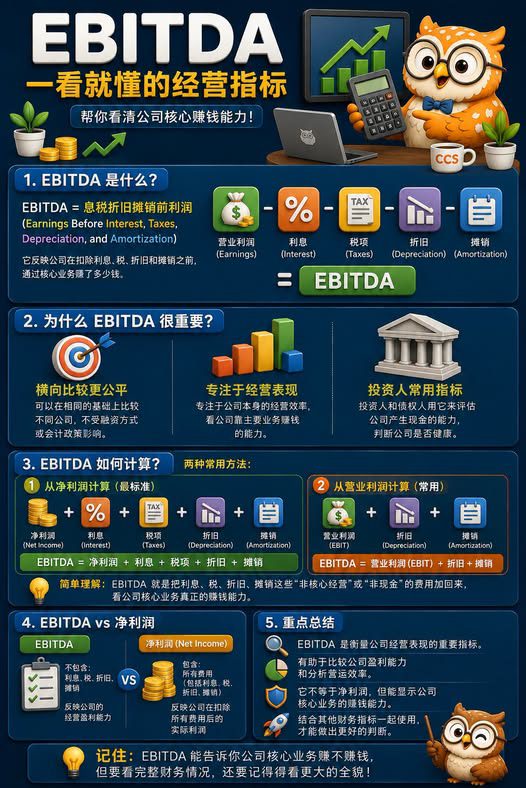
EBITDA stands for Earnings Before Interest, Tax, Depreciation and Amortisation. It sets aside interest, tax, depreciation and amortisation to assess whether the company’s core business is generating operating earnings.
A Simple Explanation
EBITDA ≈ Operating Profit + Depreciation + Amortisation
It may also be presented as:
EBITDA ≈ Net Profit + Interest + Tax + Depreciation + Amortisation
Why Do People Look at EBITDA?
Different companies may have different:
- Borrowing levels;
- Tax positions; and
- Assets and depreciation policies.
By temporarily excluding these factors, EBITDA may make it easier to compare the operating performance of different businesses.
However, EBITDA must be interpreted carefully.
High EBITDA does not necessarily mean high net profit.
High EBITDA does not necessarily mean that the company has substantial cash.
High EBITDA does not automatically mean that the company is financially healthy.
Depreciation may not involve a cash payment today, but machinery will eventually need to be repaired or replaced.
Interest may be excluded from EBITDA, but the bank has not forgotten that the company owes it money.
EBITDA, Net Profit and Cash Flow
A useful way to think about the three measures is:
- EBITDA is like assessing a person’s ability to earn an income;
- Net profit is like looking at how much remains at the end of the month after all expenses; and
- Cash flow is like asking whether the person actually has enough money to buy you a cup of tea tonight.
EBITDA is like checking whether the engine of the business is powerful.
Net profit is the final accounting result after all relevant expenses have been taken into account.
Cash flow shows the movement of actual cash in and out of the business.
All three are useful, but none should be considered in isolation.
So, the next time someone mentions EBITDA, you can think of it as:
“That is the measure of how strong my core business is, right?”
EBITDA is useful, but one should not fall in love with a company based on a single number.
CCS | Beyond Numbers
EBITDA:它能告诉你什么,又不能告诉你什么?
很多老板看到 EBITDA,第一反应可能是:
“这个又是什么?会计师发明出来折磨人的东西吗?”
其实,EBITDA 的概念没有那么复杂。
EBITDA 是 Earnings Before Interest, Tax, Depreciation and Amortisation 的缩写,中文通常称为息税折旧摊销前利润。
简单来说,EBITDA 会先把利息、税项、折旧和摊销放在一边,看看公司的核心业务本身到底能不能产生经营盈利。
简单理解
EBITDA ≈ 营业利润 + 折旧 + 摊销
也可以表示为:
EBITDA ≈ 净利润 + 利息 + 税项 + 折旧 + 摊销
为什么大家喜欢看 EBITDA?
不同公司的情况可能不同,包括:
- 借款金额不同;
- 税务情况不同;以及
- 资产及折旧政策不同。
暂时把这些因素排除后,有时会更容易比较不同公司的核心经营表现。
但是,EBITDA 必须谨慎解读。
EBITDA 高,不等于净利润高。
EBITDA 高,不等于公司现金很多。
EBITDA 高,也不等于公司一定很健康。
折旧虽然不一定代表今天有现金流出,但机器最终还是需要维修或更换。
利息虽然被 EBITDA 排除在外,但银行并没有忘记公司欠它的钱。
EBITDA、净利润与现金流
可以这样理解这三个数字:
- EBITDA 像看一个人的工作能力和赚钱能力;
- 净利润 像看他月底扣除所有费用后还剩多少钱;以及
- 现金流 则像问他今晚到底有没有足够的钱请你喝茶。
EBITDA 像是在检查公司的经营引擎有没有动力。
净利润是公司在扣除所有相关费用后得到的最终会计结果。
现金流则反映公司实际现金的流入和流出情况。
这三个指标都很有用,但不能只看其中一个。
下次有人提到 EBITDA 时,你可以笑着回答:
“哦,那个啊……就是看我的核心业务强不强,对吗?”
EBITDA 很有用,但不要只因为看到一个数字漂亮,就爱上一家公司。
CCS | Beyond Numbers