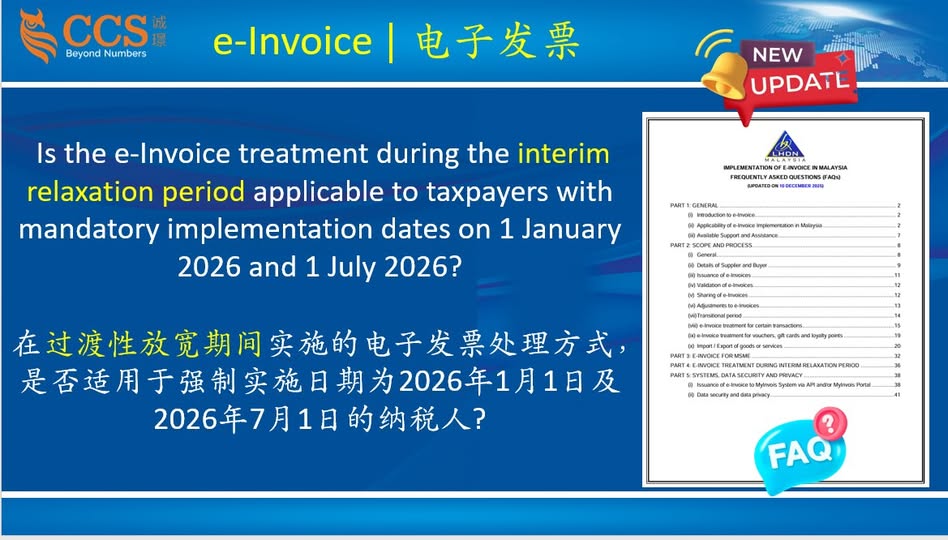
Malaysia’s e-Invoice interim relaxation period gives taxpayers time to adapt to the system. Under the current e-Invoice Specific Guideline (Version 4.9) and HASiL General FAQ, the periods vary by implementation phase. The periods for Phases 1 to 3 have ended. Taxpayers with annual turnover or revenue of up to RM5 million whose implementation date is 1 January 2026 or 1 July 2026 have an interim relaxation period until 31 December 2027.
The RM5 million phase category does not mean every business in that range is required to implement e-Invoicing. Eligible taxpayers with turnover or revenue below RM3 million may be exempt, subject to the applicable exemption criteria.
Interim relaxation periods
| Taxpayer category | Interim relaxation period |
|---|---|
| Annual turnover or revenue exceeding RM100 million | 1 August 2024 to 31 January 2025 |
| More than RM25 million and up to RM100 million | 1 January 2025 to 30 June 2025 |
| More than RM5 million and up to RM25 million | 1 July 2025 to 31 December 2025 |
| Up to RM5 million; implementation date of 1 January 2026 or 1 July 2026 | Until 31 December 2027 |
What taxpayers may do during the relaxation period
During the applicable interim relaxation period, taxpayers may issue consolidated e-Invoices for transactions, including activities otherwise listed as ineligible for consolidation under Section 3.7 of the Specific Guideline. They may also issue consolidated self-billed e-Invoices for the self-billing circumstances set out in Section 8.3.
Taxpayers using this treatment must issue and submit consolidated e-Invoices or consolidated self-billed e-Invoices monthly, in accordance with the applicable timing requirements. During the relaxation period, any appropriate description may be entered in the product or service description field; receipt, statement or bill reference numbers are not required for this purpose.
Taxpayers may decline a buyer’s request for an individual e-Invoice, or a supplier’s request for an individual self-billed e-Invoice, if they comply with the applicable consolidated e-Invoice requirements. If their systems are ready, they may instead issue individual e-Invoices or self-billed e-Invoices in accordance with the ordinary rules.
IRBM will not take prosecution action under Section 120 of the Income Tax Act 1967 for non-compliance during the relaxation period, provided taxpayers comply with the applicable requirements for consolidated e-Invoices or consolidated self-billed e-Invoices.
Examples
Retailer during Phase 3: Kedai Runcit Sinar Sdn Bhd, with annual revenue of RM15 million, entered its relaxation period from 1 July to 31 December 2025. For 5,000 sales transactions in July, it could issue one consolidated e-Invoice by 7 August 2025. The relaxation period for this phase has ended. From 1 January 2026, the company must follow the ordinary e-Invoice requirements, including issuing an individual e-Invoice when required.
Manufacturer with a 1 January 2026 implementation date: Kilang Perabot Jati Sdn Bhd has annual revenue of RM3.5 million. In January 2026, it recorded 10 sales to Company A totalling RM150,000, 15 sales to Company B totalling RM225,000, 20 sales to Company C totalling RM180,000 and 100 retail cash sales totalling RM50,000. If the company is required to implement e-Invoicing and uses the interim relaxation treatment, it may issue one consolidated e-Invoice for the 145 transactions by 7 February 2026. The description may state “Sales for January 2026”. The interim relaxation for taxpayers with a 1 January 2026 implementation date continues until 31 December 2027.
Importer during Phase 1: Global Trading Sdn Bhd, a Phase 1 taxpayer, obtained customs clearance for 30 imported shipments in August 2024. During the relaxation period, it could issue a consolidated self-billed e-Invoice by 7 November 2024, or issue individual self-billed e-Invoices by 31 October 2024.
Professional services firm: Perunding Hartanah Berjaya recorded annual revenue of RM2.8 million and provided 45 property valuation reports, 30 consultations and five training workshops in January 2026. Whether it is required to implement e-Invoicing depends on its eligibility for the exemption below RM3 million. If it is required to implement and is within the applicable interim relaxation period, it may use consolidated e-Invoicing for the relevant transactions rather than individual e-Invoices, subject to the monthly issuance requirements.
The interim relaxation is optional. It provides specific temporary flexibilities; it does not remove the need to determine whether a business is required to implement e-Invoicing, or the requirements that apply after its relaxation period ends.
电子发票临时宽松期:现行日期与主要规定
马来西亚的电子发票临时宽松期旨在让纳税人逐步适应电子发票系统。根据现行《电子发票专门指南》(4.9版)及 HASiL《一般常见问题解答》,各阶段的宽松期并不相同。第一至第三阶段的宽松期已经结束。年营业额或收入不超过 RM5 million、实施日期为2026年1月1日或2026年7月1日的纳税人,临时宽松期延长至2027年12月31日。
纳入不超过 RM5 million 的阶段,并不代表该范围内的所有企业都必须实施电子发票。年营业额或收入低于 RM3 million 的合资格纳税人,若符合适用的豁免条件,可能可获豁免。
临时宽松期一览
| 纳税人类别 | 临时宽松期 |
|---|---|
| 年营业额或收入超过 RM100 million | 2024年8月1日至2025年1月31日 |
| 超过 RM25 million、但不超过 RM100 million | 2025年1月1日至2025年6月30日 |
| 超过 RM5 million、但不超过 RM25 million | 2025年7月1日至2025年12月31日 |
| 不超过 RM5 million;实施日期为2026年1月1日或2026年7月1日 | 截至2027年12月31日 |
宽松期内纳税人可采用的处理方式
在适用的临时宽松期内,纳税人可为相关交易开具合并电子发票,包括专门指南第3.7节所列通常不得合并的活动。纳税人也可就第8.3节所列的自开情形开具合并自开电子发票。
采用此处理方式的纳税人,仍须根据适用时限,每月开具并提交合并电子发票或合并自开电子发票。在宽松期内,纳税人可在产品或服务说明栏填写适当描述,无须为此填写收据、结单或账单参考编号。
只要纳税人遵守适用的合并电子发票规定,即使买方要求个别电子发票,或供应商要求个别自开电子发票,纳税人仍可不予开具。若系统已准备就绪,纳税人也可以选择按照一般规定开具个别电子发票或自开电子发票。
若纳税人在宽松期内遵守适用的合并电子发票或合并自开电子发票要求,IRBM 不会就该期间的不合规情况根据《1967年所得税法令》第120条采取提控行动。
例子
第三阶段的零售商:Kedai Runcit Sinar Sdn Bhd 年收入为 RM15 million,其宽松期为2025年7月1日至12月31日。对于2025年7月的5,000笔销售交易,公司可在2025年8月7日前开具一张合并电子发票。该阶段的宽松期现已结束。从2026年1月1日起,公司须遵守一般电子发票规定,包括在规定情况下开具个别电子发票。
实施日期为2026年1月1日的制造商:Kilang Perabot Jati Sdn Bhd 年收入为 RM3.5 million。2026年1月,公司向 A 公司销售10笔,总额 RM150,000;向 B 公司销售15笔,总额 RM225,000;向 C 公司销售20笔,总额 RM180,000;另有100笔零售现金销售,总额 RM50,000。若公司须实施电子发票并采用临时宽松安排,可在2026年2月7日前为这145笔交易开具一张合并电子发票。说明栏可填写“2026年1月销售”。实施日期为2026年1月1日的纳税人,其临时宽松期延续至2027年12月31日。
第一阶段的进口商:Global Trading Sdn Bhd 属于第一阶段纳税人,并于2024年8月取得30批进口货物的海关清关文件。在宽松期内,公司可于2024年11月7日前开具一张合并自开电子发票,或于2024年10月31日前开具个别自开电子发票。
专业服务公司:Perunding Hartanah Berjaya 年收入为 RM2.8 million,并于2026年1月提供45份物业估值报告、30项咨询服务及五场培训研讨会。公司是否须实施电子发票,取决于其是否符合 RM3 million 以下的豁免条件。若公司须实施电子发票,且适用临时宽松期,则可针对相关交易采用合并电子发票,而非逐笔开具个别发票,但仍须遵守每月开具的规定。
临时宽松安排并非强制采用。它提供特定的临时弹性,但不会取代企业确认自身是否须实施电子发票的责任,也不会免除宽松期结束后适用的规定。