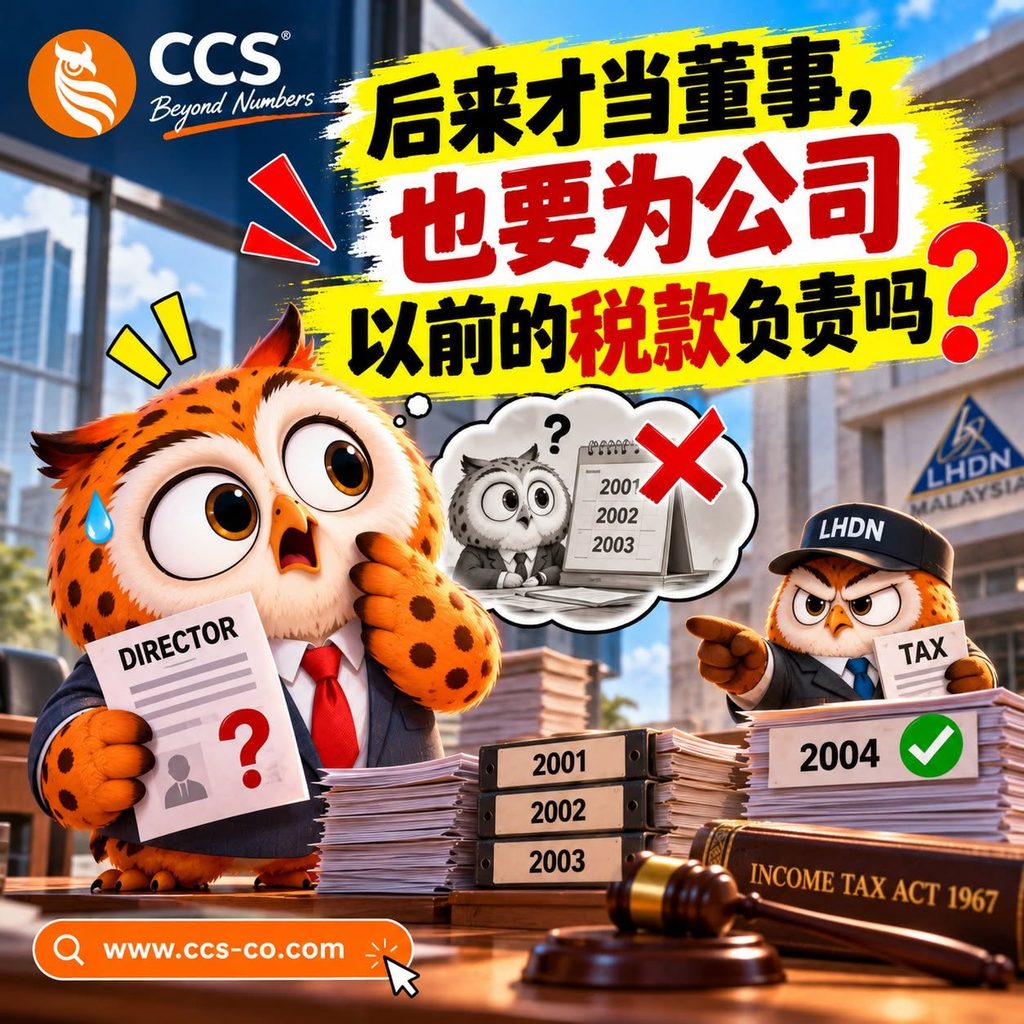
Government of Malaysia v Mahawira Sdn Bhd & Anor [2021] 4 MLRA 194 is a case worth studying for anyone preparing to become a director, considering the purchase of a company or assuming that a company’s historical tax liabilities have nothing to do with a newly appointed director.
The amount involved was not RM3,000 or RM30,000. It was RM3,003,910.69.
The Government sought to recover the company’s income tax for YA 2001, YA 2002, YA 2003 and YA 2004, including the additional tax imposed under Section 103 of the Income Tax Act 1967 (ITA).
The important question was: when did the director concerned, Teh Li Li, join the company?
She became a director only on 19 December 2003 and held 20% of the company’s shares.
This raised a significant question:
If I only became a director at the end of 2003, can I also be held responsible for the company’s tax for 2001?
Company Tax Exceeding RM3 Million
The first defendant was Mahawira Sdn Bhd.
The second defendant was its director and 20% shareholder, Teh Li Li.
The assessments involved:
- YA 2001;
- YA 2002;
- YA 2003; and
- YA 2004.
The total amount was RM3,003,910.69.
The relevant Notices of Assessment were issued only on 31 October 2014. In other words, tax relating to 2001 was being pursued in 2014, more than a decade later.
The Notices were served on the company, but neither the company nor the second defendant responded.
The Government subsequently commenced proceedings in the High Court to recover the tax.
The Company Did Not Contest the Claim, but the Director Did
The company did not contest the proceedings. As a result, the Government obtained a Judgment in Default against the company.
The position of the second defendant was different. She argued:
“These taxes relate largely to periods before I joined the company.”
The High Court considered the relevant dates. As she only became a director on 19 December 2003, the High Court ultimately held her liable only for:
- YA 2004: RM1,116,110.96.
She was not held liable for:
- YA 2001 to YA 2003: RM1,887,799.73.
The Government was dissatisfied with the decision and appealed to the Court of Appeal.
Section 75A of the Income Tax Act
The central provision in the case was Section 75A of the ITA.
The basic concept under Section 75A is important. Where the statutory conditions are satisfied, a director may be jointly and severally liable with the company for tax that is due and payable by the company.
In simple terms:
A company’s unpaid tax is not necessarily only a company problem.
A director who falls within the scope of Section 75A may also be pursued personally.
The provision concerns a director who holds office during the period in which the company’s tax becomes due and payable.
The Government’s Argument: The Tax Only Became Due in 2014
The Government advanced the following argument:
- The assessments related to YA 2001, YA 2002, YA 2003 and YA 2004;
- However, the Notices of Assessment were only issued in 2014;
- The tax only became due and payable when the Notices were issued; and
- Teh Li Li was already a director in 2014.
On that basis, the Government argued that she could be held responsible for all the tax, including the tax relating to 2001.
The argument effectively shifted the focus away from whether she was a director during the relevant year of assessment and towards whether she was a director when the tax became due and payable.
Court of Appeal: That Interpretation Would Produce an Unfair Result
The Court of Appeal did not accept the Government’s interpretation.
The court considered a hypothetical situation in which a person became a director on 31 October 2014, the date on which the Notices were issued.
Under the Government’s argument, that person would immediately become responsible for the company’s tax dating back 13 years, including the tax for 2001. In theory, the liability could even extend further back.
The Court of Appeal considered such an outcome:
“untenable, inappropriate and unfair”.
A person should not be required to assume responsibility for the company’s historical tax liabilities for a period when that person had not yet become a director and had not even had the opportunity to consider the responsibilities of the position.
The court therefore agreed with the High Court that Teh Li Li’s liability could only relate to the relevant period after she became a director on 19 December 2003.
Accordingly:
- YA 2001: Not applicable;
- YA 2002: Not applicable;
- YA 2003: Not applicable; and
- YA 2004: The High Court’s finding of liability remained relevant.
The Court of Appeal explained that the words “during the period” in Section 75A could not be interpreted as allowing a director who joined the company later to be held liable indefinitely for tax relating to periods before that person joined.
The 20% Shareholding Threshold
The case also involved an important issue concerning the applicable shareholding threshold.
Today, when considering Section 75A, attention may be drawn to the 20% threshold. However, the law applicable in 2003 must be applied to the facts at that time.
When Teh Li Li became a director on 19 December 2003, the applicable definition of “director” under Section 75A referred to a person holding more than 50% of the ordinary share capital.
The threshold was subsequently amended to not less than 20%. That amendment only came into effect in 2014.
Teh Li Li held 20% of the shares. Therefore, under the law applicable when she became a director:
20% did not amount to more than 50%.
She did not satisfy the threshold under the version of Section 75A that applied at the relevant time.
Amendments Are Not Automatically Retrospective
The Court of Appeal emphasised another important principle: legislative amendments do not generally operate retrospectively.
Unless Parliament clearly provides for retrospective effect, an amendment—particularly one affecting substantive rights—should not ordinarily be applied to an earlier period.
There was no statutory provision stating that the 2014 amendment introducing the 20% threshold was to apply retrospectively.
Accordingly, it was not possible to argue:
“The threshold is now 20%, and she held exactly 20%, so she also qualified in 2003.”
The law applicable at the material time had to be considered.
The Limitation Issue
The time gap between the years of assessment and the Notices of Assessment was also significant:
- YA 2001 to YA 2004; and
- Notices issued in 2014.
The Government relied on Section 106(1) of the ITA to pursue the tax as a debt due to the Government through civil proceedings.
The Court of Appeal then considered Section 6(1)(d) of the Limitation Act 1953, which provides for a six-year limitation period for certain actions to recover sums under written law.
The court held that, because the Government chose to pursue the tax through civil proceedings under Section 106(1) of the ITA, the proceedings were subject to the relevant limitation provision.
The court considered that pursuing the YA 2001 to YA 2004 tax through Notices issued in 2014 was too late.
It also observed that there was no provision in the ITA allowing the Government to avoid the applicable limitation constraint.
However, this aspect of the decision must be applied carefully. It should not be simplified into the statement:
“If tax is more than six years old, it never has to be paid.”
The application of limitation depends on the specific assessment, cause of action and subsequent case law.
The Notices Were Not Served on the Director
This part of the case is particularly relevant to tax practitioners.
The relevant Notices were served on the company, but they were not personally served on Teh Li Li.
The Government argued that she was nevertheless aware of the Notices because she had subsequently written to the Government. In her correspondence, she referred to the fact that the company had been wound up in 2008 and explained that she had not been a director during the relevant periods.
The court drew a clear distinction:
Knowledge of a Notice is not the same as legal service of the Notice.
A person’s awareness of a Notice does not automatically mean that the Notice has been properly served in accordance with the law.
The Court of Appeal considered Sections 96(1) and 103(2) of the ITA and held that the Notices had to be properly served before the relevant liability could arise.
As Teh Li Li had not received the legally required service, this provided another reason why she could not be held liable for the relevant tax.
The case demonstrates that in tax litigation, both the amount and the procedure matter. A claim involving more than RM3 million may turn significantly on whether a Notice was properly served.
Why Did the YA 2004 Liability Remain?
This was the procedural twist in the case.
Based on its reasoning, the Court of Appeal indicated that Teh Li Li had arguments suggesting that:
- She did not satisfy the shareholding threshold under the version of Section 75A applicable at the time; and
- The Notices had not been properly served on her.
Strictly speaking, those arguments could also have affected the YA 2004 liability.
However, Teh Li Li had not appealed against the High Court’s decision holding her liable for YA 2004. She had accepted that part of the decision.
The Court of Appeal therefore declined to disturb the YA 2004 judgment.
As a result, the liability of RM1,116,110.96 for YA 2004 remained in place.
This illustrates an important practical point in litigation:
The court may consider that a party has a stronger legal position, but it will not automatically appeal on that party’s behalf.
Final Outcome
The Government’s appeal was dismissed.
The three judges of the Court of Appeal unanimously upheld the High Court’s decision and awarded costs to the second defendant.
The broad outcome was:
Mahawira Sdn Bhd
The judgment of RM3,003,910.69 against the company remained in place.
Teh Li Li
She was not held liable, merely because she later became a director, for the YA 2001 to YA 2003 tax amounting to RM1,887,799.73.
However, because she did not appeal against the High Court’s decision concerning YA 2004, the liability of RM1,116,110.96 remained.
What Does This Mean for Business Owners?
A dangerous conclusion would be:
“Buying an old company is safe because the historical tax does not follow the new director.”
That is not what the case decided.
The case confirms only that a director’s personal liability under Section 75A must be determined strictly by considering:
- The law applicable during the relevant period;
- The person’s status as a director;
- The applicable shareholding threshold;
- The period to which the tax relates;
- The issuance and service of the Notices; and
- The relevant procedural requirements.
The case did not mean that the company’s historical tax liability disappeared.
In this matter, the company did not contest the claim and the Government had already obtained a Judgment in Default against it.
Accordingly, two separate questions must be distinguished:
- Does the company owe the tax?
- Is the director personally jointly and severally liable for that tax?
That distinction is essential.
Practical Guidance for Businesses
1. Conduct tax due diligence before becoming a director
Do not ask only whether the company is profitable.
Review, among other matters:
- Past tax returns;
- Forms C;
- Assessments;
- Audit and investigation correspondence;
- Outstanding tax;
- Appeals;
- Legal proceedings; and
- Unresolved matters involving LHDN.
2. Exercise particular caution when purchasing shares
When purchasing shares, you are acquiring an existing company—not a newly incorporated company with no history.
Whether a director’s personal liability can be pursued is one question. Whether the company’s existing liabilities remain is another.
3. Examine the Notice, not just the amount
When an LHDN Notice is received, check:
- Which year of assessment is involved;
- What type of assessment was issued;
- When it was issued;
- When and how it was served;
- On whom it was served;
- Which statutory provision is being relied upon; and
- Which version of the law applied at the relevant time.
4. Do not apply today’s law to historical transactions without checking
Tax legislation is frequently amended. The first step is to identify the law applicable at the material time.
5. Develop a complete appeal strategy
This case is a useful reminder that the scope of an appeal matters.
The Court of Appeal’s reasoning may have supported an argument that the second defendant should not even have been liable for YA 2004. However, because she did not appeal that part of the High Court’s decision, the court did not set it aside.
Conclusion
Becoming a director does not mean that the company’s entire history automatically becomes your personal history.
However, before taking that position, it is prudent to ask:
- Did the company have historical tax liabilities?
- Has LHDN conducted any audits?
- Were any old Notices issued?
- Are there unresolved disputes?
- Is there an undisclosed tax exposure of RM3 million or more?
In the business world, one of the most expensive statements is often not:
“I want to become a director.”
It is:
“There is no need to investigate. The company probably never had any serious problems.”
董事是否须承担公司的历史税务?Mahawira 案的启示
Government of Malaysia v Mahawira Sdn Bhd & Anor [2021] 4 MLRA 194,非常适合所有准备成为董事、刚刚买下一家公司,或者认为“公司以前的旧账与我无关”的人士参考。
因为本案涉及的税额不是 RM3,000,也不是 RM30,000,而是 RM3,003,910.69。
政府要追讨的是公司 YA 2001、YA 2002、YA 2003 及 YA 2004 的所得税,包括根据 Income Tax Act 1967(ITA)第 103 条所增加的税款。
关键问题是:被追讨的董事 Teh Li Li 是什么时候加入公司的?
她直到 2003 年 12 月 19 日才成为董事,并持有公司 20% 的股份。
于是,一个重要问题出现了:
如果我在 2003 年底才成为董事,2001 年的公司税也要由我负责吗?
公司欠税超过 RM3 million
第一被告是 Mahawira Sdn Bhd。
第二被告是公司的董事兼 20% 股东 Teh Li Li。
有关评估涉及:
- YA 2001;
- YA 2002;
- YA 2003;以及
- YA 2004。
总额为 RM3,003,910.69。
相关 Notices of Assessment 直到 2014 年 10 月 31 日才发出。
换句话说,2001 年的税款,到了 2014 年才被追讨,已经相隔十多年。
有关 Notices 是送达给公司的,但公司和第二被告都没有回应。
随后,政府在 High Court 提起诉讼追讨有关税款。
公司没有抗辩,但董事提出抗辩
公司本身没有 contest 这项诉讼。因此,政府取得了针对公司的 Judgment in Default。
第二被告的立场则不同。她主张:
“这些税款大部分都是在我加入公司之前产生的。”
High Court 审视相关日期后注意到,她是在 2003 年 12 月 19 日才成为董事。
因此,High Court 最终只判她承担:
- YA 2004:RM1,116,110.96。
她不需要承担:
- YA 2001 至 YA 2003:RM1,887,799.73。
政府不满意这项裁决,于是向 Court of Appeal 提出上诉。
Income Tax Act 第 75A 条
整宗案件的核心条文是 ITA 第 75A 条。
第 75A 条的基本概念非常重要。在符合相关法定条件的情况下,董事可以与公司共同及个别承担公司应缴付的税款。
简单来说:
公司欠税,不一定永远只是公司的问题。
如果董事属于第 75A 条的适用范围,该董事也可能被追讨有关税款。
该条文涉及的是:在公司税款到期应付期间担任董事的人,可能对该税款承担责任。
政府的论点:税款是在 2014 年才到期应付
政府提出的逻辑大致如下:
- 有关评估涉及 YA 2001、YA 2002、YA 2003 及 YA 2004;
- 但是,Notices of Assessment 是在 2014 年才发出;
- 税款是在 Notices 发出时才变成 due and payable;以及
- Teh Li Li 在 2014 年已经是董事。
因此,政府认为她可以被追讨全部税款,包括 2001 年的税款。
换句话说,重点不是她在 2001 年是否已经是董事,而是当税款变成 due and payable 时,她是否已经是董事。
Court of Appeal:这样的解释会产生不合理结果
Court of Appeal 不接受政府的解释。
法院提出了一个假设情况:
假设某人在 2014 年 10 月 31 日,也就是 Notices 发出的当天,才刚刚成为董事。
按照政府的逻辑,这名“第一天上班”的董事,会突然要为公司 13 年前、也就是 2001 年的税款负责。
理论上,甚至可能追溯到更早的期间。
Court of Appeal 认为,这样的结果是:
“untenable, inappropriate and unfair”。
也就是说,这样的解释不合理、不适当,而且对董事不公平。
一个人在尚未成为董事,甚至还没有机会考虑董事责任之前,不应突然被要求承担公司过去期间的税务负担。
因此,Court of Appeal 同意 High Court 的看法:Teh Li Li 的责任只能涉及她在 2003 年 12 月 19 日成为董事之后的相关期间。
所以:
- YA 2001:不适用;
- YA 2002:不适用;
- YA 2003:不适用;以及
- YA 2004:High Court 原本判定她承担的部分仍然相关。
法院特别解释,第 75A 条中的 “during the period”,不能被解释为把一名后来才加入公司的董事,无限期往前追溯,要求她承担加入以前的公司税务责任。
20% 持股门槛的问题
本案还涉及另一个重要问题:适用的持股门槛。
今天讨论第 75A 条时,大家可能会注意到 20% 这个数字。但是,不能把今天的法律直接套用到 2003 年。
当 Teh Li Li 在 2003 年 12 月 19 日成为董事时,当时适用的第 75A 条对“director”的定义,涉及持有 超过 50% 的 ordinary share capital。
后来法律才作出修订,把门槛改为 not less than 20%。这项修订是在 2014 年才出现的。
Teh Li Li 持有 20% 股份。因此,根据她成为董事时适用的法律:
20% 并不等于超过 50%。
她并不符合当时第 75A 条下的持股门槛。
法律修订并不会自动具有追溯力
Court of Appeal 也强调了另一个重要原则:法律修订通常不会自动具有 retrospective effect。
除非 Parliament 明确规定某项修订具有追溯力,否则,特别是涉及 substantive rights 的修订,一般不应随意适用于过去的期间。
本案没有任何 statutory provision 说明,2014 年引入的 20% 持股门槛可以追溯适用于过去。
因此,不能这样说:
“现在的门槛是 20%,而她刚好持有 20%,所以她在 2003 年也符合资格。”
必须依据有关时期实际适用的法律来判断。
Limitation 的问题
评估年度与 Notices of Assessment 之间的时间差,也是本案的重要部分:
- YA 2001 至 YA 2004;以及
- Notices 在 2014 年发出。
政府依靠 ITA 第 106(1) 条,通过民事诉讼把有关税款作为欠政府的债务来追讨。
Court of Appeal 因而考虑了 Limitation Act 1953 第 6(1)(d) 条。该条涉及根据 written law 追讨款项的诉讼,并规定六年的 limitation period。
法院认为,既然政府选择通过 ITA 第 106(1) 条的 civil proceedings 追讨税款,就受到有关 limitation provision 的约束。
法院认为,政府在 2014 年才通过有关 Notices 追讨 YA 2001 至 YA 2004 的税款,已经太迟。
法院也指出,在整个 ITA 中,找不到允许政府不受有关 limitation constraint 约束的条文。
不过,这一部分必须谨慎应用。不能把它简单化为:
“税款超过六年,就全部不需要偿还。”
Limitation 的适用,仍然取决于具体的 assessment、cause of action 以及后续判例。
Notices 没有送达给董事
这一部分对 tax practitioners 尤其重要。
有关 Notices 有送达给公司,但没有 personally serve 给 Teh Li Li。
政府主张,虽然没有正式送达给她,但她后来写信给政府,说明公司已经在 2008 年 wound up,并解释自己在有关期间并不是董事,因此她显然知道这些 Notices。
法院却清楚区分了两件事:
知道有一份 Notice,不等于 Notice 已经依法送达。
一个人知道某份 Notice 的存在,并不自动代表该 Notice 已经按照法律要求正式 served on that person。
Court of Appeal 结合 ITA 第 96(1) 及第 103(2) 条进行分析,认为有关 Notice 必须先依法送达,之后才可以讨论相关 liability。
由于 Teh Li Li 没有收到法律要求的 service,这也成为她不能承担有关税款责任的另一个理由。
本案说明,在税务诉讼中,金额和程序都很重要。一宗超过 RM3 million 的案件,可能因为 Notice 是否正确送达而产生重大结果。
为什么 YA 2004 的责任仍然保留?
这是本案最有意思的 procedural twist。
根据 Court of Appeal 的推理:
- 她可能不符合当时第 75A 条所适用的持股门槛;以及
- Notices 也可能没有 properly served 给她。
严格来说,这些论点甚至可能影响 YA 2004 的责任。
但是,Teh Li Li 并没有针对 High Court 判她承担 YA 2004 责任的部分提出 appeal。她接受了这部分判决。
因此,Court of Appeal 没有推翻 YA 2004 的判决。
最后,RM1,116,110.96 的 YA 2004 liability 继续维持。
这说明诉讼中一个非常现实的道理:
法院认为你可能有更好的法律立场,并不代表法院会自动替你提出上诉。
最终结果
政府的 appeal 被驳回。
Court of Appeal 三位法官一致维持 High Court 的决定,并判 costs 给第二被告。
大致结果如下:
Mahawira Sdn Bhd
针对公司的 RM3,003,910.69 judgment 继续有效。
Teh Li Li
她不需要因为后来成为董事,就承担 YA 2001 至 YA 2003 的 RM1,887,799.73 税款。
但是,由于她没有针对 High Court 对 YA 2004 的决定提出 appeal,RM1,116,110.96 的责任继续维持。
这对企业老板有什么启示?
很多人看到本案,可能会得出一个危险的结论:
“很好!买旧公司就不用怕旧税。”
这不是本案的结论。
本案只是说明,董事根据第 75A 条承担的个人责任,必须严格按照以下因素判断:
- 有关期间适用的法律;
- 有关人士是否属于董事;
- 当时适用的持股门槛;
- 税款所涉及的期间;
- Notices 的发出及送达;以及
- 相关程序要求。
本案并没有说公司的历史税务责任会自动消失。
事实上,本案公司没有 contest,而政府已经取得了针对公司的 Judgment in Default。
因此,以下两个问题必须区分:
- 公司是否欠税?
- 董事个人是否也须与公司共同及个别承担该税款?
这个 distinction 非常重要。
给企业的实际建议
1. 成为董事前进行 Tax Due Diligence
不要只问公司今年有没有赚钱。
也应当审查:
- 过去的 tax returns;
- Forms C;
- Assessments;
- Audit 及 investigation correspondence;
- Outstanding tax;
- Appeals;
- Legal proceedings;以及
- 尚未解决的 LHDN matters。
2. 买 shares 时要特别谨慎
你买的是一家 existing company,而不是一张没有历史的新公司白纸。
董事个人责任能否追到你,是一个问题;公司本身原有的责任是否仍然存在,是另一个问题。
3. 收到 LHDN Notice 时,不要只看金额
同时检查:
- 涉及哪一个 year of assessment;
- 属于哪一种 assessment;
- 何时 issued;
- 何时及如何 served;
- serve 给谁;
- 依据哪一项 statutory provision;以及
- 当时适用的是哪一个版本的法律。
4. 不要直接用今天的法律判断十几年前的交易
Tax law 经常修订。第一步应当是找出在 material time 适用的法律。
5. 进入诉讼后,必须制定完整的 appeal strategy
本案是一个很好的例子。
Court of Appeal 的 reasoning 甚至可能支持第二被告提出论点,认为她连 YA 2004 都不应承担。但因为她没有针对该部分提出 appeal,法院最终没有替她推翻。
总结
成为董事,并不代表公司的全部历史会自动变成你的个人历史。
但是,在坐上那张椅子之前,最好先问:
- 公司以前有没有欠税?
- LHDN 有没有进行过 audit?
- 有没有发出旧的 Notices?
- 有没有尚未解决的争议?
- 有没有尚未披露的 RM3 million 税务风险?
因为在商业世界里,最昂贵的一句话往往不是:
“我要成为 Director。”
而是:
“不用查啦,这家公司以前应该没有什么严重问题。”