Many business owners and accounting beginners ask the same question when they see machinery, motor vehicles, software and patents in the accounts: why are some assets depreciated while others are amortised?
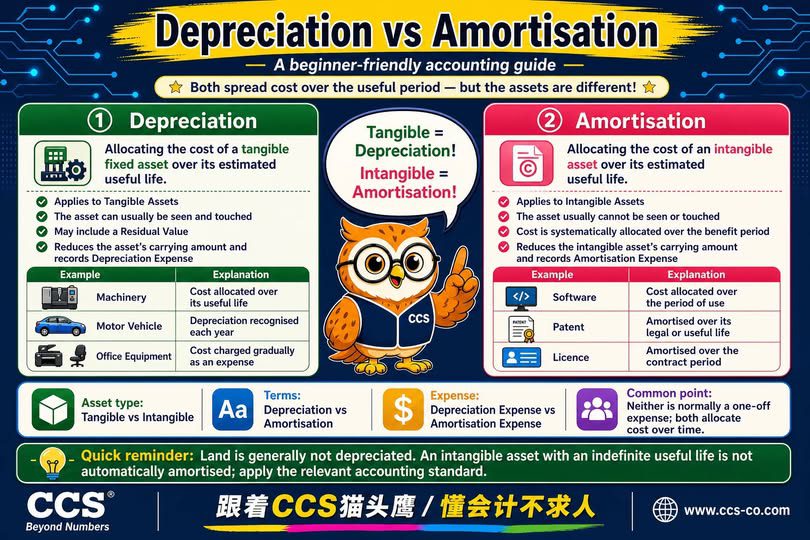
Both depreciation and amortisation allocate the cost of an asset as an expense over the period in which the business expects to receive benefits from that asset. The key difference is whether the asset is tangible or intangible.
In Simple Terms
- Depreciation applies to tangible assets—assets that can generally be seen and touched, such as machinery, motor vehicles and office equipment.
- Amortisation applies to intangible assets, such as software, patents and licences.
Neither is normally recognised as a one-off expense. Instead, the asset’s cost is allocated systematically over its estimated useful life or benefit period.
The Key Difference
| Depreciation | Amortisation |
|---|---|
| Applies to tangible assets | Applies to intangible assets |
| Allocates the cost of physical assets such as machinery, vehicles and equipment | Allocates the cost of intangible assets such as software, patents and licences |
| Recognises an expense and reduces the related asset’s carrying amount | Recognises an expense and reduces the related asset’s carrying amount |
Everyday Examples
If a company purchases machinery for RM100,000 with an estimated useful life of 10 years, depreciation expense is recognised each year using the applicable method.
If a company purchases a three-year software licence for RM30,000, amortisation expense is recognised over the period during which the licence provides benefits.
Key Reminders
- If an asset can generally be seen and touched, think depreciation.
- If an asset cannot generally be seen or touched, think amortisation.
- Land is generally not depreciated because it normally has no finite useful life. However, the actual accounting treatment must follow the applicable accounting requirements.
- An intangible asset with an indefinite useful life is not automatically amortised. The applicable accounting standard must be considered.
- Depreciation and amortisation are non-cash expenses, but they affect accounting profit and the asset’s carrying amount.
References
[1] IFRS Foundation, IAS 16 Property, Plant and Equipment
[2] IFRS Foundation, IAS 38 Intangible Assets
This content is for accounting education. The actual treatment of depreciation, amortisation, useful lives and asset classification should be assessed based on the applicable financial reporting standards, the entity’s accounting policy and the specific facts and circumstances.
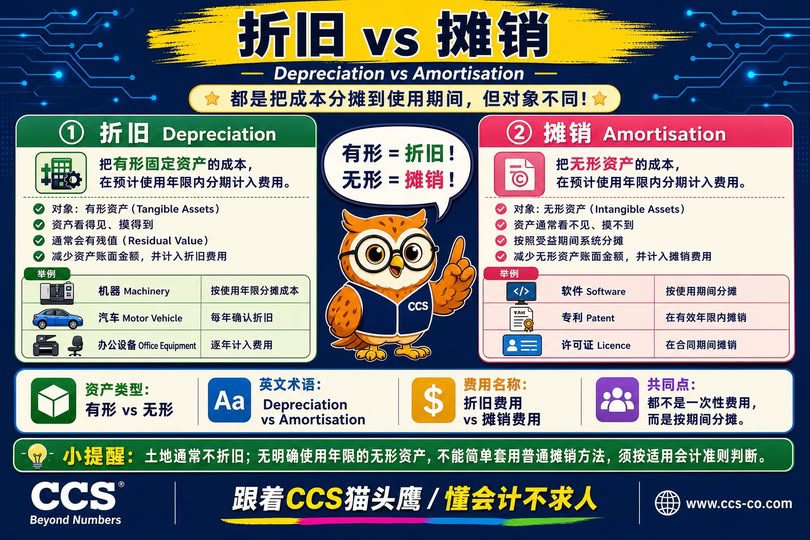
折旧与摊销:了解两者的关键区别
许多刚接触会计的企业老板和会计初学者,在账目中看到机器、汽车、软件和专利等资产时,都会问:为什么有些资产称为折旧,有些资产却称为摊销?
折旧和摊销的共同点,都是将资产成本按照企业预计从该资产获得经济利益的期间分摊为费用。两者真正的区别,在于资产属于有形资产还是无形资产。
简单来说
- 折旧(Depreciation)适用于有形资产(Tangible Assets),也就是通常看得见、摸得到的资产,例如机器、汽车和办公设备。
- 摊销(Amortisation)适用于无形资产(Intangible Assets),例如软件、专利和许可证。
折旧和摊销通常都不是一次性计入损益的费用,而是按照资产预计使用年限或受益期间系统地分摊其成本。
核心区别
| 折旧 | 摊销 |
|---|---|
| 适用于有形资产 | 适用于无形资产 |
| 分摊机器、车辆和设备等实物资产的成本 | 分摊软件、专利和许可证等无形资产的成本 |
| 确认费用,并减少相关资产的账面金额 | 确认费用,并减少相关资产的账面金额 |
生活化例子
如果公司以 RM100,000 购买一台机器,预计使用年限为 10 年,公司会按照适用的折旧方法,每年确认折旧费用(Depreciation Expense)。
如果公司以 RM30,000 购买一套三年期的软件许可证,公司会在该许可证能够带来经济利益的期间内确认摊销费用(Amortisation Expense)。
重点提醒
- 如果资产通常看得见、摸得到,可以联想到折旧。
- 如果资产通常看不见、摸不到,可以联想到摊销。
- 土地通常不计提折旧,因为土地一般没有有限的使用年限。不过,实际会计处理仍须按照适用的会计要求进行判断。
- 具有无限使用年限的无形资产,并不代表可以自动进行摊销;企业必须参考适用的会计准则。
- 折旧和摊销都属于非现金费用(Non-cash Expenses),但会影响会计利润及相关资产的账面金额。
参考资料
[1] IFRS Foundation,《IAS 16 不动产、厂房及设备》
[2] IFRS Foundation,《IAS 38 无形资产》
本文仅用于会计教育。折旧、摊销、使用年限及资产分类的实际处理,应根据适用的财务报告准则、企业会计政策以及具体事实和情况进行判断。