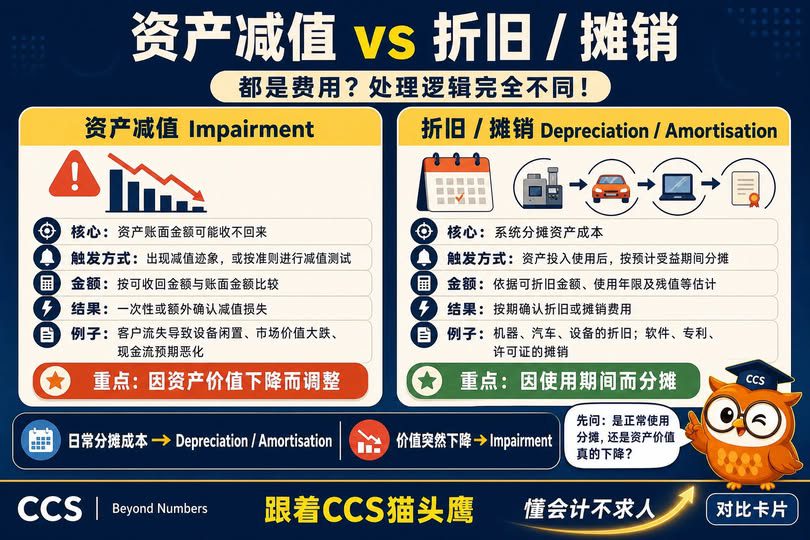
Depreciation, amortisation and impairment all reduce the carrying amount of an asset, but they do so for different reasons.
Depreciation and Amortisation
Depreciation is the systematic allocation of the cost of a tangible asset over its estimated useful life.
Under Malaysian financial reporting requirements:
- MFRS 116 applies to Property, Plant and Equipment; and
- MPERS Section 17 applies to Property, Plant and Equipment.
Amortisation is the systematic allocation of the cost of an intangible asset over its estimated useful life.
The relevant requirements include:
- MFRS 138 for Intangible Assets; and
- MPERS Section 18 for Intangible Assets.
In simple terms, depreciation and amortisation reflect the normal consumption of an asset’s economic benefits over the period in which the asset is expected to be used.
Asset Impairment
Impairment arises when an asset’s recoverable amount is lower than its carrying amount.
In that situation, the carrying amount must be reduced to reflect the asset’s lower recoverable value.
The relevant requirements include:
- MFRS 136 for Impairment of Assets; and
- MPERS Section 27 for Impairment of Assets.
Impairment is therefore not simply a routine allocation of cost over time. It reflects a decline in the asset’s value or recoverability.
The Key Question
When deciding whether an adjustment represents depreciation or amortisation, or an impairment loss, ask:
Is this the normal allocation of an asset’s cost as it is used, or has the asset’s value actually declined?
This is the central distinction in practice:
- Normal use over the estimated benefit period → Depreciation or amortisation
- Recoverable amount falls below carrying amount → Impairment
CCS | Beyond Numbers
资产减值、折旧与摊销:了解三者的分别
资产减值、折旧及摊销都会减少资产的账面金额,但三者背后的原因并不相同。
折旧与摊销
**折旧(Depreciation)**是按照有形资产预计的使用寿命,有系统地分摊资产成本。
在马来西亚财务报告准则下:
- MFRS 116适用于不动产、厂房及设备(Property, Plant and Equipment);以及
- MPERS Section 17适用于不动产、厂房及设备。
**摊销(Amortisation)**则是按照无形资产预计的使用寿命,有系统地分摊资产成本。
相关要求包括:
- MFRS 138适用于无形资产(Intangible Assets);以及
- MPERS Section 18适用于无形资产。
简单来说,折旧和摊销反映的是资产在预计使用期间内,经济利益被正常消耗的过程。
资产减值
当资产的可收回金额(Recoverable Amount)低于其账面金额时,就可能发生资产减值(Impairment)。
在这种情况下,资产的账面金额必须调低,以反映其较低的可收回价值。
相关要求包括:
- MFRS 136适用于资产减值;以及
- MPERS Section 27适用于资产减值。
因此,资产减值并不是单纯按照时间进行的日常成本分摊,而是反映资产价值或可收回能力已经下降。
最关键的问题
在判断一项调整属于折旧、摊销还是减值损失时,可以先问:
这是资产正常使用期间的成本分摊,还是资产的价值真的下降了?
这就是实务中区分三者的核心:
- 资产在预计受益期间内正常使用 → 折旧或摊销
- 可收回金额低于账面金额 → 资产减值
CCS | Beyond Numbers