Many people learning accounting make the same initial mistake:
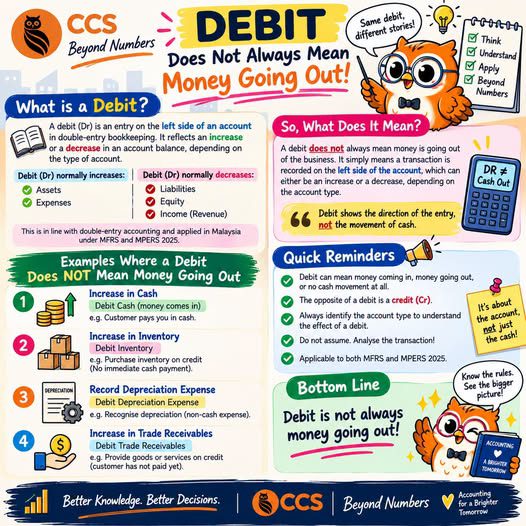
Debit = money going out?
Not necessarily.
In accounting, debit simply means that an entry is recorded on the left-hand side of an account. What the debit actually represents depends on the account involved and the transaction being recorded.
For example:
- When a customer repays the company, cash increases, so the entry is a debit to Cash.
- When inventory is purchased on credit, the company has not yet paid any money, but the entry is a debit to Inventory.
- When depreciation is recorded, the entry is a debit to Depreciation Expense, even though not a single ringgit leaves the bank account.
Therefore, a transaction should not be judged by the word “debit” alone.
Debit tells you where the entry is recorded, not where the cash goes.
Understand the account first, then understand the transaction.
Remember: Debit tells you the side of the account; cash flow tells you where the money moves.
CCS | Beyond Numbers
Debit 就是钱出去了吗?
很多人刚开始学习会计时,第一个误会就是:
Debit = 钱出去了?
如果真的这么简单,会计师大概小学毕业就可以上班了。
其实不一定。
在会计中,**Debit(借方)**只是表示一笔分录记在账户的左边。至于这笔 Debit 具体代表什么,则要看涉及的账户以及所记录的交易。
例如:
- 客户还钱给公司,现金增加,因此应借记 Cash(现金)。
- 公司赊账购买存货,虽然一分钱还没有付出去,但应借记 Inventory(存货)。
- 公司确认折旧时,应借记 Depreciation Expense(折旧费用),但银行账户完全没有现金流出。
所以,看到 Debit 时,不要马上抱紧钱包。
Debit 只是告诉你,这一笔分录记在账户的左边;它并不代表现金一定流出。
至于钱是流入、流出,还是根本没有发生现金流动,就要看它是什么账户,以及发生了什么交易。
记住一句话:Debit 看左右,Cash Flow 才看钱往哪里走。
CCS | Beyond Numbers