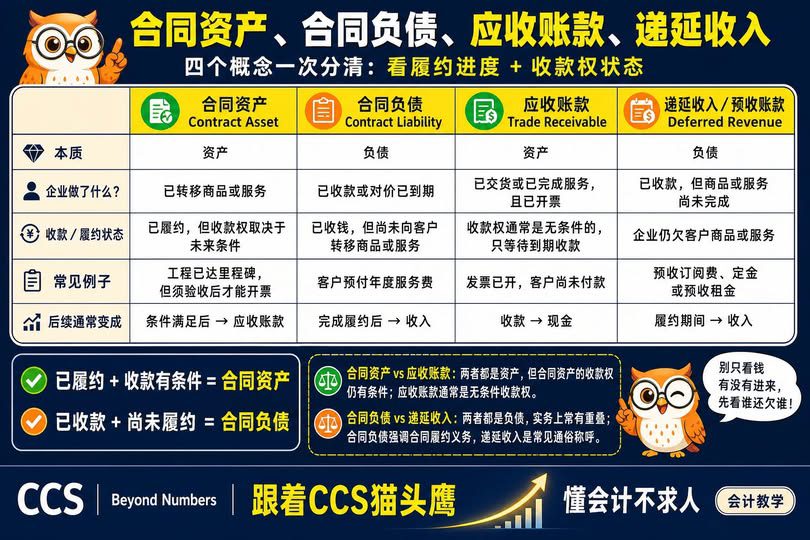
These four concepts are often confused. The distinction becomes clearer if you ask two questions:
- Has the company already performed by delivering the goods or services?
- Is the right to receive payment unconditional, or does it still depend on a future condition?
Contract Asset
A contract asset arises when the company has already performed its obligation, but its right to receive payment still depends on a future condition.
Example
A contractor has completed a stage of work and achieved a project milestone, but the contract requires the customer’s final acceptance before the contractor can issue an invoice.
The company has performed, but the right to payment is still conditional.
Contract asset = Performance completed, but the right to payment remains conditional.
A contract asset is an asset, but it is not yet an unconditional receivable.
Contract Liability
A contract liability arises when the customer has already paid, but the company has not yet delivered the related goods or services.
The company therefore still owes the customer its performance under the contract.
Examples
- A customer pays for a service before it is provided;
- A customer pays a subscription fee in advance; or
- A customer pays a deposit before the goods or services are delivered.
Contract liability = Payment received, but performance is still outstanding.
A contract liability is a liability because the company still has an obligation to deliver goods or services to the customer.
Trade Receivable
A trade receivable generally arises when:
- The company has delivered the goods or completed the services;
- The invoice has been issued; and
- The right to payment is unconditional, subject only to the payment becoming due.
The company has completed its performance, and the customer has been billed.
Trade receivable = Performance completed, invoice issued and payment unconditional.
A trade receivable is an asset.
Deferred Revenue or Unearned Revenue
Deferred revenue, also known as unearned revenue or revenue received in advance, refers to money received before the related goods or services have been delivered.
Examples
- Prepaid subscription fees;
- Customer deposits; and
- Rent received in advance.
Deferred revenue is a liability because the company still owes the customer the relevant goods or services.
In practice, deferred revenue and unearned revenue are commonly used as traditional terms for amounts that may fall within the concept of a contract liability. Contract liability is the terminology that more directly emphasises the company’s outstanding performance obligation under the contract.
The Two Key Questions
1. Has the Company Performed?
If the company has transferred the goods or services to the customer, it may need to recognise revenue or a contract asset, depending on whether the right to payment is unconditional.
If the company has not yet performed but has already received payment, it will generally recognise a contract liability. Traditionally, this may also be described as deferred revenue or an advance received.
2. Is the Right to Payment Unconditional?
If the company must still wait for:
- Customer acceptance;
- Achievement of a milestone; or
- Satisfaction of another contractual condition,
the right to payment remains conditional and will generally be presented as a contract asset.
If the company is only waiting for the payment due date, the right to payment is generally unconditional and the balance will usually be a trade receivable.
A Simple Comparison
| Item | What Has Happened? | Is the Right to Payment Conditional? | Classification |
|---|---|---|---|
| Contract asset | Performance completed | Yes | Asset |
| Contract liability | Payment received, performance not completed | Not applicable | Liability |
| Trade receivable | Performance completed and invoice issued | Generally no | Asset |
| Deferred revenue | Payment received in advance | Not applicable | Liability |
The Memory Rule
Receive first, perform later → Contract liability/deferred revenue.
Perform first, but payment remains conditional → Contract asset.
Perform, issue the invoice and wait only for payment → Trade receivable.
Do not look only at whether money has been received. First ask:
Who still owes whom?
In simple terms:
- Performance completed and payment still conditional → Contract asset;
- Payment received and performance not yet completed → Contract liability/deferred revenue; and
- Performance completed, invoice issued and payment unconditional → Trade receivable.
Once these four concepts are separated, revenue recognition becomes much easier to understand.
The actual recognition of revenue, identification of performance obligations and classification of contract assets and contract liabilities must be assessed based on the contract terms, the pattern of performance and the applicable financial reporting standards.
CCS | Beyond Numbers
合同资产、合同负债、应收账款与递延收入:到底有什么分别?
这四个概念经常被混淆。其实,只要先问两个问题,就会清楚很多:
- 企业是否已经履约,也就是已经交付商品或提供服务?
- 企业的收款权是无条件的,还是仍然取决于未来条件?
合同资产(Contract Asset)
当企业已经履行了合同中的履约义务,但收款权仍然取决于某个未来条件时,就可能产生合同资产。
例子
承包商已经完成工程的某个阶段,也达到了项目里程碑,但合同规定必须等客户最终验收后,才可以正式开票。
这时,企业已经履约,但收款权仍然有条件。
合同资产 = 已经履约,但收款权仍然有条件。
合同资产属于资产,但还不是一项无条件的应收账款。
合同负债(Contract Liability)
当客户已经先付款,但企业还没有向客户交付相关商品或服务时,就会产生合同负债。
由于企业仍然欠客户相应的履约服务,合同负债属于一项负债。
例子
- 客户先支付服务费,但服务还没有提供;
- 客户预先支付订阅费;或
- 客户先支付定金,但商品或服务还没有交付。
合同负债 = 钱已经收到,但企业还没有完成履约。
合同负债属于负债,因为企业仍然有义务向客户提供商品或服务。
应收账款(Trade Receivable)
当以下情况发生时,一般会产生应收账款:
- 企业已经交付商品或完成服务;
- 发票已经开出;以及
- 企业的收款权已经是无条件的,只是在等待付款到期。
企业已经完成履约,也已经向客户开票。
应收账款 = 已经履约、已经开票,收款权通常已经无条件。
应收账款属于资产。
递延收入或预收收入(Deferred Revenue/Unearned Revenue)
递延收入,也称为未赚取收入(Unearned Revenue)或预收收入,是指企业已经收到款项,但相关商品或服务尚未交付。
例子
- 预收订阅费;
- 客户支付的定金;以及
- 预收租金。
递延收入属于负债,因为企业仍然欠客户相关的商品或服务。
在实务上,Deferred Revenue 或 Unearned Revenue 通常是较传统的称呼,所描述的金额可能属于合同负债的范围。而 Contract Liability 更强调企业在合同下尚未完成的履约义务。
两个最关键的判断问题
第一个问题:企业是否已经履约?
如果企业已经向客户转移商品或服务,可能需要确认收入,或者确认合同资产。具体要看企业的收款权是否已经变成无条件。
如果企业还没有履约,但已经收到客户付款,通常会确认合同负债。传统上,这也可能称为递延收入或预收款项。
第二个问题:收款权是否无条件?
如果企业还需要等待:
- 客户验收;
- 达到某个里程碑;或
- 满足其他合同条件,
那么收款权仍然有条件,通常会列为合同资产。
如果企业只是等待付款到期,而不需要再满足其他条件,收款权通常已经是无条件的,相关余额一般属于应收账款。
简单对照表
| 项目 | 已经发生什么? | 收款权是否有条件? | 分类 |
|---|---|---|---|
| 合同资产 | 已经履约 | 是 | 资产 |
| 合同负债 | 已经收款,但尚未履约 | 不适用 | 负债 |
| 应收账款 | 已经履约并已开票 | 通常不是 | 资产 |
| 递延收入 | 已经预先收款 | 不适用 | 负债 |
记忆口诀
先收钱,后做事 → 合同负债/递延收入。
先做事,但收款有条件 → 合同资产。
做完事、已开票,只等付款 → 应收账款。
不要只看钱有没有进来,先问一个问题:
到底是谁还欠谁?
简单来说:
- 已经履约,但收款仍然有条件 → 合同资产;
- 已经收款,但尚未履约 → 合同负债/递延收入;以及
- 已经履约、已经开票,而且收款权无条件 → 应收账款。
把这四个概念分清楚后,收入确认就会容易理解很多。
实际确认收入、识别履约义务,以及区分合同资产与合同负债,仍然必须根据合同条款、履约模式及适用的财务报告准则进行专业判断。
CCS | Beyond Numbers