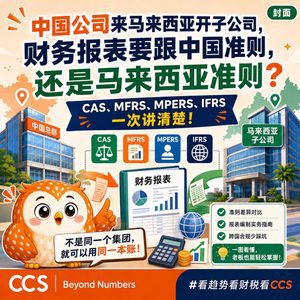
China and Malaysia apply different financial reporting frameworks. For a Chinese state-owned enterprise (SOE) establishing a subsidiary in Malaysia, understanding the relationship between these frameworks is essential for preparing local financial statements and group consolidated financial statements.
1. Accounting Standards Applied in China
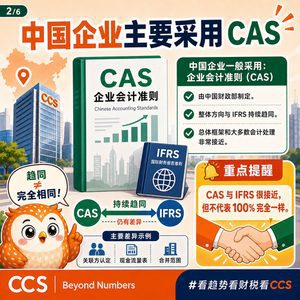
Chinese enterprises apply the Chinese Accounting Standards (CAS), which are formulated and issued by the Ministry of Finance of the People’s Republic of China.
According to the Roadmap for Continuing Convergence between Chinese Accounting Standards for Business Enterprises and International Financial Reporting Standards, issued by the Ministry of Finance in 2010, Chinese Accounting Standards achieved convergence with International Financial Reporting Standards (IFRS) in 2005.
In practice, CAS and IFRS are broadly consistent in their overall framework and in most accounting treatments, with an overall similarity commonly estimated at approximately 90% to 95%.
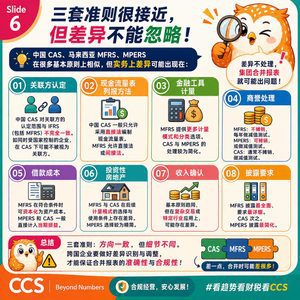
However, differences remain in certain areas, including:
- The identification of related parties;
- The preparation of statements of cash flows; and
- The determination of the scope of consolidation.
The CAS framework began applying from 1 January 2007 to all listed companies, certain non-listed financial enterprises and large central state-owned enterprises. Its application has since expanded progressively and now covers almost all medium-sized and large enterprises.
2. Malaysia’s Financial Reporting Frameworks
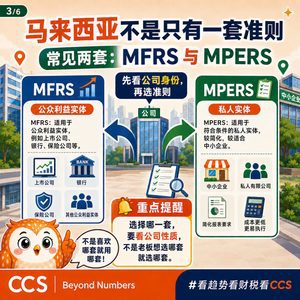
Malaysia has two main accounting frameworks, which apply to different types of entities.
2.1 MFRS: Malaysian Financial Reporting Standards
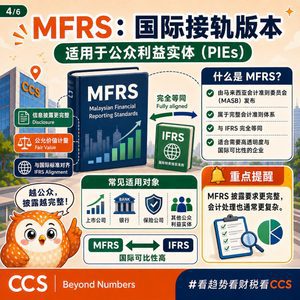
MFRS, or the Malaysian Financial Reporting Standards, is the full financial reporting framework issued by the Malaysian Accounting Standards Board (MASB).
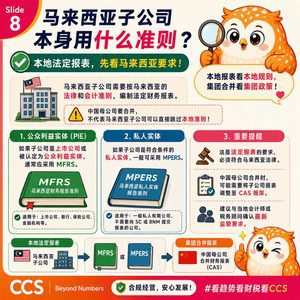
MFRS is fully equivalent to IFRS and generally applies to Public Interest Entities (PIEs), including:
- Listed companies;
- Banks;
- Insurance companies;
- Financial institutions; and
- Other entities with significant public accountability.
MFRS provides comprehensive accounting guidance and detailed disclosure requirements, supporting the international comparability of financial information.
2.2 MPERS: Malaysian Private Entities Reporting Standard
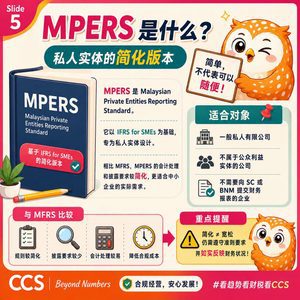
MPERS, or the Malaysian Private Entities Reporting Standard, is a simplified framework based on the IFRS for SMEs Accounting Standard.
It became effective from 1 January 2016 and is designed specifically for private entities, including entities that are not required to submit financial statements to the Securities Commission Malaysia or Bank Negara Malaysia.
MPERS retains the fundamental principles of IFRS while simplifying certain complex accounting treatments, making it more practical for private entities and SMEs.
According to an announcement issued by MASB on 10 October 2025, MPERS 2025 will apply to annual periods beginning on or after 1 January 2027.
MPERS 2025 is based on the third edition of the IFRS for SMEs Accounting Standard issued by the International Accounting Standards Board (IASB) on 27 February 2025.
This means that MPERS 2025 is no longer based on the 2015 edition of the IFRS for SMEs Accounting Standard. Instead, it is based on the latest third edition, which includes important areas of alignment with the full IFRS Standards.
3. Financial Reporting Arrangements for a Chinese SOE’s Malaysian Subsidiary
3.1 The Chinese Parent Must Prepare Consolidated Financial Statements
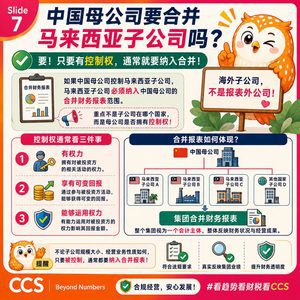
Under Accounting Standard for Business Enterprises No. 33 — Consolidated Financial Statements, revised in 2014, Article 4 provides that a parent company must prepare consolidated financial statements.
Accordingly, a Malaysian subsidiary established by a Chinese SOE must generally be included in the parent company’s consolidated financial statements.
The standard requires a parent company to include all subsidiaries it controls within the scope of consolidation, regardless of:
- The size of the subsidiary; or
- The nature of its business activities.
The scope of consolidation is determined based on the concept of control.
Control exists when the investor:
- Has power over the investee;
- Has exposure, or rights, to variable returns from its involvement with the investee; and
- Has the ability to use its power to affect those returns.
3.2 Accounting Policies Must Be Unified
Article 27 of Accounting Standard for Business Enterprises No. 33 requires the parent company to unify the accounting policies used by its subsidiaries so that they are consistent with the parent company’s accounting policies.
In practice, this may be achieved in either of two ways.
First, if the subsidiary’s accounting policies differ from those of the parent, the parent may make the necessary adjustments to the subsidiary’s financial statements so that they comply with the parent’s accounting policies.
Second, the parent may require the subsidiary to prepare a separate set of financial statements using the parent’s accounting policies.
Therefore, if a Malaysian subsidiary prepares its local financial statements under MFRS or MPERS, the Chinese parent may need to:
- Convert or adjust the subsidiary’s financial information to the CAS framework; or
- Require the subsidiary to prepare an additional set of financial statements under CAS.
The parent is also required to unify the accounting periods of its subsidiaries with its own accounting period.
If the subsidiary’s accounting period differs from that of the parent, the parent may either:
- Adjust the subsidiary’s financial statements to align with the parent’s reporting period; or
- Require the subsidiary to prepare a separate set of financial statements covering the parent’s accounting period.
3.3 Components of the Consolidated Financial Statements
Under the Chinese Accounting Standards, consolidated financial statements should generally include:
- Consolidated balance sheet;
- Consolidated income statement;
- Consolidated statement of cash flows;
- Consolidated statement of changes in owners’ equity; and
- Notes to the financial statements.
When preparing consolidated financial statements, the parent company treats the entire group as a single accounting entity.
Using unified accounting policies and applying the relevant recognition, measurement and presentation requirements, the consolidated financial statements should reflect the group’s overall:
- Financial position;
- Operating results; and
- Cash flows.
4. Practical Implications
A Chinese SOE establishing a subsidiary in Malaysia may therefore need to manage two reporting requirements:
- Local statutory reporting: The Malaysian subsidiary prepares financial statements under the applicable Malaysian framework, such as MFRS or MPERS; and
- Group reporting: The subsidiary’s financial information is adjusted or converted, where necessary, to comply with CAS for inclusion in the Chinese parent’s consolidated financial statements.
The accounting framework used for local statutory reporting may therefore differ from the framework used for group consolidation.
This makes early coordination among the Malaysian finance team, the Chinese parent company, auditors and consolidation teams particularly important.
CCS | Beyond Numbers
中国 CAS 与马来西亚 MFRS/MPERS:中资国企马来西亚子公司的财务报告安排
中国和马来西亚采用不同的财务报告准则体系。对于在马来西亚设立子公司的中国国有企业而言,了解两地准则之间的关系,对于准备当地财务报表及中国母公司的集团合并财务报表都非常重要。
一、中国采用的会计准则
中国企业适用的是中国企业会计准则(Chinese Accounting Standards,CAS),由中国财政部制定和发布。
根据财政部于 2010 年发布的《中国企业会计准则与国际财务报告准则持续趋同路线图》,中国企业会计准则已于 2005 年实现与**国际财务报告准则(IFRS)**的趋同。
从实际应用来看,中国企业会计准则与 IFRS 在总体框架及大多数会计处理方面保持一致,整体相似度通常估计约为 90% 至 95%。
不过,两者在部分具体领域仍然存在差异,例如:
- 关联方的认定;
- 现金流量表的编制;以及
- 合并范围的确定。
中国 CAS 体系自 2007 年 1 月 1 日起,适用于所有上市公司、部分非上市金融企业及中央大型国有企业。其适用范围之后逐步扩大,目前已经涵盖几乎所有大中型企业。
二、马来西亚的财务报告准则体系
马来西亚采用两套主要的会计准则框架,分别适用于不同类型的企业。
2.1 MFRS:马来西亚财务报告准则
**MFRS(Malaysian Financial Reporting Standards)是由马来西亚会计准则委员会(Malaysian Accounting Standards Board,MASB)**发布的完整财务报告准则体系。
MFRS 与 IFRS 完全等同,主要适用于公众利益实体(Public Interest Entities,PIEs),包括:
- 上市公司;
- 银行;
- 保险公司;
- 金融机构;以及
- 具有重大公众问责性的其他企业。
MFRS 提供全面的会计指引及详细的披露要求,以提高财务信息的国际可比性。
2.2 MPERS:马来西亚私人实体报告准则
MPERS(Malaysian Private Entities Reporting Standard)是以IFRS for SMEs Accounting Standard为基础制定的简化版财务报告准则。
MPERS 自 2016 年 1 月 1 日起生效,专门为私人实体设计,包括不被要求向马来西亚证券委员会或马来西亚国家银行提交财务报表的企业。
MPERS 在保留 IFRS 基本原则的同时,简化了部分复杂的会计处理,使其更适合私人企业及中小型企业的实际需要。
根据 MASB 于 2025 年 10 月 10 日发布的公告,MPERS 2025 将适用于 2027 年 1 月 1 日或之后开始的年度期间。
MPERS 2025 是以国际会计准则委员会(International Accounting Standards Board,IASB)于 2025 年 2 月 27 日发布的第三版 IFRS for SMEs Accounting Standard 为基础。
这表示 MPERS 2025 不再以 2015 年版本的 IFRS for SMEs Accounting Standard 为基础,而是以最新的第三版为基础,其中包括与完整 IFRS 准则进行重要对齐的内容。
三、中国国企在马来西亚设立子公司的财务报表安排
3.1 中国母公司必须编制合并财务报表
根据 2014 年修订的《企业会计准则第 33 号——合并财务报表》第四条,母公司应当编制合并财务报表。
因此,中国国企在马来西亚设立的子公司,一般必须纳入中国母公司的合并财务报表范围。
该准则要求,母公司应将其控制的所有子公司纳入合并范围,而不论子公司的:
- 规模大小;或
- 经营业务性质。
合并范围以控制为基础确定。
当投资方同时具备以下条件时,一般表示其控制被投资方:
- 拥有对被投资方的权力;
- 因参与被投资方的相关活动而享有或承担可变回报;以及
- 有能力运用其对被投资方的权力影响回报金额。
3.2 会计政策必须统一
《企业会计准则第 33 号》第二十七条规定,母公司应当统一子公司所采用的会计政策,使子公司的会计政策与母公司的会计政策保持一致。
实际处理可以通过以下两种方式进行。
第一,如果子公司采用的会计政策与母公司不一致,母公司可以按照母公司的会计政策,对子公司的财务报表进行必要调整。
第二,母公司也可以要求子公司按照母公司的会计政策另行编制一套财务报表。
因此,如果马来西亚子公司根据 MFRS 或 MPERS 编制当地财务报表,中国母公司可能需要:
- 将子公司的财务资料转换或调整至 CAS 框架;或
- 要求子公司另外按照 CAS 编制一套财务报表。
此外,母公司也应当统一子公司的会计期间,使其与母公司的会计期间保持一致。
如果子公司的会计期间与母公司不一致,母公司可以:
- 按照母公司的报告期间对子公司财务报表进行调整;或
- 要求子公司按照母公司的会计期间另行编制财务报表。
3.3 合并财务报表的组成部分
根据中国企业会计准则,合并财务报表一般至少应当包括:
- 合并资产负债表;
- 合并利润表;
- 合并现金流量表;
- 合并所有者权益变动表;以及
- 财务报表附注。
母公司在编制合并财务报表时,应当将整个企业集团视为一个会计主体。
在采用统一会计政策,并根据相关企业会计准则进行确认、计量及列报的基础上,合并财务报表应反映集团整体的:
- 财务状况;
- 经营成果;以及
- 现金流量。
四、实际执行上的影响
因此,中国国企在马来西亚设立子公司后,通常需要同时管理两类财务报告要求:
- **当地法定财务报告:**马来西亚子公司根据适用的马来西亚准则,例如 MFRS 或 MPERS,编制当地财务报表;以及
- **集团报告:**子公司的财务资料在需要时进行调整或转换,以符合中国 CAS,供中国母公司编制合并财务报表。
因此,马来西亚子公司用于当地法定报告的会计准则,可能与中国母公司用于集团合并的会计准则不同。
这使得马来西亚财务团队、中国母公司、审计师及集团合并团队之间的提前协调尤其重要。
CCS | Beyond Numbers