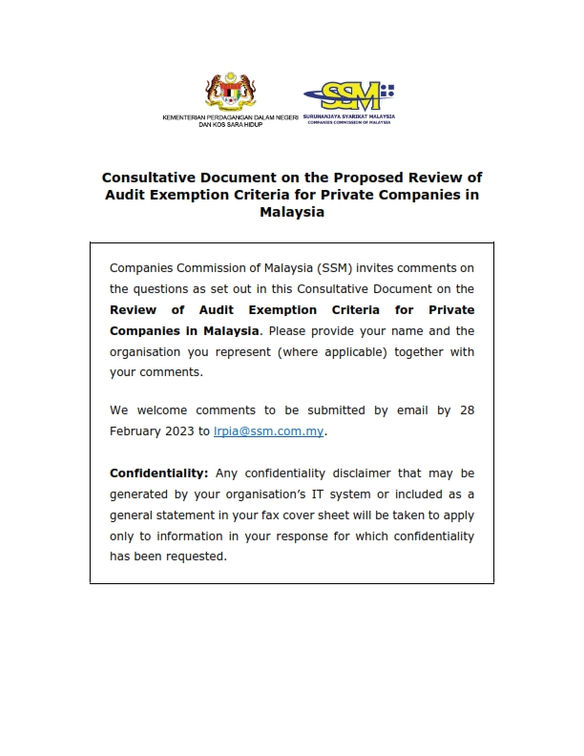
Consultative Documents on Proposed Review of Audit Exemption Criteria for Companies in Malaysia
19
Penyata Kewangan Parti Pribumi Bersatu Malaysia

17
How ISQM 1 has Changed from ISQC 1 with Respect to Leadership

Clarification of who is required to have an understanding of ISQM 1. Increased emphasis on leadership’s accountability for the System of Quality Management (SOQM). Expanded requirements to assign specific responsibilities related to the SOQM: Enhanced requirements addressing the qualifications of individuals assigned responsibilities: New requirement requiring a direct line of communication between: 明确了谁需要对 ISQM 1 […]
The Relationship of ISQM 1 with ISQM 2 and ISA 220 (Revised)

ISQM 1: Quality management at the firm level ISQM 1 requires the firm to design, implement and operate a SOQM to manage the quality of engagements performed by the firm. The firm’s SOQM creates an environment that enables and supports engagement teams in performing quality engagements. ISQM 1:事务所层面的质量管理 ISQM 1 要求事务所设计、实施和运行一个 SOQM,以管理事务所的业务质量。 事务所的 SOQM 创造了一个环境,使参与团队能够执行高质量的业务。 […]
The Structure of ISQM 1 and the Components

ISQC 1 includes six elements for which the firm needs to design policies and procedures. ISQM 1 has eight components. The components in ISQM 1 are aligned with the elements in ISQC 1 and include two new components: ISQC 1 包括六个要素,事务所需要为其设计政策和程序。 ISQM 1 有八个组成部分。ISQM 1 的组成部分与 ISQC 1 的要素相一致,并包括两个新的组成部分 ISQM 1 comprises of: The firm […]
Internal Control: Manual versus Automated Controls

The internal control system will consist of manual and automated controls for most entities. The risks and benefits associated with the different types of control are outlined below. 对于大多数实体来说,内部控制系统将由人工和自动控制的混合体组成。 不同类型的控制所带来的风险和好处概述如下。 Benefits | 优点 Manual Controls 人工控制 Automated Controls 自动控制 Risks | 风险 Manual Controls 人工控制 Automated Controls 自动控制 CONSIDER POINT When the entity has a […]
Internal Control: Pervasive Controls (that address financial statement level risks)

We have now addressed each of the five components of internal control. Some of these controls are pervasive in nature (financial statement-level risks). They only indirectly serve to prevent a misstatement from occurring or to detect and correct it after it has occurred. Other controls relate to particular transaction (assertion level) risks (such as payroll, […]
Internal Control: Anti-Fraud Controls

In the last few years, a new type of internal control has emerged, sometimes called anti-fraud controls. Since the vast majority of sizable frauds tend to involve senior management, establishing strong anti-fraud programs and controls is considered a healthy part of the control environment in larger entities. Anti-fraud controls can be likened to speed bumps […]
Overview: Introduction to ISQM 1

Quality Management for Firms that Perform Audits or Reviews of Financial Statements or Other Assurance or Related Services Engagements 从事财务报表审计或审查或其他鉴证或相关服务工作的事务所的质量管理 WHAT? | 什么来的? ISQM 1, Quality Management for Firms that Perform Audits or Reviews of Financial Statements, or Other Assurance or Related Services Engagements, replaces the IAASB’s previous standard, International Standard on Quality Control (ISQC) […]
Internal Control Components: Monitoring

Monitoring assesses the effectiveness of the internal control’s performance over time. The objective is to ensure that the controls are working properly and, if not, to take necessary corrective actions. Monitoring provides feedback to management on whether the internal control system they have designed to mitigate risks is: Management accomplishes the monitoring of controls through […]