A customer owes your business money but does not pay. Should the amount be written off as a bad debt or recognised as a provision for doubtful debts?
This is a common concern for SME owners. The answer is not simply a matter of choosing between two accounting entries. Confusing a write-off with a provision can distort the financial statements, and the tax treatment may also be adjusted by the Inland Revenue Board of Malaysia (IRB).
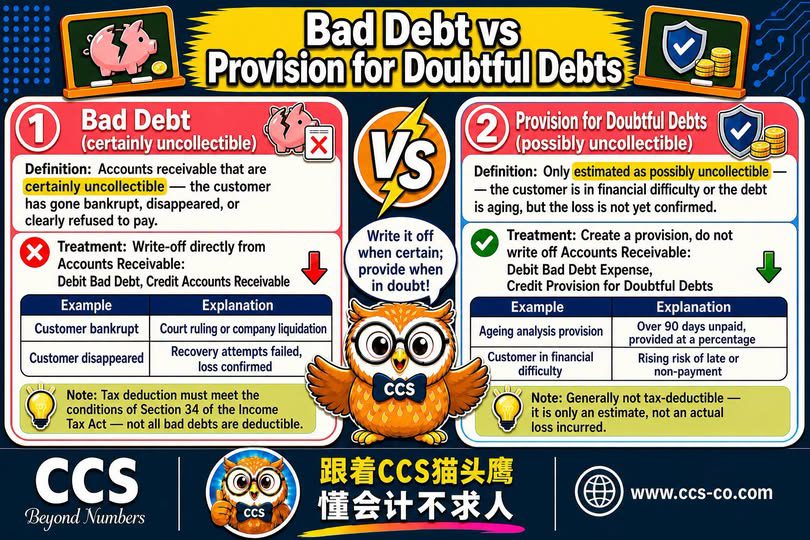
Bad Debt: The Amount Is Confirmed as Uncollectible
A bad debt arises when there is sufficient evidence that the customer’s balance is no longer recoverable.
Examples may include situations where:
- The customer has been declared bankrupt;
- The customer has ceased operations or disappeared;
- Liquidation proceedings have commenced;
- Recovery efforts have failed; or
- Other evidence confirms that the amount cannot reasonably be collected.
When the amount is confirmed as irrecoverable, it may be written off directly against Accounts Receivable.
The accounting entry may be:
Dr Bad Debt Expense or Loss Allowance
Cr Accounts Receivable
As a result, the gross receivable is removed from the accounting records.
Provision for Doubtful Debts: The Amount Is Only Estimated to Be Uncollectible
A provision for doubtful debts, also commonly referred to as an allowance for doubtful debts, is relevant when the business believes that a customer may not pay, but the loss has not yet been confirmed.
Examples may include:
- The customer is experiencing financial difficulty;
- The balance has been outstanding for a long time;
- The customer has repeatedly delayed payment; or
- There is increased credit risk, but recovery remains possible.
In this situation, the business generally recognises an allowance or provision without immediately removing the receivable from its records.
A typical accounting entry may be:
Dr Bad Debt Expense or Impairment Loss
Cr Allowance/Provision for Doubtful Debts
The Accounts Receivable balance remains recorded at its gross amount, while the allowance is presented as a contra-asset to show the estimated recoverable amount more prudently.
The Key Difference
The main distinction is the level of certainty:
Certain that the amount cannot be recovered: write it off.
Only estimated or suspected to be uncollectible: recognise a provision or allowance.
Accounting Treatment and Tax Treatment Are Not the Same
A provision may be appropriate for accounting purposes based on prudence and the applicable financial reporting requirements.
However, for tax purposes, a provision for doubtful debts is generally an estimate of a potential loss. It is therefore generally not automatically deductible.
Bad debts may be deductible only if the relevant requirements under Section 34 of the Income Tax Act 1967 and other applicable tax rules are satisfied.
The accounting entry alone does not establish tax deductibility. The business must retain sufficient evidence to support the tax treatment.
Build an Evidence Trail for Bad Debt Write-Offs
Before writing off a customer balance, the business should consider whether it has sufficient evidence, such as:
- Statements of account;
- Collection records;
- Demand letters;
- Lawyers’ letters;
- Court documents;
- Liquidation or winding-up documents;
- Bankruptcy notices; and
- Evidence that recovery efforts have been unsuccessful.
The stronger the evidence trail, the easier it is to support the accounting and tax treatment.
Key Reminders for Business Owners
- First assess the level of certainty: is the amount definitely irrecoverable, or is it only potentially uncollectible?
- A confirmed bad debt may be written off against Accounts Receivable.
- A doubtful debt is generally recognised through an allowance or provision while the receivable remains recorded.
- A provision follows the applicable accounting requirements but is generally not automatically deductible for tax purposes.
- Bad debt deductions require compliance with the relevant requirements under Section 34 of the Income Tax Act 1967.
- Review the Accounts Receivable Ageing Analysis before year end.
- Consider payment history, recovery efforts and available evidence when assessing customer balances.
- Plan the accounting and tax treatment of bad debts and doubtful debts together.
In most accounting contexts, Allowance for Doubtful Debts and Provision for Doubtful Debts are different terms commonly used to describe a similar estimated adjustment for receivables that may not be recoverable.
Modern financial reporting standards more commonly use terms such as Expected Credit Loss (ECL) and Loss Allowance.
In simple terms:
Write off what is confirmed to be uncollectible. Provide for what is only estimated to be at risk.
CCS | Beyond Numbers
客户欠钱收不回:应该核销还是计提?
客户欠公司钱却一直不付款,账目到底应该怎样处理?
是直接核销为坏账,还是先计提呆账准备?
这是许多 SME 老板经常面对的问题。答案不是随便选择其中一个处理方式。把核销(Write-off)和计提准备(Provision)混淆,可能导致财务报表失真,税务处理也可能受到马来西亚内陆税收局(IRB)的调整。
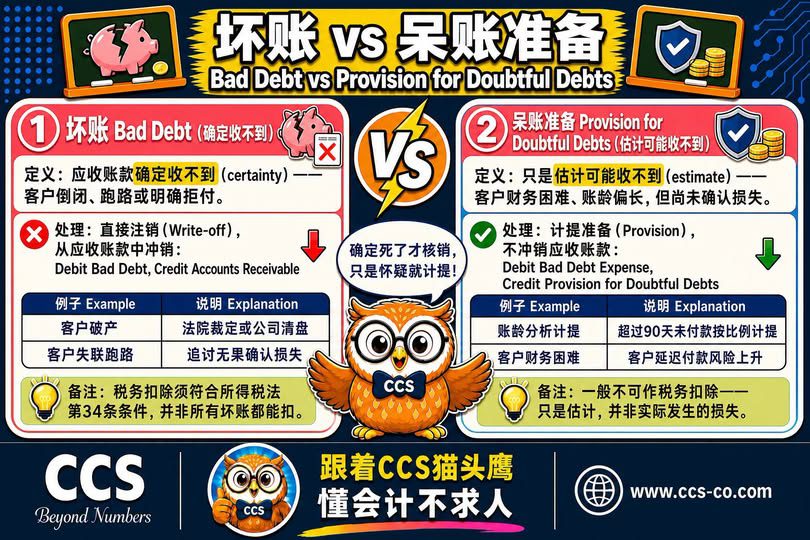
坏账(Bad Debt):已经确定无法收回
当企业拥有足够证据,确认客户欠款已经无法收回时,就可能构成坏账(Bad Debt)。
常见情况包括:
- 客户已经被宣告破产;
- 客户停止营业或已经失联;
- 客户进入清盘程序;
- 多次追讨仍然无法收回;或
- 其他证据显示相关款项已无法合理收回。
当款项确定无法收回后,企业可以将其直接从**应收账款(Accounts Receivable)**中核销。
会计分录可能为:
借:坏账费用或损失准备
贷:应收账款
这样,相关的应收账款总额就会从账目中移除。
呆账准备(Provision for Doubtful Debts):只是估计可能收不回
当企业认为客户可能无法付款,但损失还没有完全确定时,就可能需要确认呆账准备(Provision for Doubtful Debts),也常称为呆账备抵(Allowance for Doubtful Debts)。
常见情况包括:
- 客户正面对财务困难;
- 款项已经拖欠很长时间;
- 客户一再延迟付款;或
- 客户的信用风险增加,但仍有可能收回。
在这种情况下,企业一般会先确认呆账准备或损失准备,但不会马上把应收账款从账目中删除。
常见会计分录为:
借:坏账费用或减值损失
贷:呆账准备/呆账备抵
应收账款仍然以总额记录,而呆账准备则作为**备抵资产项目(Contra-asset)**列示,以更谨慎地反映预计可收回的金额。
核心区别在哪里?
最重要的分别,是损失的确定程度:
已经确定收不回:核销。
只是估计可能收不回:计提呆账准备。
会计处理与税务处理不是一回事
根据谨慎性原则及适用的财务报告要求,企业可能需要在会计上确认呆账准备。
不过,在税务方面,呆账准备通常只是对潜在损失的估计,因此一般不会自动获得税务扣除。
坏账只有在符合《1967 年所得税法(Income Tax Act 1967)》第 34 条及其他适用税务规定的情况下,才可能获得扣除。
换句话说,账上已经做了会计分录,并不代表税务上就一定可以扣除。企业必须保留足够的证据,支持相关税务处理。
坏账核销必须建立证据链
在核销客户欠款之前,企业应考虑是否拥有足够的证明文件,例如:
- 客户对账单;
- 追讨记录;
- 催款信函;
- 律师信;
- 法院文件;
- 清盘或清算文件;
- 破产通知;以及
- 追讨失败的相关证据。
证据链越完整,越容易支持相关的会计及税务处理。
企业老板需要记住的重点
- 先判断确定性:这笔钱是已经确定收不回,还是只是可能收不回?
- 已经确认无法收回的坏账,可以从应收账款中核销。
- 只是存在收回风险的呆账,一般通过呆账准备或损失准备处理,同时保留原应收账款记录。
- 呆账准备须按照适用的会计要求确认,但通常不会自动获得税务扣除。
- 坏账税务扣除必须符合《所得税法》第 34 条及相关规定。
- 年结前应检查应收账款账龄分析(Accounts Receivable Ageing Analysis)。
- 评估客户欠款时,应同时考虑付款记录、追讨过程及现有证据。
- 坏账和呆账准备的会计及税务处理,应一并规划。
在大多数会计语境中,Allowance for Doubtful Debts 与 Provision for Doubtful Debts 通常是两个不同名称,但一般都用于表示针对可能无法收回的应收账款所作出的估计调整。
现代财务报告准则则更常使用 **Expected Credit Loss(预期信用损失,ECL)**及 **Loss Allowance(损失准备)**等术语。
简单来说:
确定收不回的,才核销;只是估计有风险的,先计提准备。
CCS | Beyond Numbers