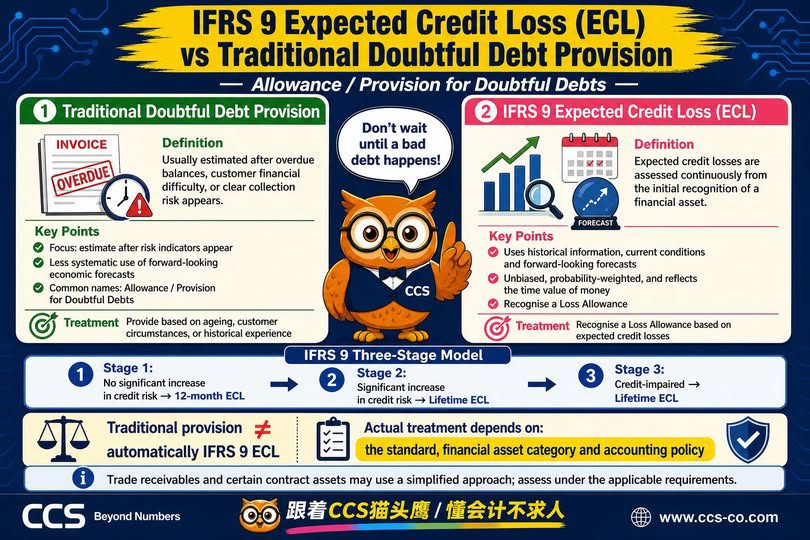
Many business owners and accountants in Malaysia still follow the approach of recognising doubtful debts only after a customer becomes overdue or the amount is clearly difficult to recover.
However, the accounting treatment depends on the financial reporting framework applied by the company.
Companies applying MFRS (Malaysian Financial Reporting Standards) follow MFRS 9, which is equivalent to IFRS 9, and must use the Expected Credit Loss (ECL) model.
Private entities applying MPERS (Malaysian Private Entities Reporting Standard) continue to use the traditional incurred loss model. This is why many small and medium-sized enterprises still use the traditional doubtful debt provision approach in practice.
The Difference in Simple Terms
Traditional Doubtful Debt Provision or MPERS Approach
Under the traditional approach, the estimated doubtful debt is generally recognised after indicators of collection risk have appeared, such as:
- Overdue balances;
- The customer experiencing financial difficulties; or
- Other clear indications that the amount may be difficult to recover.
The estimate may be based on the ageing of the receivables, the customer’s circumstances or historical experience.
MFRS 9 Expected Credit Loss Model
Under MFRS 9, an entity does not wait until a loss has already occurred.
From the initial recognition of a financial asset, the entity considers historical information, current conditions and forward-looking economic forecasts to estimate expected credit losses and recognise a loss allowance.
MFRS 9’s Three-Stage Model
For entities applying MFRS, the ECL model generally includes the following three stages:
- Stage 1: Where credit risk has not increased significantly, the entity generally recognises 12-month ECL, representing the expected credit losses arising from possible defaults within the next 12 months.
- Stage 2: Where credit risk has increased significantly but the financial asset is not yet credit-impaired, the entity recognises lifetime ECL.
- Stage 3: Where the financial asset has become credit-impaired, the entity continues to recognise lifetime ECL and calculates interest income in accordance with the applicable requirements.
Key Reminders for Businesses
- If your company applies MFRS, you need to adopt an ECL approach. You should not simply wait until a customer formally collapses before recognising an allowance.
- If your company applies MPERS, the incurred loss model remains applicable, and ageing analysis and historical experience continue to play an important role.
- Allowance for Doubtful Debts, Provision for Doubtful Debts and Loss Allowance under MFRS 9 should not automatically be treated as identical in every situation.
- Trade receivables under MFRS 9 may qualify for a simplified approach involving the direct recognition of lifetime ECL, subject to the applicable requirements.
This article is for accounting education. The actual financial reporting treatment should be assessed with reference to the applicable financial reporting framework, whether MFRS or MPERS, and relevant professional advice.
MFRS 与 MPERS 下的呆账准备:是否一定要等到坏账发生才确认?
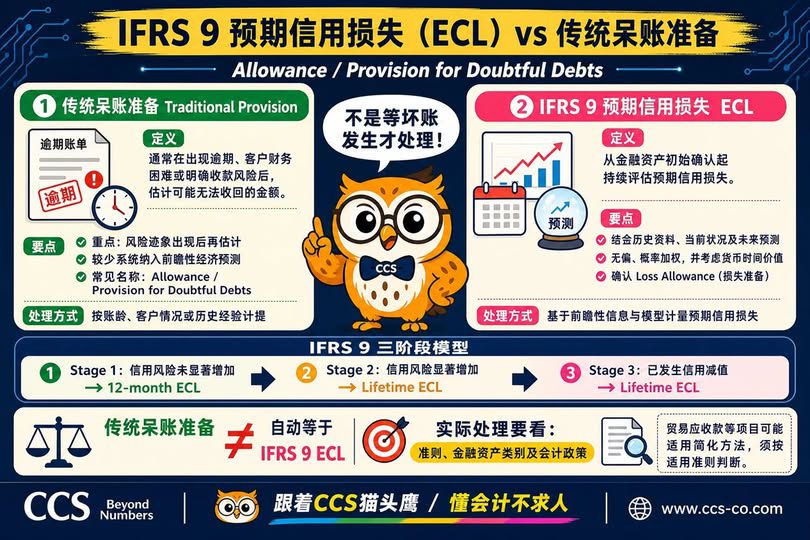
许多企业老板和会计人员仍然习惯在客户出现逾期,或款项明显难以收回后,才确认呆账或坏账准备。
不过,实际会计处理取决于企业所采用的财务报告框架。
采用 MFRS(马来西亚财务报告准则)的公司,须遵循与 IFRS 9 等同的 MFRS 9,并采用预期信用损失(Expected Credit Loss,ECL)模型。
采用 **MPERS(马来西亚私人实体报告准则)的私人实体,则继续以传统的已发生损失模型(Incurred Loss Model)**为主。这也是为什么许多中小企业在实际操作中,仍然采用传统呆账准备的做法。
简单来说,两者有什么不同?
传统呆账准备或 MPERS 做法
在传统做法下,企业通常会在收款风险已经出现后,才估计并确认可能无法收回的金额,例如:
- 应收款项已经逾期;
- 客户出现财务困难;或
- 已经出现明显的收款风险。
企业可以根据应收款项账龄、客户的具体情况或历史经验,估计可能无法收回的金额。
MFRS 9 预期信用损失模型
在 MFRS 9 下,企业不需要等到损失已经发生才进行确认。
从金融资产初始确认开始,企业就需要结合历史资料、当前情况以及前瞻性的经济预测,估计预期信用损失,并确认损失准备(Loss Allowance)。
MFRS 9 的三阶段模型
对于采用 MFRS 的企业,ECL 模型一般包括以下三个阶段:
- 第一阶段(Stage 1):如果信用风险没有显著增加,企业通常确认未来 12 个月的预期信用损失(12-month ECL),也就是未来 12 个月内可能发生违约所产生的预期信用损失。
- 第二阶段(Stage 2):如果信用风险已经显著增加,但金融资产尚未发生信用减值,企业则确认整个存续期的预期信用损失(Lifetime ECL)。
- **第三阶段(Stage 3):**如果金融资产已经发生信用减值,企业继续确认整个存续期的预期信用损失,并按照适用的规定计算利息收入。
企业需要记住的重点
- 如果公司采用 MFRS,就需要采用 ECL 的思维,不能简单地等到客户正式倒闭后才确认损失准备。
- 如果公司采用 MPERS,目前仍以已发生损失模型为主,账龄分析和历史经验仍然是重要依据。
- Allowance for Doubtful Debts(呆账准备)、**Provision for Doubtful Debts(呆账拨备)**与 MFRS 9 下的 Loss Allowance(损失准备),不能在所有情况下简单视为完全相同。
- 根据 MFRS 9,贸易应收款项可能适用简化方法,直接确认整个存续期的预期信用损失,但仍须根据适用的会计要求进行判断。
本文仅用于会计教育。实际财务报告处理应参考适用的财务报告准则(MFRS 或 MPERS)及相关专业意见。