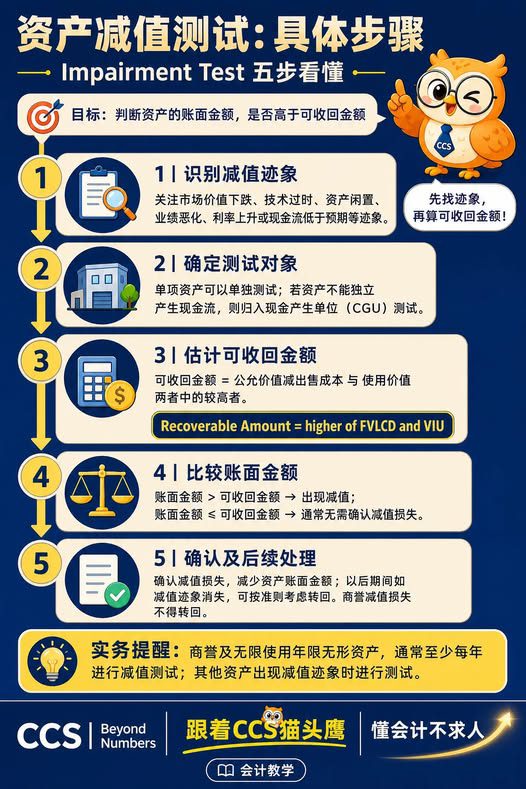
Asset impairment testing is essentially about asking:
How much is this asset really worth now, and is its carrying amount overstated?
If the carrying amount of an asset is higher than the amount that can be recovered from it, the asset is impaired and an impairment loss must be recognised.
A Simple Five-Step Process
1. Look for Indicators of Impairment
First, assess whether there are signs that the asset may have lost value.
Examples include:
- A machine is idle or underutilised;
- Products are no longer selling well;
- The market price of the asset has fallen significantly;
- A customer has ceased operations; or
- The asset’s performance has deteriorated.
Where an impairment indicator exists, further testing is required. Certain assets, such as goodwill and some intangible assets, may also require impairment testing in accordance with the applicable requirements even if no indicator is present.
2. Determine What Should Be Tested
An asset that can generate cash inflows independently may be tested separately.
If an asset cannot generate cash inflows independently, it should generally be tested together with the group of assets that generates cash inflows, known as a Cash-Generating Unit (CGU).
3. Calculate the Recoverable Amount
The recoverable amount is the higher of:
(a) Fair Value Less Costs of Disposal
How much could be obtained by selling the asset now, after deducting the costs of disposal?
(b) Value in Use
How much value can the asset generate if it continues to be used, based on the present value of expected future cash flows?
The higher of these two amounts is the asset’s recoverable amount.
4. Compare the Amounts
Compare the asset’s carrying amount with its recoverable amount.
- Carrying amount > Recoverable amount: The asset is impaired and an impairment loss must be recognised.
- Carrying amount ≤ Recoverable amount: No impairment loss is required based on that assessment.
5. Record and Review the Impairment
Once an impairment loss is recognised, the asset’s carrying amount is reduced.
If the asset’s recoverable amount subsequently improves, an impairment loss may generally be reversed, subject to the applicable requirements and limitations.
However, an impairment loss recognised for goodwill must not be reversed.
Impairment vs Depreciation and Amortisation
The difference can be remembered as follows:
Depreciation or amortisation is the normal, systematic allocation of an asset’s cost as it is used.
Impairment is the recognition that an asset has unexpectedly lost value and is no longer worth as much as its carrying amount.
In simple terms:
Depreciation and amortisation reflect normal use over time. Impairment reflects a sudden or significant decline in recoverable value.
CCS | Beyond Numbers
资产减值测试五步流程:MFRS 136 与 MPERS Section 27
资产减值测试,简单来说就是检查:
这项资产现在还值多少钱?财务报表上记录的账面金额是不是太高了?
如果资产的账面金额高于企业能够收回的金额,就表示资产可能已经发生减值,企业需要确认一笔减值损失,并降低资产的账面金额。
五步简单理解
第一步:先找有没有减值迹象
首先,要检查资产是否出现可能减值的信号。
例如:
- 机器长期闲置或使用率很低;
- 产品越来越卖不动;
- 资产的市场价格大幅下跌;
- 客户已经停止营业;或
- 资产的表现明显恶化。
如果出现减值迹象,就需要进一步进行减值测试。某些资产,例如商誉及部分无形资产,即使没有明显减值迹象,也可能需要根据适用规定进行减值测试。
第二步:确定要测试哪一项资产
如果一项资产可以独立产生现金流入,就可以单独进行减值测试。
如果一项资产不能独立产生现金流入,就需要与能够共同产生现金流入的资产组合在一起测试。这组资产称为现金产生单位(Cash-Generating Unit,CGU)。
第三步:计算可收回金额
可收回金额,是以下两个金额中较高的一个:
(a)公允价值减处置成本
如果现在把资产卖掉,扣除出售或处置相关费用后,能够收回多少钱?
(b)使用价值
如果继续使用这项资产,根据未来预计现金流量的现值,这项资产能够为企业带来多少价值?
以上两个金额中较高的一个,就是资产的可收回金额。
第四步:进行比较
将资产的账面金额与可收回金额进行比较:
- **账面金额 > 可收回金额:**资产发生减值,需要确认减值损失。
- **账面金额 ≤ 可收回金额:**根据这次评估,不需要确认减值损失。
第五步:记录减值,并持续检讨
确认减值损失后,应降低资产的账面金额。
如果之后资产的可收回金额回升,一般可以根据适用规定转回之前确认的减值损失,但仍须遵守相关限制。
不过,商誉已经确认的减值损失不得转回。
减值与折旧、摊销有什么分别?
可以这样记:
折旧或摊销,是资产在正常使用过程中,将成本有系统地分摊到各个期间。
减值,则是发现资产的可收回价值突然或明显下降,已经不再值原本账面上记录的那么多。
简单来说:
折旧和摊销反映资产随着时间正常使用而逐步消耗;减值反映资产的可收回价值突然或显著下降。
CCS | Beyond Numbers