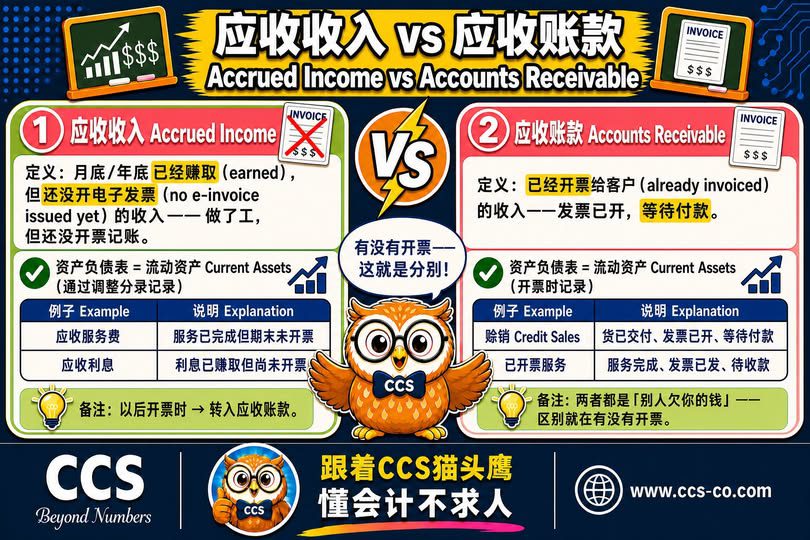
Both accrued income and accounts receivable represent amounts due from customers. So why do they have different names?
The key difference is the timing of invoicing.
Accrued Income
Accrued income arises when:
- The work has been completed;
- The income has already been earned; but
- The invoice has not yet been issued to the customer.
This commonly arises from month-end or year-end adjustments.
The amount is recorded through an adjusting entry and presented as accrued income until the invoice is issued.
Accounts Receivable
Accounts receivable arises when:
- The work has been completed;
- The income has been earned; and
- An invoice has already been issued to the customer.
The amount is recorded when the invoice is issued and remains as accounts receivable until payment is received.
A Simple Way to Remember
Has the invoice been issued? That is the key distinction.
- No invoice yet → Accrued income
- Invoice already issued → Accounts receivable
Once the invoice, including an e-Invoice where applicable, is subsequently issued, the accrued income balance is generally transferred to accounts receivable.
Both are current assets because they represent amounts due from customers. The difference is mainly the stage at which the amount is recognised and invoiced.
Accrued income means the income has been earned but not yet invoiced. Accounts receivable means the amount has been invoiced and is awaiting collection.
CCS | Beyond Numbers
应收收入与应收账款:到底有什么分别?
应收收入和应收账款,都是别人欠公司的钱。既然如此,为什么还要使用两个不同的名称?
真正的差别,在于开票的时间点。
应收收入(Accrued Income)
当以下情况发生时,通常会产生应收收入:
- 工作已经完成;
- 收入已经赚取;但是
- 还没有向客户开出发票。
这类情况常见于月结或年结时进行的调整。
企业会通过调整分录记录相关金额,并在发票开出之前,将其列为应收收入。
应收账款(Accounts Receivable)
当以下情况发生时,通常会形成应收账款:
- 工作已经完成;
- 收入已经赚取;以及
- 发票已经开给客户。
相关金额会在开票时入账,并继续列为应收账款,直到客户完成付款为止。
一个简单的记忆方法
有没有开出发票,就是关键区别。
- 还没有开发票 → 应收收入(Accrued Income)
- 已经开发票 → 应收账款(Accounts Receivable)
之后,当企业补开发票,包括在适用情况下开出电子发票时,应收收入一般会转入应收账款。
两者都属于流动资产,因为它们都代表客户应支付给企业的款项。主要区别在于,相关收入处于不同的确认及开票阶段。
应收收入是收入已经赚取,但还没有开发票;应收账款是发票已经开出,正在等待客户付款。
CCS | Beyond Numbers