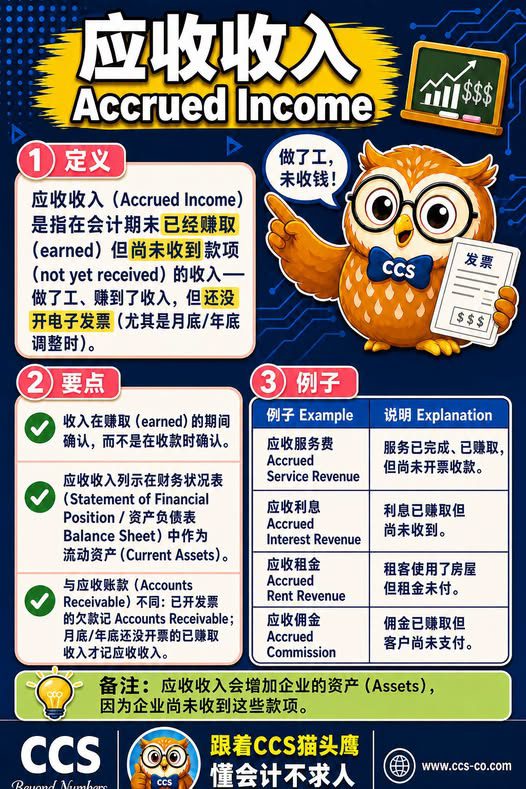
The work has been completed, the income has been earned, but no invoice has been issued. How should the income be recorded?
This is a common month-end and year-end issue for SME owners and junior accountants. One of the items most often overlooked in closing adjustments is accrued income.
A Common Situation
A company may have:
- Completed the services;
- Delivered the goods;
- Earned the income; but
- Not yet received payment or issued an invoice, including an e-Invoice where applicable.
If the accounts are closed without recording the income, the revenue for the period may be understated, which may also understate profit.
The timing between completing the work and issuing the e-Invoice therefore needs to be handled properly under accrual accounting.
Accrued Income vs Accounts Receivable
The distinction is mainly whether an invoice has been issued.
- Invoice already issued: Record the balance as Accounts Receivable.
- Income earned but no invoice issued at month end or year end: Record the balance as Accrued Income.
Both represent amounts owed to the company and are assets. The difference is the stage at which the income has been invoiced.
Typical Accounting Entries
At month end or year end, when the income has been earned but the invoice has not yet been issued:
Dr Accrued Income
Cr Revenue
When the invoice is subsequently issued:
Dr Accounts Receivable
Cr Accrued Income
This transfers the balance from accrued income to accounts receivable while avoiding duplicate recognition of the revenue.
Key Reminders
- Income is recognised when it is earned, not only when payment is received. This is a core principle of accrual accounting.
- Review completed work, delivered goods and services provided before closing the monthly or annual accounts.
- Record accrued income for revenue that has been earned but not yet invoiced.
- Transfer the balance to accounts receivable when the invoice or e-Invoice is issued.
- Do not omit the adjustment entry, as this may cause the reported revenue and profit for the period to be understated.
- Keep sufficient supporting documents, including service records, delivery documents, contracts and billing information, to support the accrual.
In simple terms:
Work completed and income earned, but not yet invoiced → Accrued Income.
Invoice issued but payment not yet received → Accounts Receivable.
CCS | Beyond Numbers
做了工、赚到了钱,但还没开票:这笔收入怎么记账?
服务已经完成,收入已经赚取,但发票还没有开出,这笔收入应该怎样记录?
这是许多 SME 老板和新手会计在月底或年底进行结账时经常遇到的问题。其中最容易漏记、也最需要关注的期末调整项目之一,就是应收收入(Accrued Income)。
常见情况
企业可能已经:
- 完成服务;
- 交付货物;
- 赚取收入;但是
- 还没有收到客户付款,也还没有开出发票,包括在适用情况下尚未开出电子发票。
如果企业在结账时没有记录这笔已经赚取的收入,该期间的 Revenue 可能会被低估,Profit 也可能因此被低估。
因此,在工作完成与开出 e-Invoice 之间的时间段,企业需要根据权责发生制进行适当的会计处理。
应收收入与应收账款有什么分别?
两者的主要区别,在于发票是否已经开出。
- **已经开出发票的欠款:**记录为 Accounts Receivable(应收账款)。
- **收入已经赚取,但截至月底或年底还没有开发票:**记录为 Accrued Income(应收收入)。
两者都代表客户欠企业的款项,也都属于资产。区别只是在于收入目前是否已经进入开票阶段。
常见会计分录
在月底或年底,如果收入已经赚取但发票尚未开出:
借:应收收入(Accrued Income)
贷:收入(Revenue)
之后开出发票时:
借:应收账款(Accounts Receivable)
贷:应收收入(Accrued Income)
这样可以把相关余额从应收收入转入应收账款,同时避免重复确认收入。
企业需要记住的重点
- 收入是在赚取时确认,而不是只有收到钱时才确认。这是权责发生制的核心原则。
- 在月结或年结前,应检查已经完成的工作、已经交付的货物及已经提供的服务。
- 对于已经赚取但尚未开票的收入,应确认应收收入。
- 发票或电子发票开出后,应将相关余额转入应收账款。
- 不要遗漏调整分录,否则该期间的 Revenue 和 Profit 可能被低估。
- 应保留足够的支持文件,例如服务记录、交付文件、合同及开票资料,以支持应收收入的确认。
简单来说:
工作已完成、收入已赚取,但还没有开票 → 应收收入。
发票已经开出,但客户还没有付款 → 应收账款。
CCS | Beyond Numbers