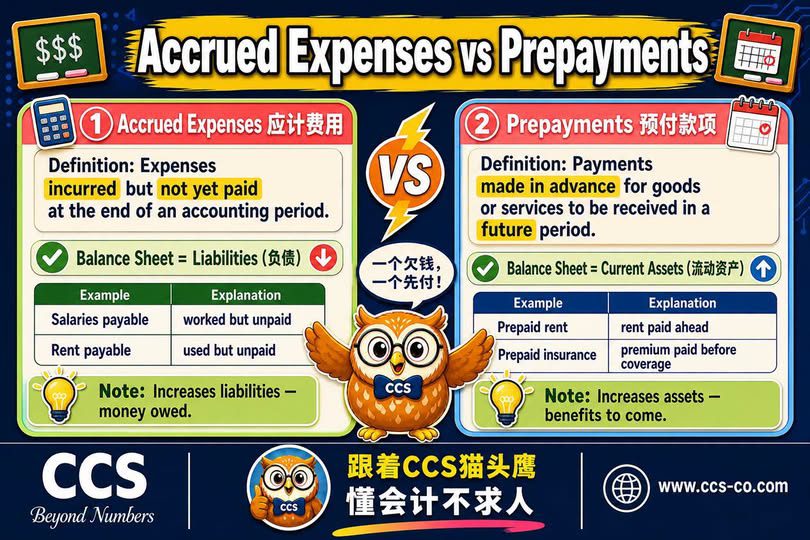
One means that the company owes money. The other means that the company has already paid in advance.
The two concepts are often confused, but the distinction is straightforward.
Accrued Expenses: Use First, Pay Later
Accrued expenses arise when:
- The company has already received or used the goods or services;
- The related expense has already been incurred; but
- Payment has not yet been made.
Because the company still owes money to another party, accrued expenses are recognised as a liability.
Examples
- Employees have already worked, but their salaries have not yet been paid;
- The company has used its office premises, but the rent has not yet been paid; or
- Utilities have been consumed, but the bill has not yet been settled.
A typical accounting entry is:
Dr Expense
Cr Accrued Expense or Accrued Payable
When payment is subsequently made:
Dr Accrued Expense or Accrued Payable
Cr Bank
Prepayments: Pay First, Use Later
Prepayments, also known as prepaid expenses, arise when:
- The company has already paid; but
- The related goods or services have not yet been fully received or used.
Because the company has already paid for future benefits, the amount is initially recognised as a current asset, provided the benefit is expected to be received within the next 12 months.
Examples
- Rent paid in advance;
- Insurance premiums paid before the coverage period begins; or
- Software subscriptions paid for a future period.
A typical entry when the payment is made is:
Dr Prepayment
Cr Bank
As the benefit is received or used:
Dr Expense
Cr Prepayment
A Simple Summary
Use first, pay later → Accrued expense → Liability
Pay first, use later → Prepayment → Asset
| Item | What Has Happened? | Balance Sheet Classification |
|---|---|---|
| Accrued expense | Goods or services used, payment not yet made | Liability |
| Prepayment | Payment made, goods or services not yet fully used | Current asset |
Do not confuse the two. Otherwise, the statement of financial position may not accurately reflect the company’s assets and obligations.
CCS | Beyond Numbers
应计费用与预付款项:哪个是负债,哪个是资产?
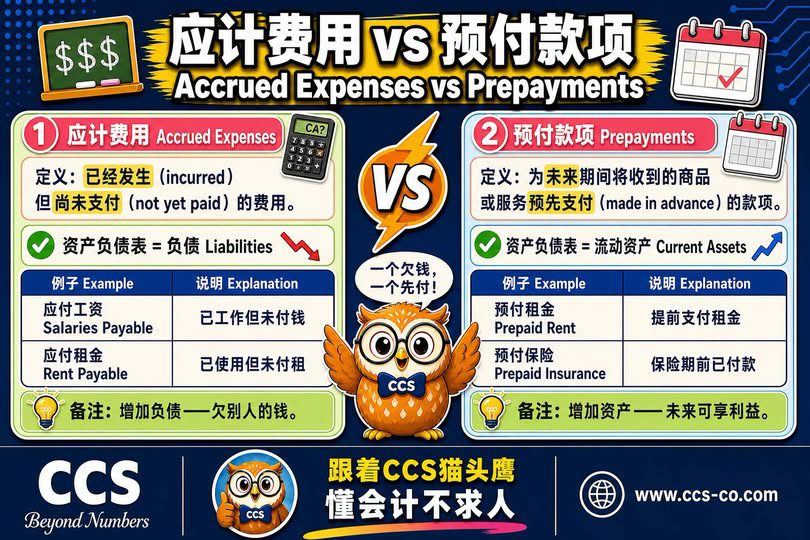
一个是公司欠别人钱,另一个是公司已经先把钱付出去了。
应计费用和预付款项经常被混淆,但两者的分别其实很清楚。
应计费用(Accrued Expenses):先享受,后付款
当以下情况发生时,就可能产生应计费用:
- 公司已经收到或使用了商品或服务;
- 相关费用已经发生;但是
- 公司还没有付款。
由于公司仍然欠另一方款项,应计费用会确认为一项负债。
例子
- 员工已经完成工作,但薪水还没有支付;
- 公司已经使用办公室,但租金还没有支付;或
- 水电已经使用,但账单还没有缴清。
常见会计分录为:
借:费用
贷:应计费用或应计应付款
之后实际付款时:
借:应计费用或应计应付款
贷:银行存款
预付款项(Prepayments/Prepaid Expenses):先付款,后使用
当以下情况发生时,就可能产生预付款项:
- 公司已经先付款;但是
- 相关商品或服务还没有完全收到或使用。
由于公司已经为未来的利益付款,这笔款项一开始会确认为流动资产,前提是相关利益预计会在未来 12 个月内实现或使用。
例子
- 提前支付租金;
- 在保险保障期开始前支付保险费;或
- 提前支付未来期间的软件订阅费。
付款时常见的会计分录为:
借:预付款项
贷:银行存款
随着相关商品或服务被使用:
借:费用
贷:预付款项
一个简单总结
先使用,后付款 → 应计费用 → 负债
先付款,后使用 → 预付款项 → 资产
| 项目 | 已经发生什么? | 资产负债表分类 |
|---|---|---|
| 应计费用 | 商品或服务已经使用,款项尚未支付 | 负债 |
| 预付款项 | 款项已经支付,商品或服务尚未完全使用 | 流动资产 |
千万不要把两者混淆,否则财务状况表可能无法准确反映公司的资产和义务。
CCS | Beyond Numbers