Does signing a contract mean that the company must immediately recognise an asset and a liability?
Not necessarily.
MPERS 2025 Section 2 highlights two important concepts:
- Unit of account; and
- Executory contracts.
Understanding these concepts helps explain why the signing of a contract does not, by itself, determine the accounting treatment.
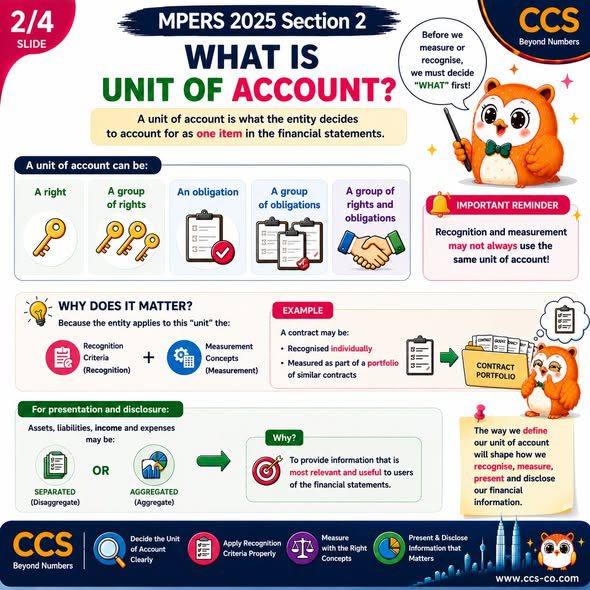
What Is a Unit of Account?
A unit of account refers to what the entity treats as a single accounting item for recognition and measurement purposes.
Depending on the circumstances, the unit of account may be:
- A single right;
- A group of rights;
- A single obligation;
- A group of obligations; or
- A combination of rights and obligations.
The appropriate unit of account depends on the nature of the arrangement and the economic substance of the rights and obligations created.
What Is an Executory Contract?
An executory contract is a contract under which:
- Neither party has performed its obligations; or
- Both parties have performed their obligations to approximately the same extent.
The contract creates both a right and an obligation for each party. When considered together, those rights and obligations may form a single asset or a single liability rather than separate assets and liabilities.
Favourable or Unfavourable Exchange Terms
The accounting outcome may depend on whether the exchange terms are favourable or unfavourable to the entity.
- If the exchange terms are currently favourable, the net position may represent an asset;
- If the exchange terms are currently unfavourable, the net position may represent a liability.
The analysis should consider the rights and obligations together rather than looking at only one side of the contract.
The Key Principle
Do not look only at whether the contract has been signed. Assess the rights, obligations and economic substance of the exchange.
A signed contract does not automatically mean that separate asset and liability balances should be recognised immediately.
The entity should assess the specific terms of the arrangement and apply the relevant recognition requirements under MPERS 2025.
CCS | Beyond Numbers
合同签了,是不是马上就要确认资产和负债?
合同签署后,是不是公司就必须马上确认一项资产和一项负债?
答案是:
未必。
MPERS 2025 Section 2 提到了两个重要概念:
- 会计单位(Unit of Account);以及
- 待履行合同(Executory Contract)。
理解这两个概念,就能明白为什么“合同已经签了”本身,并不能自动决定会计处理方式。
什么是会计单位?
会计单位(Unit of Account),简单来说,就是企业在确认及计量时,究竟把什么视为一个会计项目。
根据具体情况,会计单位可以是:
- 一项权利;
- 一组权利;
- 一项义务;
- 一组义务;或
- 权利与义务的组合。
会计单位的确定,取决于交易安排的性质,以及相关权利和义务背后的经济实质。
什么是待履行合同?
待履行合同(Executory Contract),是指:
- 合同双方都还没有履行各自的义务;或
- 双方已经按照大致相同的程度履行义务。
这类合同会同时为双方产生权利和义务。将这些权利与义务放在一起考虑后,最终可能形成一项资产或一项负债,而不是分别确认一项资产和一项负债。
交换条件有利还是不利?
会计处理结果,可能取决于交换条件对企业目前是有利还是不利。
- 如果交换条件目前对企业有利,净额可能代表一项资产;
- 如果交换条件目前对企业不利,净额可能代表一项负债。
分析时,应把合同中的权利和义务放在一起考虑,而不是只看其中一方。
关键原则
不要只看合同有没有签署,而要分析合同产生的权利、义务,以及交换安排背后的经济实质。
合同已经签署,并不代表企业一定要立即分别确认一项资产和一项负债。
企业应根据具体合同条款及安排,按照 MPERS 2025 的相关确认要求进行评估。
CCS | Beyond Numbers