Day: October 15, 2026

  • e-Invoice Exemption: Should a Buyer Still Request an e-Invoice from Its Supplier?

    e-Invoice Exemption: Should a Buyer Still Request an e-Invoice from Its Supplier?

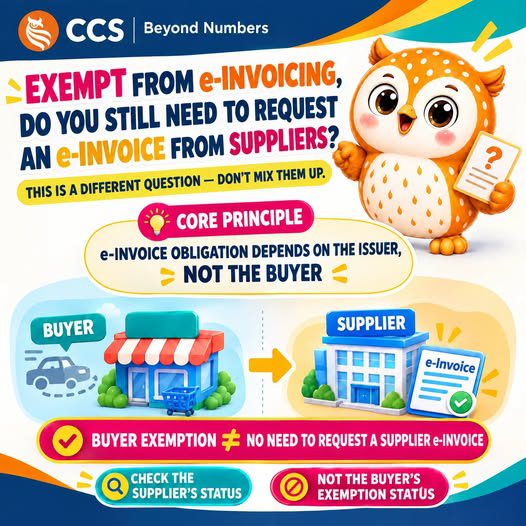
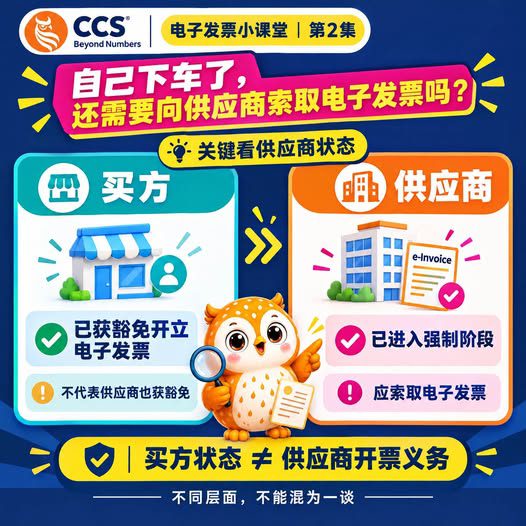
    A buyer’s exemption from issuing e-Invoices and a supplier’s obligation to issue them are separate matters and should not be confused.

    The Core Principle: The Issuance Requirement Depends on the Supplier

    Whether e-Invoice issuance is mandatory is determined by the seller’s (supplier’s) annual turnover or revenue and the applicable threshold. The current threshold is RM3 million, as stated in paragraph 1.6.10 of the e-Invoice Guideline v4.8.

    This is not directly related to whether the buyer is “out of scope”—that is, whether the buyer’s own turnover is below RM3 million and it is exempt from issuing e-Invoices.

    A business’s exemption means that, when acting as a seller, it is not required to issue e-Invoices to its customers. It does not change the requirements that apply when the business acts as a buyer and requests an invoice from a supplier.

    Should a Buyer Request an e-Invoice from Its Supplier?

    The key factor is the supplier’s e-Invoice status.

    Scenario 1: The Supplier Has Reached the Mandatory Implementation Threshold

    If the supplier has reached the mandatory implementation threshold and has started issuing e-Invoices, the buyer should request one as supporting documentation for claiming the expense as a tax deduction.

    Even if the buyer is exempt from issuing e-Invoices, requesting one from a supplier that is already issuing e-Invoices through the MyInvois system is the prudent approach.

    Scenario 2: The Supplier Has Not Reached the Threshold or Is Exempt

    During the transition period, the buyer may use an ordinary invoice or receipt to support a tax deduction. An e-Invoice is not compulsory if the supplier has not yet reached its mandatory implementation date or is exempt.

    The official FAQs state that, during the transition period, taxpayers may use ordinary bills, receipts or invoices from suppliers that have not yet reached their mandatory implementation date or are exempt to substantiate business expenses, until e-Invoicing is fully implemented.

    Additional Clarification

    If a supplier claims to be exempt but is not actually eligible, the compliance obligation generally rests with the issuer—the supplier—rather than the buyer, who records the expense using an ordinary invoice.

    In summary: Whether your business is “out of scope” does not determine whether you should request an e-Invoice as a buyer. The key question is whether your supplier has entered the mandatory e-Invoice implementation phase.

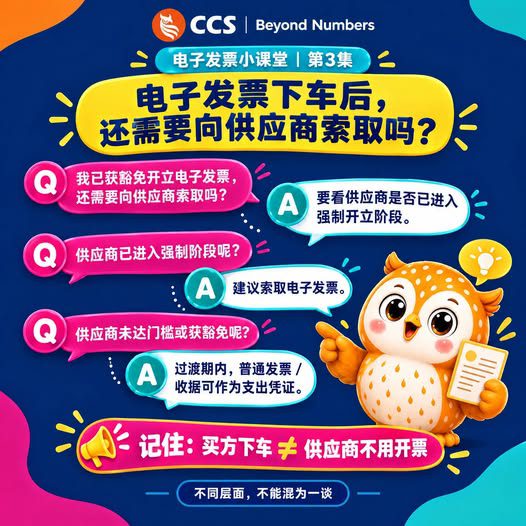
    买方获豁免,仍需向供应商索取 e-Invoice 吗?

    买方是否获豁免开具 e-Invoice,与供应商是否有义务开具 e-Invoice,是两个不同层面的问题,不能混为一谈。

    核心原则:开票义务取决于供应商

    是否必须开具 e-Invoice,取决于卖方(供应商)的年度营业额或收入是否达到适用门槛。目前的门槛为RM300万,参见《e-Invoice Guideline v4.8》第1.6.10段。

    这与买方是否“下车”并无直接关系。所谓“下车”,是指买方自身营业额低于RM300万,因此获豁免开具 e-Invoice。

    换言之,企业获豁免,代表其作为卖方时无需向自己的客户开具 e-Invoice;但这不会改变其作为买方向供应商索取发票时所适用的规则。

    买方是否应向供应商索取 e-Invoice?

    关键在于供应商自身的 e-Invoice 实施状态。

    情况一:供应商已达到强制实施门槛

    如果供应商已达到强制实施门槛并开始开具 e-Invoice,买方应向供应商索取 e-Invoice,作为申报扣除该笔支出的凭证。

    即使买方本身获豁免开具 e-Invoice,只要供应商已在MyInvois系统开具 e-Invoice,向供应商索取仍是较稳妥的做法。

    情况二:供应商尚未达到门槛或本身获豁免

    在过渡期间,如果供应商尚未进入强制实施阶段或本身获豁免,买方仍可使用普通发票或收据作为申报扣除该笔支出的凭证,并非必须索取 e-Invoice。

    官方常见问题解答指出,在过渡期间,纳税人可以使用尚未达到强制实施期限或获豁免的供应商所提供的普通账单、收据或发票,作为证明交易支出的凭证,直至 e-Invoice 全面落实。

    补充说明

    如果供应商声称自己属于豁免范围,但实际上并不符合资格,原则上,合规义务在于开具发票的一方——供应商,而非使用普通发票入账的买方。

    简单来说:自己是否“下车”,不影响您作为买方判断是否应索取发票。真正要看的是供应商是否已进入 e-Invoice 强制实施阶段。
  • e-Invoice Exemption: Does the Buyer Still Need to Request an e-Invoice from the Supplier?

    e-Invoice Exemption: Does the Buyer Still Need to Request an e-Invoice from the Supplier?

    Not necessarily—but the buyer’s exemption does not determine the supplier’s obligations.

    Businesses sometimes confuse two separate matters: whether they are required to issue e-Invoices themselves, and whether their suppliers are required to issue e-Invoices. These are separate obligations.

    The requirement to issue an e-Invoice primarily depends on the supplier as the issuing party; it is not determined solely by whether the buyer is exempt.

    Even if your business falls within an exemption, it is prudent to request an e-Invoice if your supplier has entered the mandatory implementation phase. If the supplier has not yet reached the implementation threshold or is exempt, an ordinary invoice, bill or receipt may still serve as an important record of the expense during the transition period.

    Remember: A buyer’s exemption does not mean that the supplier is exempt from issuing an e-Invoice.

    买方获豁免,仍需向供应商索取 e-Invoice 吗?

    不一定,但买方获豁免,并不决定供应商是否须开具 e-Invoice。

    不少商家会把两个不同的问题混为一谈:企业自身是否需要开具 e-Invoice,以及供应商是否需要开具 e-Invoice。这是两项不同的义务。

    是否需要开具 e-Invoice,主要取决于作为开票方的供应商,而不能只看买方是否获得豁免。

    即使您的企业属于豁免范围,只要供应商已进入 e-Invoice 强制实施阶段,向供应商索取 e-Invoice 仍是较稳妥的做法。如果供应商尚未达到实施门槛或属于豁免范围,在过渡期间,普通发票、账单或收据仍可能是记录支出的重要凭证。

    请记住:买方获豁免,不代表供应商也获豁免。

  • e-Invoice Exemption: Should You Still Request an e-Invoice from Your Supplier?

    e-Invoice Exemption: Should You Still Request an e-Invoice from Your Supplier?

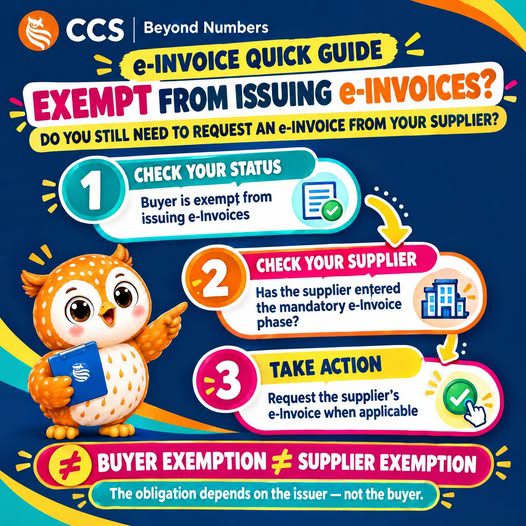
    If your business is exempt from issuing e-Invoices, you should still request one from your supplier if the supplier has entered the mandatory e-Invoice phase.

    Your exemption applies only to your own obligation to issue e-Invoices. It does not automatically exempt your supplier.

    Buyer exemption does not mean supplier exemption. Always check your supplier’s e-Invoice status.

    获豁免开具 e-Invoice,仍需向供应商索取吗?

    如果您的企业获豁免开具 e-Invoice,但供应商已进入 e-Invoice 强制实施阶段,您仍应向供应商索取 e-Invoice。

    您的豁免仅适用于自身开具 e-Invoice 的义务,并不会自动延伸至供应商。

    买方获豁免,不代表供应商也获豁免。请务必确认供应商的 e-Invoice 实施状态。

  • e-Invoice Exemption: Do You Still Need to Request One from Your Supplier?

    e-Invoice Exemption: Do You Still Need to Request One from Your Supplier?

    If your business is exempt from issuing e-Invoices, you may still need to request one from your supplier if the supplier has entered the mandatory e-Invoice phase.

    Your exemption applies only to your own obligation to issue e-Invoices. It does not automatically exempt your supplier.

    Buyer exemption does not mean supplier exemption. Always check your supplier’s e-Invoice status.

    免开 e-Invoice,仍需向供应商索取吗?

    如果您的企业获豁免开具 e-Invoice,当供应商已进入强制实施阶段时,您仍可能需要向供应商索取 e-Invoice。

    您的豁免仅适用于自身开具 e-Invoice 的义务,并不会自动延伸至供应商。

    买方获豁免,不代表供应商也获豁免。请务必确认供应商的 e-Invoice 实施状态。

  • e-Invoicing Is About Building Better Business Records, Not Instant Perfection

    e-Invoicing Is About Building Better Business Records, Not Instant Perfection

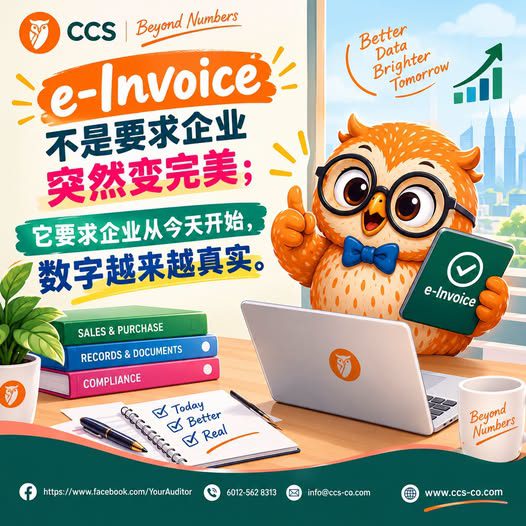
    e-Invoicing does not require businesses to become perfect overnight.

    Its real purpose is to encourage businesses, from today onwards, to make every transaction, record and figure increasingly accurate, complete and traceable.

    A business does not need to achieve a perfect score immediately. What matters is taking steps now to improve its processes, records and data.

    As business information becomes more accurate, compliance is not the only benefit. Businesses can also gain a clearer and more reliable picture of their operations.

    CCS | Beyond Numbers
    Better Data. Brighter Tomorrow.

    e-Invoice 并非要求企业一夜之间变得完美

    e-Invoice并不是要求企业一夜之间做到完美。

    它真正推动的是企业从现在开始,让每一笔交易、每一份记录和每一个数字,都变得越来越真实、完整且有迹可循。

    企业不必立即做到满分。重要的是从现在开始,逐步完善流程、记录与数据。

    当业务数据越来越真实,企业获得的就不只是合规,更能看清一个更清晰、更可靠的生意。

    CCS | Beyond Numbers
    更好的数据,更明亮的未来。

  • Build the Business First, Then Get the Tax Right

    Build the Business First, Then Get the Tax Right

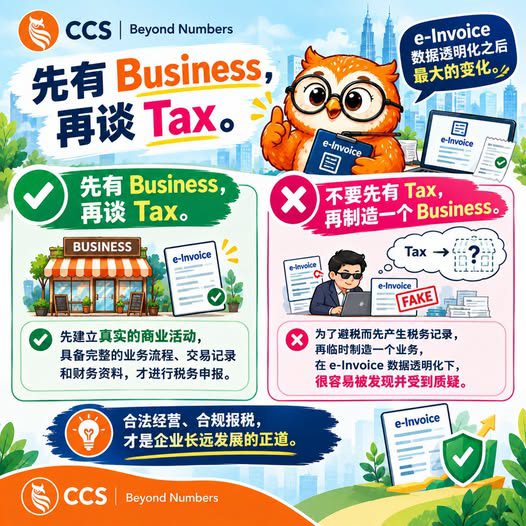
    Tax reporting should be grounded in genuine business activities: real business operations, transactions and income. A business should not be put together simply to create tax records.

    As e-Invoicing makes transaction data more transparent, a company’s business model, transaction processes and financial records need to be consistent with one another.

    Build the business first, then get the tax right.

    Lawful operations, genuine transactions and complete records are the foundation for a business’s long-term development.

    CCS | Beyond Numbers

    先有生意,再谈税务

    税务申报应建立在真实的商业活动之上——企业的业务、交易与收入都应真实存在,而不是为了“制造”税务记录,才临时拼凑出一个业务。

    随着 e-Invoice 推动交易数据更加透明,企业的业务模式、交易流程与财务记录之间,也需要保持一致。

    先把生意做好,再把税务做好。

    合法经营、真实交易与完整记录,才是企业长期发展的基础。

    CCS | Beyond Numbers

  • e-Invoice Buyer Information Requirements for the Aviation Industry

    e-Invoice Buyer Information Requirements for the Aviation Industry

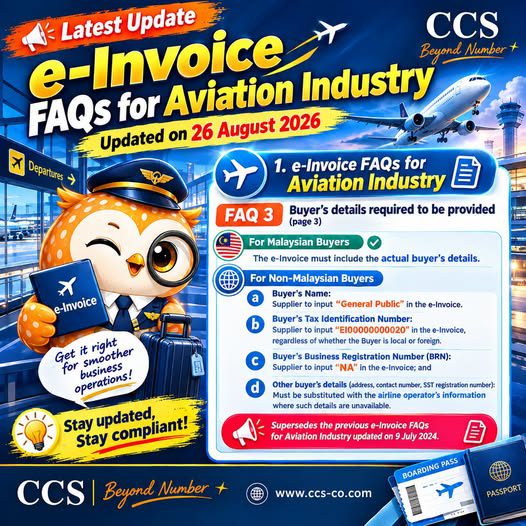
    FAQ 3 of the e-Invoice FAQs for the Aviation Industry (page 3) sets out the buyer information to be provided:

    • Malaysian buyers: The e-Invoice must include the actual buyer’s details.

    • Non-Malaysian buyers: If the buyer’s address, contact number or SST registration number is unavailable, the airline operator’s information must be provided in its place.

    This FAQ supersedes the previous e-Invoice FAQs for the Aviation Industry, updated on 9 July 2024.

    航空业 e-Invoice 买方资料要求

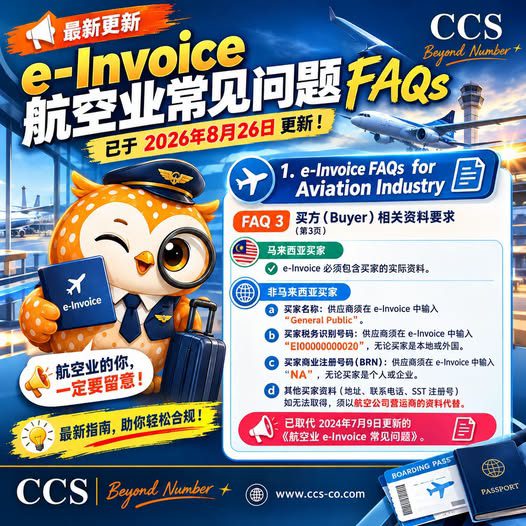
    《航空业 e-Invoice 常见问题解答》第3页的常见问题3,说明了须提供的买方资料:

    • 马来西亚买方:e-Invoice必须包含实际买方的资料。

    • 非马来西亚买方:如果无法取得买方的地址、联系电话或SST注册号码,则须以航空公司运营方的资料替代。

    本文件取代此前于2024年7月9日更新的《航空业 e-Invoice 常见问题解答》。

  • e-Invoice Requirements for Pawnbroking Transactions: Loan Principal, Fees and Interest

    e-Invoice Requirements for Pawnbroking Transactions: Loan Principal, Fees and Interest

    Q: Does a pawnbroker need to issue an e-Invoice when lending money?

    The loan principal advanced by a pawnbroker does not require an e-Invoice.

    However, e-Invoices are required for:

    • Pawnbroking fees

    • Interest on redemption or renewal

    The document to provide to the customer depends on whether an e-Invoice is requested:

    • If the customer requests an e-Invoice: issue an e-Invoice.

    • If the customer does not request one: provide a receipt.

    Transactions for which individual e-Invoices have not been issued should not be overlooked. At month-end, consolidate these transactions and issue a consolidated e-Invoice within seven days.

    In short: No e-Invoice is required for the loan principal, but pawnbroking fees and interest must be invoiced.

    典当借款也要了解 e-Invoice 的处理方式

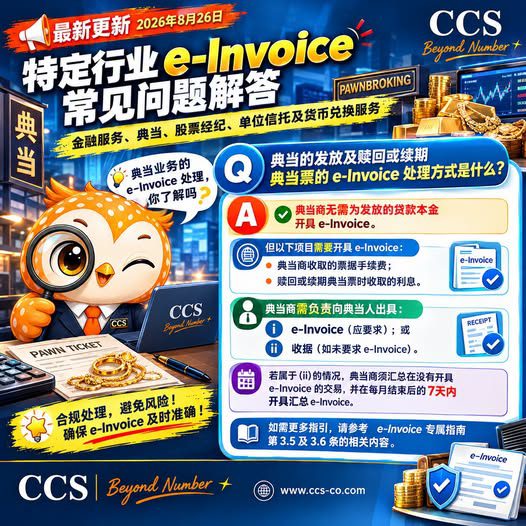
    问:典当行借出款项,需要开具 e-Invoice 吗?

    典当行借出的贷款本金无需开具 e-Invoice。

    不过,以下项目需要开具 e-Invoice:

    • 典当手续费

    • 赎回或续当利息

    是否向客户开具 e-Invoice,取决于客户是否提出要求:

    • 客户要求开具 e-Invoice:开具 e-Invoice。

    • 客户没有要求:提供收据。

    没有逐笔开具 e-Invoice 的交易也别漏掉。月底应汇总这些交易,并在七天内开具汇总 e-Invoice(Consolidated e-Invoice)。

    简单来说:贷款本金不用开 e-Invoice,但典当手续费和利息需要开具。

  • Self-Billed e-Invoice for Unredeemed Pledged Goods Where the Loan Is RM200 or Less

    Self-Billed e-Invoice for Unredeemed Pledged Goods Where the Loan Is RM200 or Less

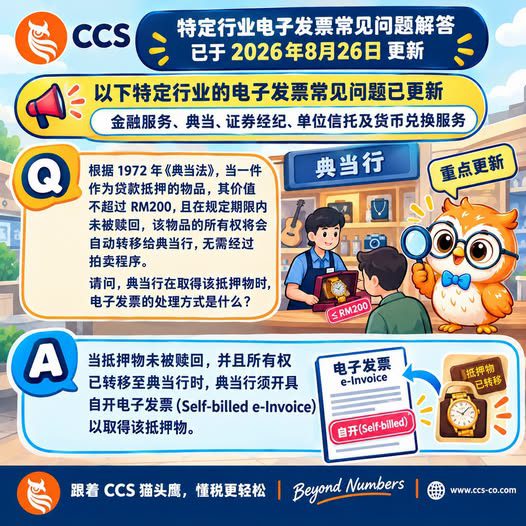
    The Specific Industry e-Invoice FAQs were updated on 26 August 2026. They clarify the e-Invoice treatment when pledged goods are not redeemed and the loan amount is RM200 or less.

    Under the Pawnbrokers Act 1972, if the pledged goods are not redeemed within the prescribed period, ownership automatically transfers to the pawnbroker. No auction is required.

    In this situation, the pawnbroker must issue a self-billed e-Invoice for the acquisition of the pledged goods.

    In short: If goods securing a loan of RM200 or less are not redeemed, ownership transfers to the pawnbroker and a self-billed e-Invoice is required. This requirement also applies when ownership transfers automatically without an auction.

    CCS Cat Owl | Beyond Numbers

    贷款不超过RM200的典当物未获赎回,需要开具自开 e-Invoice 吗?

    Specific Industry e-Invoice FAQs于2026年8月26日更新,说明贷款金额不超过RM200而典当物未获赎回时的 e-Invoice 处理方式。

    根据《1972年典当商法令》(Pawnbrokers Act 1972),如果典当物在规定期限内未获赎回,其所有权将自动转归典当商,无需经过拍卖程序。

    在此情况下,典当商必须就取得该典当物开具自开 e-Invoice(Self-Billed e-Invoice)。

    简单来说:贷款金额不超过RM200的典当物未获赎回时,所有权转归典当商,典当商须开具自开 e-Invoice。即使所有权是自动转移而非经拍卖取得,也不能忽略这项要求。

    CCS Cat Owl|Beyond Numbers

  • e-Invoice Requirements When Pledged Goods Are Purchased at Auction

    e-Invoice Requirements When Pledged Goods Are Purchased at Auction

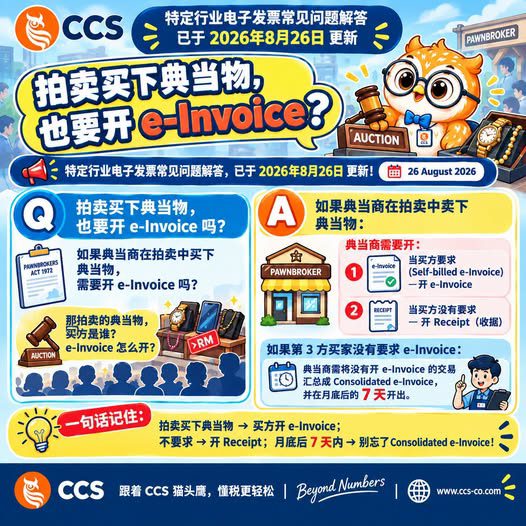
    When a loan exceeds RM200 and the pledged goods are not redeemed, the goods enter the auction process. The e-Invoice treatment depends on who purchases them.

    Scenario 1: The Pawnbroker Purchases the Goods

    If the pawnbroker buys the pledged goods at auction:

    • Self-billed e-Invoice: Issued for the purchase of the pledged goods.

    • e-Invoice: Issued for interest and any other applicable charges.

    Scenario 2: A Third-Party Bidder Purchases the Goods

    If a third-party bidder buys the pledged goods at auction:

    • Self-billed e-Invoice: The third-party bidder issues it for the purchase of the pledged goods.

    • e-Invoice: The pawnbroker issues it for interest and any other applicable charges.

    In short: The buyer of the pledged goods handles the self-billed e-Invoice for the purchase. The pawnbroker separately issues an e-Invoice for interest and applicable charges.

    CCS Cat Owl | Beyond Numbers

    典当物拍卖后由买方购得,需要开具 e-Invoice 吗?

    当借款超过RM200,而典当物未获赎回时,典当物将进入拍卖程序。e-Invoice的处理方式取决于买方是谁。

    情况一:典当商买下典当物

    如果典当商在拍卖中买下典当物:

    • 自开 e-Invoice(Self-Billed e-Invoice):用于购买典当物。

    • e-Invoice:用于利息及其他适用费用。

    情况二:第三方竞标者买下典当物

    如果第三方竞标者在拍卖中买下典当物:

    • 自开 e-Invoice(Self-Billed e-Invoice):由第三方竞标者就购买典当物开具。

    • e-Invoice:由典当商就利息及其他适用费用开具。

    简单来说:谁买下典当物,谁就负责购买该典当物的自开 e-Invoice;典当商则另行就利息及适用费用开具 e-Invoice。

    CCS Cat Owl|Beyond Numbers