
Day: October 15, 2026

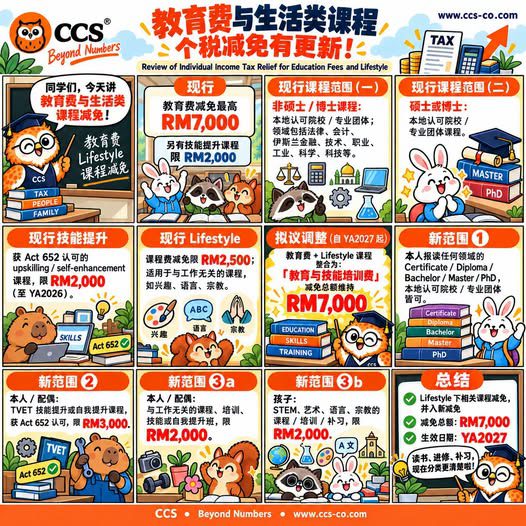
  • YA 2027: Education and Skills Training Tax Relief Consolidated Under a RM7,000 Cap

    YA 2027: Education and Skills Training Tax Relief Consolidated Under a RM7,000 Cap

    Claiming tax relief for education expenses can feel like a classification exercise: does a course qualify as education fees, lifestyle expenses or TVET training?

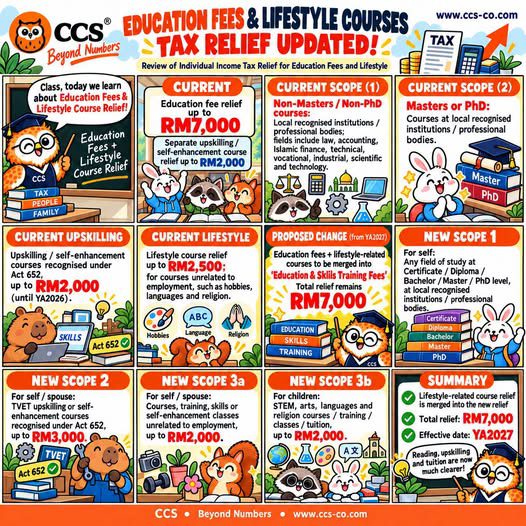
    From Year of Assessment (YA) 2027, education expenses and related skills training courses will be consolidated under “Education and Skills Training Fees”. The total deduction cap remains RM7,000, while the scope and sub-limits are set out more clearly.

    Subject to the applicable requirements:

    • Fees for the taxpayer’s Certificate, Diploma, Bachelor’s, Master’s or PhD studies may qualify.

    • The taxpayer or their spouse may claim up to RM3,000 within the RM7,000 overall limit for an eligible TVET programme.

    • A separate portion, capped at RM2,000, applies to courses unrelated to the taxpayer’s or spouse’s work, or to children’s courses in STEM, arts, languages or religion.

    The changes do not mean taxpayers should sign up for every course available. But if you or your family are already planning to study or attend eligible courses, it is worth checking the requirements so you do not overlook the available relief.

    In short: From YA 2027, eligible education and skills training expenses are grouped under one category, with the overall deduction cap remaining RM7,000.

    YA 2027:教育与技能培训费用整合,减免上限维持RM7,000

    申报教育相关税务减免,有时就像在做分类题:这项属于教育费用、生活方式开销,还是TVET培训?

    从2027课税年度(YA 2027)起,教育费用及相关技能培训课程将整合为“教育与技能培训费用”(Education and Skills Training Fees),总减免上限维持RM7,000,适用范围及分项上限也更加明确。

    在符合相关条件的情况下:

    • 纳税人修读Certificate、Diploma、Bachelor’s、Master’s或PhD课程的费用可能符合资格。

    • 纳税人或其配偶修读合资格的TVET课程,可在RM7,000总上限内申报,相关减免最高为RM3,000。

    • 另有最高RM2,000的分项上限,适用于纳税人或其配偶修读与工作无关的课程,或子女修读STEM、艺术、语言或宗教课程。

    这并不是鼓励大家报名参加所有课程。不过,如果您或家人本来就计划进修或参加符合条件的课程,记得先确认适用要求,以免错过可申报的减免。

    简单来说:从YA 2027起,符合条件的教育与技能培训费用归入同一类别,总减免上限仍为RM7,000。
  • Budget 2027: Proposed Payment-Traceability Requirement for Salary Deductions

    Budget 2027: Proposed Payment-Traceability Requirement for Salary Deductions

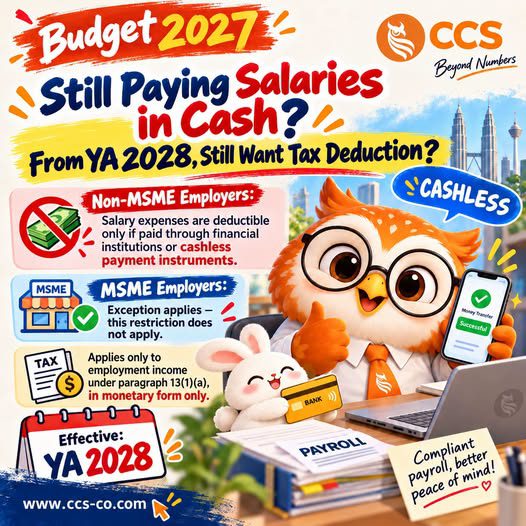
    Under a new measure announced in Budget 2027, employers seeking a tax deduction for salary payments will need to ensure that the payments can be traced.

    Payments made by bank transfer, e-wallet or cheque leave a record that can be used to support a deduction claim. Cash payments, by contrast, may not meet the proposed traceability requirement because they do not provide the same visible payment trail.

    Micro, small and medium-sized enterprise (MSME) employers are exempt from the measure.

    The requirement is stated to take effect from Year of Assessment (YA) 2028, giving employers time to establish cashless salary payment processes.

    In short: For salary payments to support a tax deduction under the new measure, employers will need to keep a clear payment trail.

    Budget 2027:薪资扣税拟要求付款留有记录

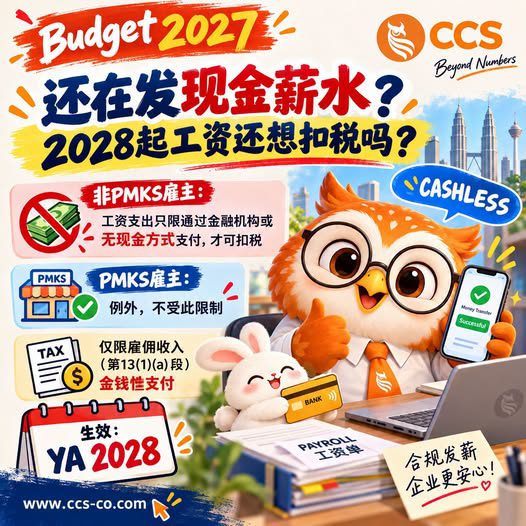
    根据《2027年财政预算案》公布的新措施,雇主若要就薪资支出申请税务扣除,须确保付款过程可追溯。

    通过银行转账、电子钱包或支票付款,会留下记录,可用于支持扣税申请。相比之下,现金付款无法提供同样清晰的付款记录,因此可能不符合拟议的可追溯要求。

    微型、小型及中型企业(MSME)雇主获豁免适用这项措施。

    该要求据称将从2028课税年度(YA)起生效,雇主尚有时间建立无现金支付薪资的流程。

    简单来说:根据这项新措施,雇主若要以薪资支出申请税务扣除,就需要保留清晰的付款记录。

  • Budget 2027: Proposed Extension of Tax Incentives for International Events to 2030

    Budget 2027: Proposed Extension of Tax Incentives for International Events to 2030

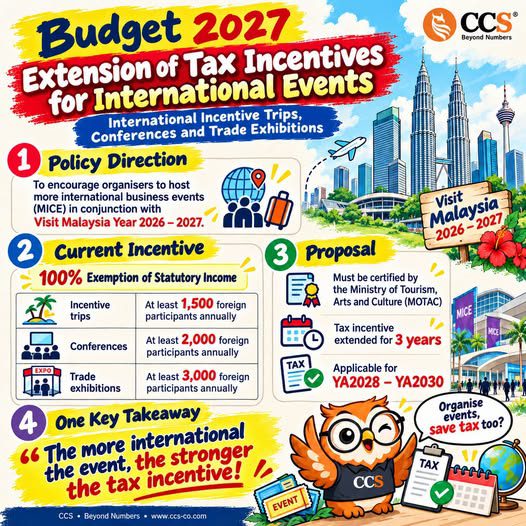
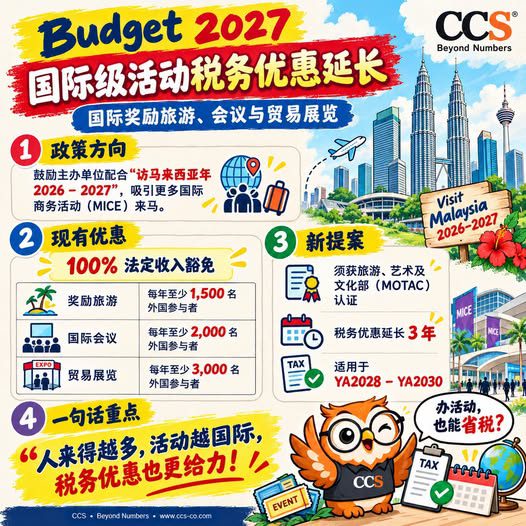
    Hosting international events in Malaysia may come with significant tax benefits. Budget 2027 proposes extending the tax incentives for international events for three years, covering Years of Assessment (YA) 2028 to 2030.

    The proposal is aligned with Visit Malaysia Year 2026–2027. Eligible events may qualify for a 100% exemption of statutory income, subject to the applicable requirements.

    Annual Participant Thresholds

    The stated thresholds for foreign participants are:

    • Incentive travel: 1,500 participants per year

    • International conferences: 2,000 participants per year

    • Trade exhibitions: 3,000 participants per year

    The proposal also refers to endorsement by the Ministry of Tourism, Arts and Culture Malaysia (MOTAC).

    The proposed three-year extension could provide an opportunity for organisers to bring more international events and participants to Malaysia. The applicable eligibility criteria and implementation details will be important in determining how the incentive operates.

    CCS | Beyond Numbers

    Budget 2027:拟将国际活动税务优惠延长至2030年

    在马来西亚举办国际活动,可能享有相应的税务优惠。《2027年财政预算案》提出将国际活动税务优惠延长三年,适用于2028至2030课税年度(YA)。

    这项提案配合“2026–2027马来西亚旅游年”(Visit Malaysia Year 2026–2027)推出。符合条件的活动可享有法定收入100%豁免,具体仍须遵守适用要求。

    每年外国参与者人数门槛

    相关活动所列的外国参与者人数门槛如下:

    • 奖励旅游:每年1,500人

    • 国际会议:每年2,000人

    • 贸易展览:每年3,000人

    提案也提及须获得马来西亚旅游、艺术及文化部(MOTAC)认可。

    拟议的三年延长措施,或为主办方吸引更多国际活动及参与者到马来西亚提供机会。实际优惠如何落实,仍有赖于适用资格条件及后续执行细节。

    CCS | Beyond Numbers

  • Proposed 2027 e-Invoice Rules for E-Commerce Platforms: Could They Cover Overseas Transactions?

    Proposed 2027 e-Invoice Rules for E-Commerce Platforms: Could They Cover Overseas Transactions?

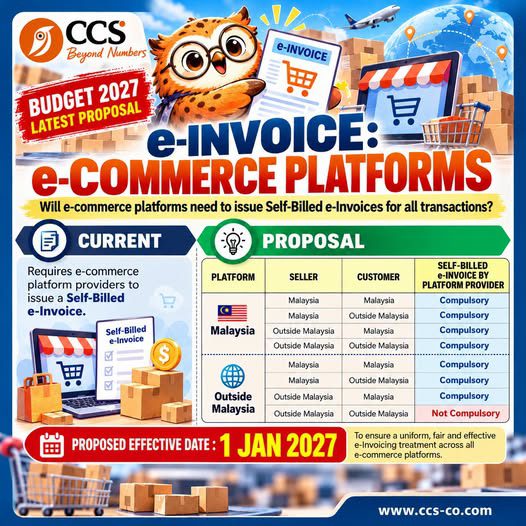
    The 2027 Budget proposes standardising how e-commerce platforms handle self-billed e-Invoices, with clearer rules for domestic and international transactions. The proposed effective date is 1 January 2027.

    Under the proposal, platform providers would generally be required to issue self-billed e-Invoices in seven of the eight possible combinations involving the location of the platform, seller and buyer. The scenarios highlighted include:

    • Malaysian seller to Malaysian buyer;

    • Malaysian seller to overseas buyer;

    • overseas seller to Malaysian buyer; and

    • overseas seller to overseas buyer, where the platform is based in Malaysia.

    The only combination identified as outside the proposed requirement is an overseas platform serving an overseas seller and an overseas buyer.

    The Proposal Is Not Yet Final

    This remains a policy proposal under the 2027 Budget. Its implementation will be subject to the guidelines and enforcement rules that the Inland Revenue Board of Malaysia (LHDN) is expected to issue.

    What Does This Mean for Sellers?

    Having a platform issue a self-billed e-Invoice may make invoicing more convenient. However, it does not necessarily mean sellers can leave all tax matters to the platform. Responsibility for issuing an invoice should not be confused with responsibility for a seller’s wider tax obligations.

    Will the proposal make e-commerce more convenient, or increase platforms’ compliance costs? The detailed guidelines should clarify how the requirements will work in practice.

    CCS | Beyond Numbers

    2027年起,电商平台的自开 e-Invoice 会涵盖海外交易吗?

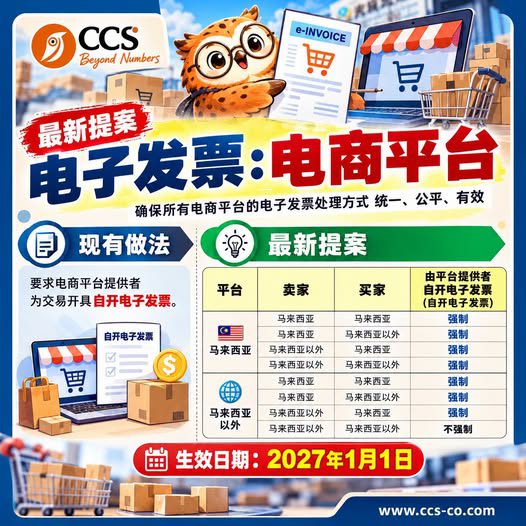
    《2027年财政预算案》提出统一电商平台处理自开电子发票(Self-Billed e-Invoice)的方式,并进一步明确国内及国际交易的相关规则。建议生效日期为2027年1月1日。

    根据这项提案,涉及平台、卖家和买家所在地的八种可能组合中,原则上有七种须由平台提供者开具自开电子发票。提案特别列出的情形包括:

    • 马来西亚卖家向马来西亚买家销售;

    • 马来西亚卖家向海外买家销售;

    • 海外卖家向马来西亚买家销售;以及

    • 海外卖家向海外买家销售,但平台设在马来西亚。

    提案指出,唯一不适用的组合是:平台、卖家和买家均位于海外。

    提案尚待落实细则

    这仍是《2027年财政预算案》中的政策提案。具体实施方式仍须以马来西亚内陆税收局(LHDN)之后发布的指南及执行规定为准。

    对卖家意味着什么?

    由平台开具自开 e-Invoice,或许能让开票流程更方便,但这并不代表卖家可以把所有税务事项都交由平台处理。开票责任与卖家整体税务责任不能混为一谈。

    这项提案会让电商交易更便利,还是会增加平台的合规成本?后续发布的详细指南将有助于厘清实际执行方式。

    CCS | Beyond Numbers

  • E-Invoice Guideline v4.9, Paragraph 8.8: Self-Billed e-Invoice Details for Individual Suppliers

    E-Invoice Guideline v4.9, Paragraph 8.8: Self-Billed e-Invoice Details for Individual Suppliers

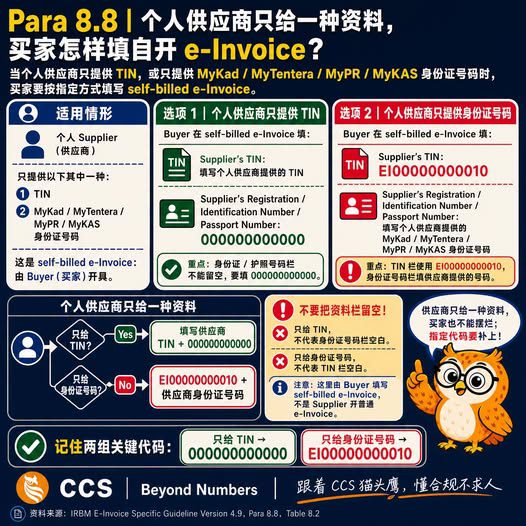
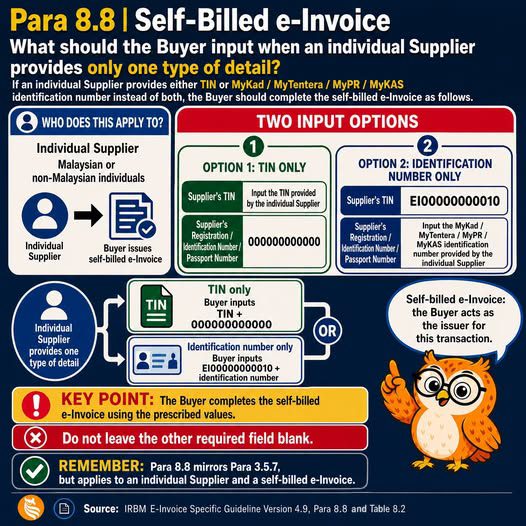
    Paragraph 8.8 of the E-Invoice Specific Guideline (Version 4.9) applies when an individual supplier provides only a TIN or only a MyKad, MyTentera, MyPR or MyKAS identification number. In these cases, the buyer issues the self-billed e-Invoice.

    If the Supplier Provides Only a TIN

    Enter the TIN provided by the individual supplier in the TIN field. In the Registration/Identification Number/Passport Number field, enter 000000000000.

    If the Supplier Provides Only an Identification Number

    Enter EI00000000010 in the TIN field. In the identification number field, enter the MyKad, MyTentera, MyPR or MyKAS number provided by the supplier.

    Important: The relevant information fields must not be left blank. These requirements apply to self-billed e-Invoices and should not be confused with the details required for standard sales e-Invoices.

    《E-Invoice Specific Guideline》第4.9版第8.8段:个人供应商的自开 e-Invoice 资料填写

    《E-Invoice Specific Guideline》第4.9版第8.8段适用于个人供应商仅提供TIN,或仅提供MyKad、MyTentera、MyPR或MyKAS身份证号码的情况。在这些情况下,由买方开具自开 e-Invoice。

    个人供应商仅提供TIN

    在TIN栏填写个人供应商提供的TIN;在注册号码/身份证号码/护照号码栏填写 000000000000。

    个人供应商仅提供身份证号码

    在TIN栏填写 EI00000000010;在身份证号码栏填写供应商提供的MyKad、MyTentera、MyPR或MyKAS号码。

    请注意:相关资料栏不得留空。这些要求适用于自开 e-Invoice,不应与普通销售 e-Invoice 的资料填写要求混淆。

  • E-Invoice Guideline v4.9: Self-Billed e-Invoices for Individual Suppliers Providing Limited Details

    E-Invoice Guideline v4.9: Self-Billed e-Invoices for Individual Suppliers Providing Limited Details

    Paragraph 8.8 of the E-Invoice Specific Guideline (Version 4.9) applies when an individual supplier provides only a TIN or only an identification number: MyKad, MyTentera, MyPR or MyKAS. In these cases, the buyer issues the self-billed e-Invoice.

    If the Supplier Provides Only a TIN

    • Enter the TIN provided by the individual supplier in the TIN field.

    • In the Registration/Identification Number/Passport Number field, enter 000000000000.

    If the Supplier Provides Only an Identification Number

    • Enter EI00000000010 in the TIN field.

    • Enter the MyKad, MyTentera, MyPR or MyKAS number provided by the supplier in the identification number field.

    Important: The relevant fields must not be left blank. This guidance concerns self-billed e-Invoices and should not be confused with the filing requirements for standard sales e-Invoices.

    《e-Invoice Specific Guideline》第4.9版第8.8段:个人供应商仅提供有限资料时的自开 e-Invoice

    《e-Invoice Specific Guideline》第4.9版第8.8段适用于个人供应商仅提供TIN,或仅提供MyKad、MyTentera、MyPR或MyKAS身份证号码的情况。在这些情况下,由买方开具自开 e-Invoice。

    供应商仅提供TIN

    • 在TIN栏填写个人供应商提供的TIN。

    • 在注册号码/身份证号码/护照号码栏填写 000000000000。

    供应商仅提供身份证号码

    • 在TIN栏填写 EI00000000010。

    • 在身份证号码栏填写供应商提供的MyKad、MyTentera、MyPR或MyKAS号码。

    请注意:相关栏位不得留空。本指引适用于自开 e-Invoice,不应与普通销售 e-Invoice 的申报逻辑混淆。

  • E-Invoice Guideline v4.9: Four Specific Uses of General TIN EI00000000010

    E-Invoice Guideline v4.9: Four Specific Uses of General TIN EI00000000010

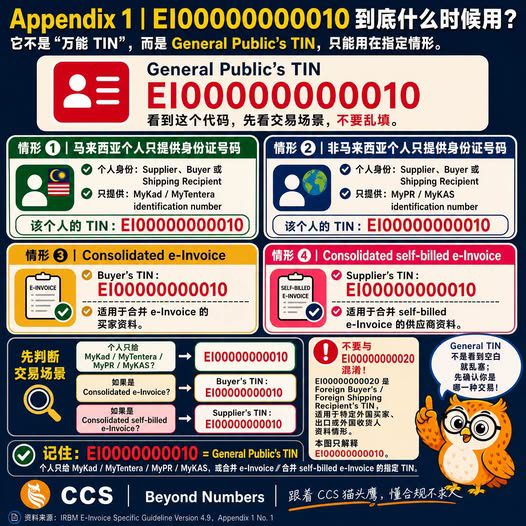
    General TIN EI00000000010 applies in four specific situations:

    • A Malaysian individual provides only a MyKad or MyTentera identification number as the TIN for an individual supplier, buyer or shipping recipient.

    • A non-Malaysian individual provides only a MyPR or MyKAS identification number as the TIN for an individual supplier, buyer or shipping recipient.

    • The buyer’s TIN in a consolidated e-Invoice.

    • The supplier’s TIN in a consolidated self-billed e-Invoice.

    Important: EI00000000010 is not a universal TIN. Do not confuse it with EI00000000020, which applies to specific foreign buyer or foreign shipping recipient situations.

    通用TIN EI00000000010的四种特定用途

    通用TIN EI00000000010适用于以下四种特定情况:

    • 马来西亚个人仅提供MyKad或MyTentera身份证号码,作为个人供应商、买方或收货人的TIN。

    • 非马来西亚个人仅提供MyPR或MyKAS身份证号码,作为个人供应商、买方或收货人的TIN。

    • 汇总 e-Invoice 中的买方TIN。

    • 汇总自开 e-Invoice 中的供应商TIN。

    特别提醒:EI00000000010并非万能TIN,不应与 EI00000000020混淆。EI00000000020适用于特定外国买方或外国收货人情形。

  • E-Invoice Guideline v4.9: Four Specific Uses of General TIN EI00000000010

    E-Invoice Guideline v4.9: Four Specific Uses of General TIN EI00000000010

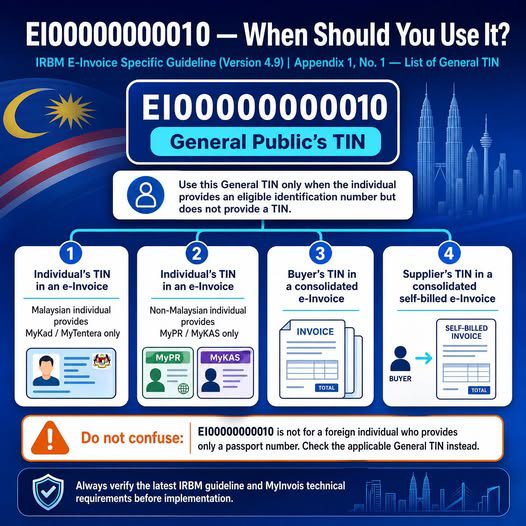
    Appendix 1 of the E-Invoice Specific Guideline (Version 4.9) identifies four specific situations in which General TIN EI00000000010 applies:

    • Malaysian individuals who provide only their MyKad or MyTentera identification number as the TIN for an individual supplier, buyer or shipping recipient.

    • Non-Malaysian individuals who provide only their MyPR or MyKAS identification number as the TIN for an individual supplier, buyer or shipping recipient.

    • The buyer’s TIN in a consolidated e-Invoice.

    • The supplier’s TIN in a consolidated self-billed e-Invoice.

    Important: EI00000000010 is not a universal TIN. It should not be confused with EI00000000020, which applies to specific foreign buyers or foreign shipping recipients.

    《e-Invoice Specific Guideline》第4.9版:通用TIN EI00000000010的四种特定用途

    《e-Invoice Specific Guideline》第4.9版附录1列明,通用TIN EI00000000010适用于以下四种特定情况:

    • 马来西亚个人仅提供MyKad或MyTentera身份证号码,作为个人供应商、买方或收货人的TIN。

    • 非马来西亚个人仅提供MyPR或MyKAS身份证号码,作为个人供应商、买方或收货人的TIN。

    • 汇总 e-Invoice中的买方TIN。

    • 汇总自开 e-Invoice中的供应商TIN。

    请注意:EI00000000010并非通用TIN,不应与 EI00000000020混淆。EI00000000020适用于特定外国买方或外国收货人。

  • E-Invoice Guideline v4.9: When to Use General TIN EI00000000030 for Foreign Suppliers

    E-Invoice Guideline v4.9: When to Use General TIN EI00000000030 for Foreign Suppliers

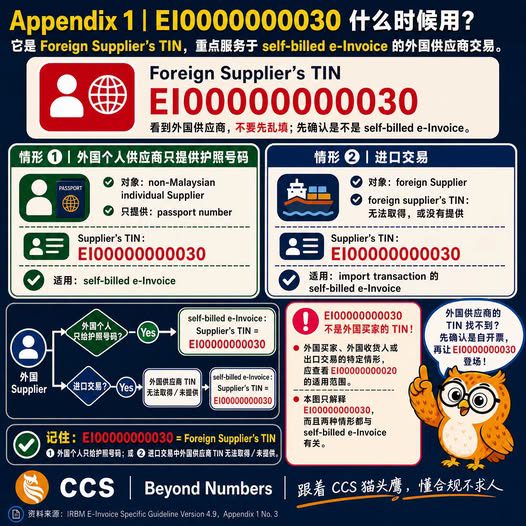
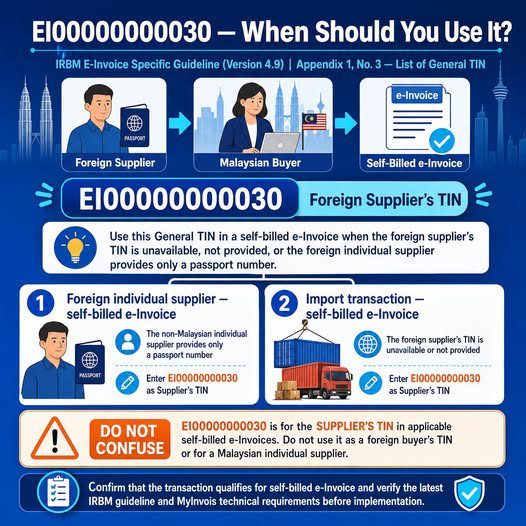
    Appendix 1 of the E-Invoice Specific Guideline (Version 4.9) identifies two specific situations in which General TIN EI00000000030 should be used as the supplier’s TIN in a self-billed e-Invoice:

    • Foreign individual suppliers who provide only a passport number: Enter EI00000000030 as the supplier’s TIN in the self-billed e-Invoice.

    • Import transactions: If the foreign supplier’s TIN cannot be obtained or has not been provided, enter EI00000000030 as the supplier’s TIN in the self-billed e-Invoice for the import transaction.

    Important: EI00000000030 is the TIN for a foreign supplier. It is not the TIN for a foreign buyer or foreign consignee. For situations involving foreign buyers, exports or foreign consignees, refer to EI00000000020.

    《e-Invoice Specific Guideline》第4.9版:通用TIN EI00000000030的适用情形

    《e-Invoice Specific Guideline》第4.9版附录1列明,以下两种特定情形须在自开 e-Invoice 中将通用TIN EI00000000030填写为供应商的TIN:

    • 外国个人供应商仅提供护照号码:在自开 e-Invoice 中,将 EI00000000030填写为供应商的TIN。

    • 进口交易:如果无法取得或未获提供外国供应商的TIN,在该进口交易的自开 e-Invoice 中,将 EI00000000030填写为供应商的TIN。

    特别提醒:EI00000000030是外国供应商的TIN,并非外国买方或外国收货人的TIN。涉及外国买方、出口或外国收货人的情况,请另行参阅 EI00000000020。

  • E-Invoice Guideline v4.9: When to Use General TIN EI00000000030 for Foreign Suppliers

    E-Invoice Guideline v4.9: When to Use General TIN EI00000000030 for Foreign Suppliers

    Appendix 1 of the E-Invoice Specific Guideline (Version 4.9) identifies two situations in which the General TIN EI00000000030 should be used as the supplier’s TIN in a self-billed e-Invoice:

    • Foreign individual suppliers provide only a passport number: Enter EI00000000030 as the supplier’s TIN in the self-billed e-Invoice.

    • Import transactions where the foreign supplier’s TIN is unavailable: If the foreign supplier’s TIN cannot be obtained or has not been provided, enter EI00000000030 as the supplier’s TIN in the self-billed e-Invoice for the import transaction.

    Important: EI00000000030 is the TIN for a foreign supplier. It is not the TIN for a foreign buyer or foreign consignee. For foreign buyers, exports or foreign consignees, refer to EI00000000020.

    《e-Invoice Specific Guideline》第4.9版:外国供应商何时使用通用TIN EI00000000030

    《e-Invoice Specific Guideline》第4.9版附录1列明,在以下两种情况下,开具自开 e-Invoice 时应将通用TIN EI00000000030填写为供应商的TIN:

    • 外国个人供应商仅提供护照号码:在自开 e-Invoice 中,将 EI00000000030填写为供应商的TIN。

    • 进口交易中无法取得外国供应商的TIN:如果无法取得或未获提供外国供应商的TIN,在该进口交易的自开 e-Invoice 中,将 EI00000000030填写为供应商的TIN。

    请注意:EI00000000030是外国供应商的TIN,并非外国买方或外国收货人的TIN。涉及外国买方、出口或外国收货人的情况,请参阅 EI00000000020。