
Day: February 29, 2024

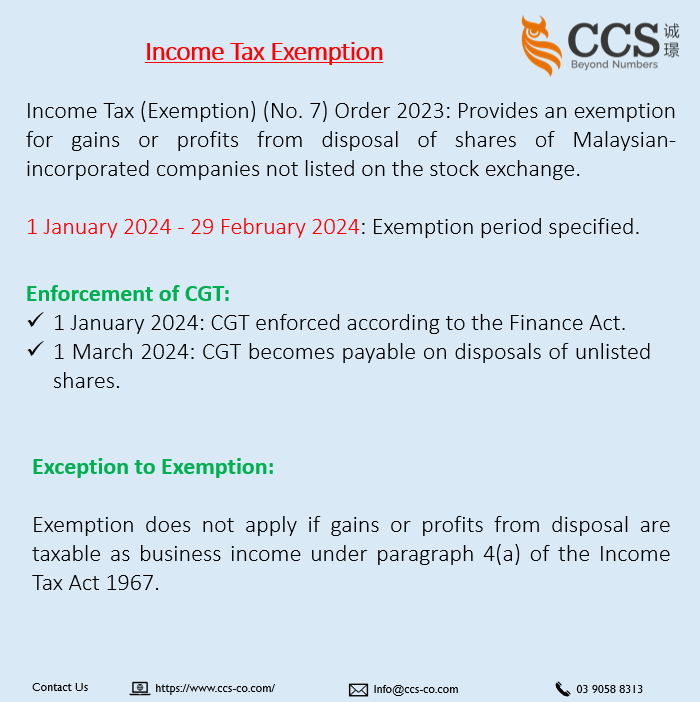
  • Income Tax (Exemption) (No. 7) Order 2023

    Income Tax (Exemption) (No. 7) Order 2023

    Following the re-tabling of Malaysia’s Budget 2023 on 24 February 2023, it was announced that the Government would explore the implementation of a capital gains tax (CGT) on the disposal of unlisted shares by companies at a reduced rate.

    Subsequently, the Budget 2024 announcement on 13 October 2023 provided further elaboration on this proposal, including details such as the proposed commencement date, tax rates, affected taxpayers, and potential exemptions.

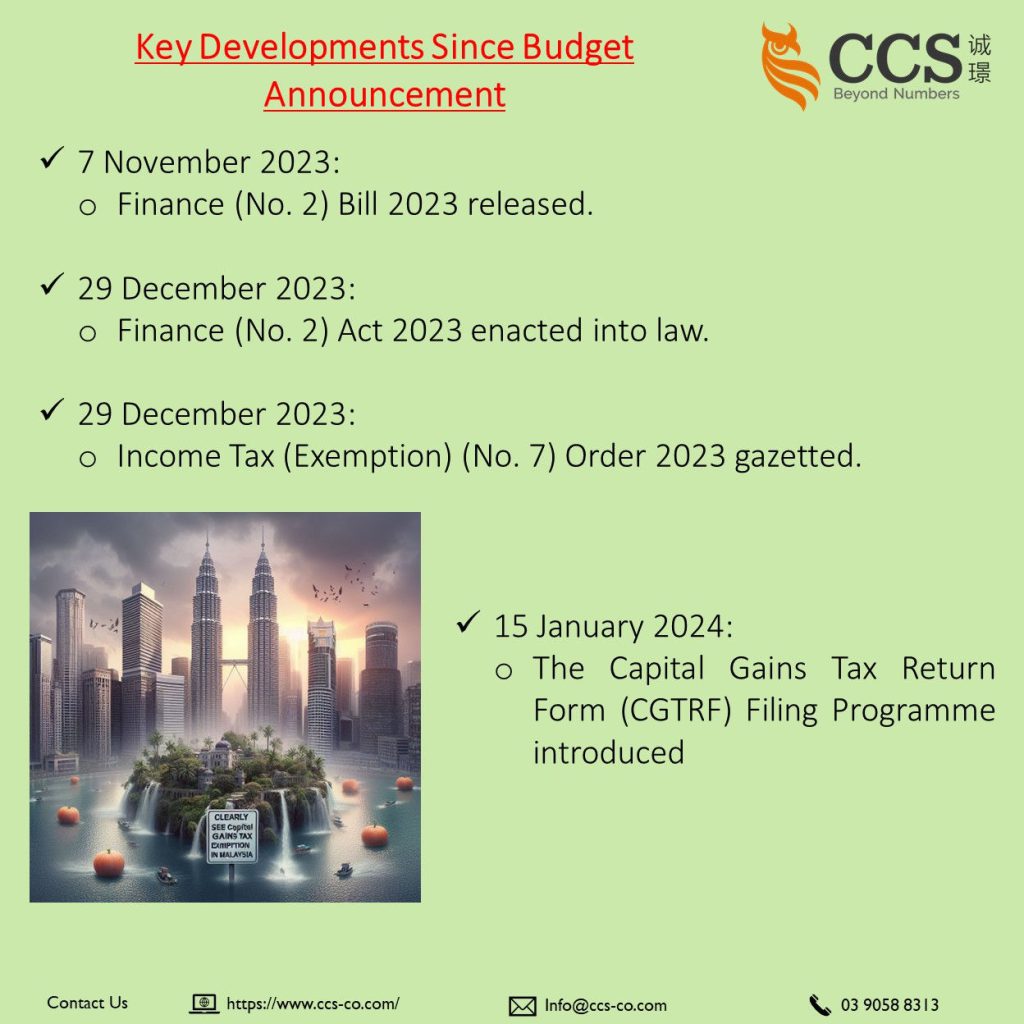
    Since the Budget announcement, several developments have occurred:

    1. On 7 November 2023, the Finance (No. 2) Bill 2023 (Bill) was released and presented for its initial reading.
    2. On 29 December 2023, the Finance (No. 2) Act 2023 (Finance Act) was officially enacted into law after being gazetted. The Finance Act encompasses all the amendments proposed in the Bill.
    3. Additionally, on 29 December 2023, the Income Tax (Exemption) (No. 7) Order 2023 [P.U.(A) 410] (Exemption Order) was gazetted, providing exemptions related to CGT and deferring the effective date for CGT concerning certain disposals.
    4. On 15 January 2024, the Inland Revenue Board (HASiL) introduced the Capital Gains Tax Return Form (CGTRF) Filing Programme, which is set to take effect from 1 March 2024.

    It is worth noting that according to the Finance Act, CGT will be enforced starting 1 January 2024.

    However, the Income Tax (Exemption) (No. 7) Order 2023 [P.U. (A) 410/2023] provides that a company, LLP, trust body, or co-operative society is given an income tax exemption to any gains or profits received from the disposal of shares of a company incorporated in Malaysia not listed on the stock exchange.

    This exemption applies to such disposals from 1 January 2024 to 29 February 2024.

    Hence, CGT will only be payable on disposals of unlisted shares in Malaysian-incorporated companies from 1 March 2024.

    The order specifies an exception to the exemption of income tax on profits or gains from the disposal of shares.

    Specifically, the exemption does not apply to a disposal of shares where the gains or profits are taxable as business income under paragraph 4(a) of the Income Tax Act 1967.

    This means that if the gains or profits from the disposal of shares are considered business income, they will not be eligible for the tax exemption outlined in the order.

    Reference:

    Income Tax (Exemption) (No. 7) Order 2023
    1
  • Service Tax (Amendment) Regulations 2024

    Service Tax (Amendment) Regulations 2024

    The Service Tax (Amendment) Regulations 2024, gazetted on 23 February 2024, introduce amendments to the existing Service Tax Regulations 2018.

    Effective Date: The amendments came into operation on 26 February 2024.

    Some of the key amendments include:

    • Expansion of scope for certain existing taxable services
    • Introduction of new taxable services such as karaoke centre services, maintenance and repair services, brokering and underwriting services, and logistic services
    • Changes in terminology used in describing the scope of certain services
    • Deletion of certain services from the list of taxable services
    • Introduction of value threshold for logistic services

    This gazette contains important changes to Malaysia’s service tax framework that those in relevant industries should know.

    For those interested in the detailed provisions and their potential impact on specific sectors, downloading the full text of the Service Tax (Amendment) Regulations 2024 is highly recommended.

    This will provide a comprehensive view of the changes and help understand the broader implications for businesses and service providers within the affected categories.

    3
  • Income Tax (Exemption) (No. 2) Order 2024

    Income Tax (Exemption) (No. 2) Order 2024

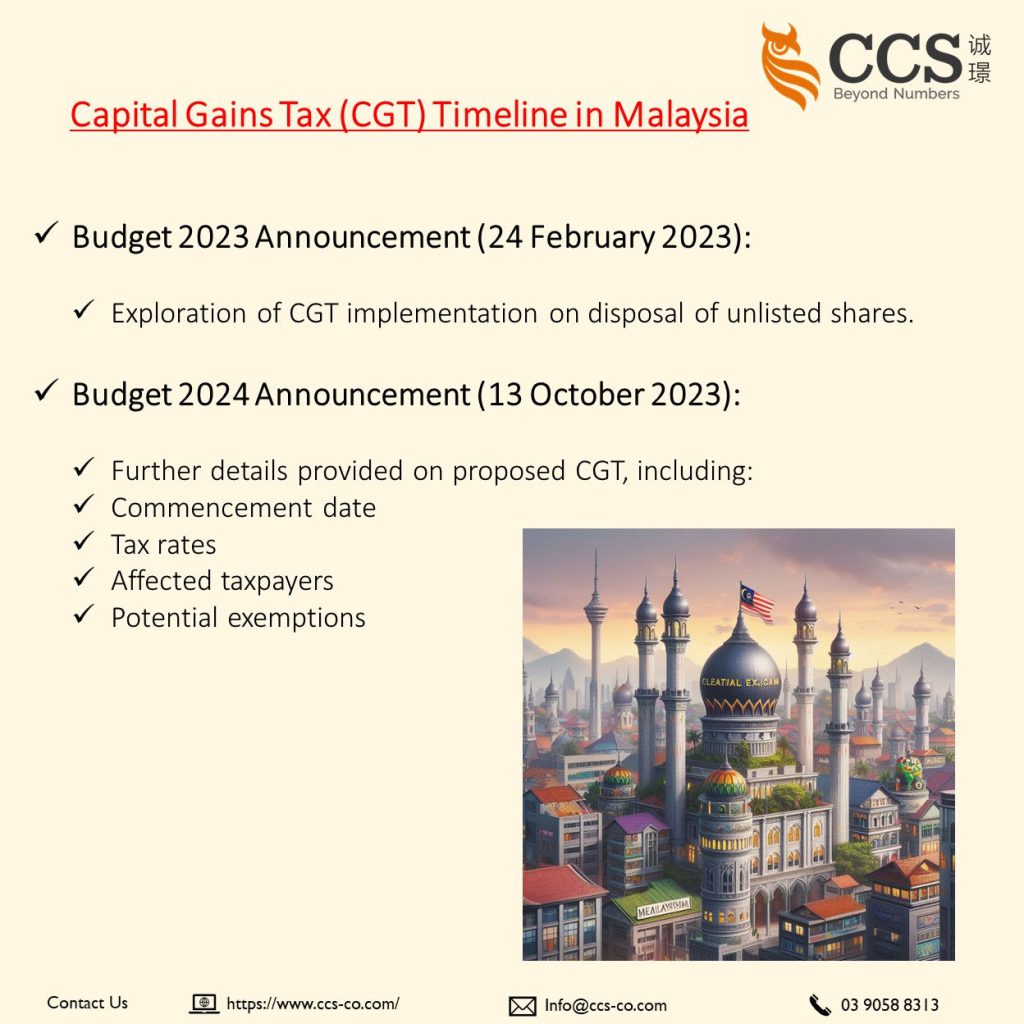
    Following the re-tabling of Malaysia’s Budget 2023 on 24 February 2023, it was announced that the Government would explore the implementation of a capital gains tax (CGT) on the disposal of unlisted shares by companies at a reduced rate.

    Subsequently, the Budget 2024 announcement on 13 October 2023 provided further elaboration on this proposal, including details such as the proposed commencement date, tax rates, affected taxpayers, and potential exemptions.

    Since the Budget announcement, several developments have occurred:

    1. On 7 November 2023, the Finance (No. 2) Bill 2023 (Bill) was released and presented for its initial reading.
    2. On 29 December 2023, the Finance (No. 2) Act 2023 (Finance Act) was officially enacted into law after being gazetted. The Finance Act encompasses all the amendments proposed in the Bill.
    3. Additionally, on 29 December 2023, the Income Tax (Exemption) (No. 7) Order 2023 [P.U.(A) 410] (Exemption Order) was gazetted, providing exemptions related to CGT and deferring the effective date for CGT concerning certain disposals.
    4. On 15 January 2024, the Inland Revenue Board (HASiL) introduced the Capital Gains Tax Return Form (CGTRF) Filing Programme, which is set to take effect from 1 March 2024.
    5. On 23 February 2024, the Income Tax (Exemption) (No. 2) Order 2024 [P.U.(A) 57] (Exemption Order) was gazetted, providing exemptions related to CGT and deferring the effective date for CGT concerning the disposal of shares under section 15C of the Income Tax Act 1967.

    It is worth noting that according to the Finance Act, CGT will be enforced starting 1 January 2024.

    However, the Income Tax (Exemption) (No. 2) Order 2024 [P.U. (A) 57/2024] provides that a company, LLP, trust body, or co-operative society is given an income tax exemption to any gains or profits received from the disposal of shares under section 15C of the Income Tax Act 1967.

    This exemption applies to such disposals of shares under section 15C of the Income Tax Act 1967 from 1 January 2024 to 29 February 2024.

    Hence, CGT will only be payable on disposals of shares under section 15C of the Income Tax Act 1967 from 1 March 2024.

    The order specifies an exception to the exemption of income tax on profits or gains from the disposal of shares under section 15C of the Income Tax Act 1967.

    Specifically, the exemption does not apply to a disposal of shares under section 15C of the Income Tax Act 1967, where the gains or profits are taxable as business income under paragraph 4(a) of the Income Tax Act 1967.

    This means that if the gains or profits from the disposal of shares under section 15C of the Income Tax Act 1967 are considered business income, they will not be eligible for the tax exemption outlined in the order.

    Reference:

    Income Tax (Exemption) (No. 2) Order 2024

    Based on a review of the Income Tax (Exemption) (No. 7) Order 2023 [P.U. (A) 410] and the Income Tax (Exemption) (No. 2) Order 2024 [P.U. (A) 57], the key differences are:
    Effective dates

    • No. 7 Order 2023: 1 January 2024 to 29 February 2024
    • No. 2 Order 2024: 1 January 2024 to 29 February 2024

    The type of shares exempted

    • No. 7 Order 2023: Shares of unlisted companies incorporated in Malaysia
    • No. 2 Order 2024: Shares disposed under section 15C of the Income Tax Act 1967

    Non-application provision

    • No. 7 Order 2023: Exemption does not apply if gains/profits from share disposal are taxable as business income
    • No. 2 Order 2024: Exemption does not apply if gains/profits from share disposal under section 15C are taxable as business income

    In summary, No. 7 Order 2023 provides income tax exemption specifically for disposal gains/profits of unlisted company shares, while No. 2 Order 2024 exempts disposal gains/profits under section 15C. Both have identical effective dates.

    The key difference is the types of shares exempted and the non-application provisions referencing the specific exemption scope defined in each order.

    1
  • Customs Duties (Exemption)(Amendment) Order 2024

    Customs Duties (Exemption)(Amendment) Order 2024

    The Customs Duties (Exemption) (Amendment) Order 2024 [P.U (A) 63/2024], gazetted on 26 February 2024, introduces amendments to the Customs Duties (Exemption) Order 2017.

    This amendment order specifically adds “Jadestone Energy (Malaysia) Pte. Ltd.” to the list of companies that qualify for customs duty exemption on approved materials and equipment imported for use in petroleum and gas upstream operations.

    With this amendment, Jadestone Energy Malaysia now enjoys the same exemption from customs duties when importing such qualifying goods, subject to certain conditions on usage, record keeping, and restrictions on sale/disposal.

    The amendment aims to support petroleum exploration companies operating in Malaysia through tax incentives that lower business costs.

    References:

    1
  • Service Tax (Rate of Tax) (Amendment) Order 2024

    Service Tax (Rate of Tax) (Amendment) Order 2024

    The Service Tax (Rate of Tax) (Amendment) Order 2024, a significant legislative update, has been officially gazetted on 26 February 2024 and revises the standard service tax rate while retaining lower rates for certain services.

    Key Points

    • Increases standard service tax rate from 6% to 8% effective 1 March 2024
    • Retains 6% service tax rate for:
      • Food and beverage services
      • Telecommunication services
      • Parking place services
      • Logistic services
    • Transitional rules on charging a 6% or 8% service tax rate for services spanning the effective date
    • Transitional rules on payments received before but relating to services provided after the effective date

    Transitional Rules

    1. Services spanning the effective date (Paragraph 3(a))
    • For taxable services provided before but continuing after 1 March 2024:
      • Service tax to be charged at 8% on the proportion of services that can be attributed to the period after 1 March 2024
    • Effectively, services spanning the periods before and after the effective date will be subject to differential tax rates
    1. Payments received before the effective date (Paragraph 3(b))
    • For taxable services where any payment was received before 1 March 2024 (even though service is provided after)
      • Service tax rate of 6% applies on such payment already received
    1. Registered persons to provide betting and gaming, accounting based on payments (Paragraph 3(c))
    • For registered persons who account for service tax when payment is received
      • Payments received before 1 March 2024 – 6% rate
      • Payments received on or after 1 March 2024 – 8% rate
      • Any invoice issued for a taxable service to be provided after the effective date of the order – – 8% rate
    1. Imported taxable services (Paragraphs 3(d) and (e))
    • Similar differential rate for imported services spanning the effective date or where due date differs from when service was acquired

    The rules cater for the transition and avoid a sudden change in service tax rate on payments already received.

    The amended differential service tax rates seek to balance government revenue needs and socio-economic considerations. Businesses should review the change in the standard service tax rate and check if transitional rules apply to their services.

    Reference:

    3
  • Service Tax (Imposition of Tax for Taxable Service in respect of Designated Areas and Special Areas) (Amendment) Order 2024

    Service Tax (Imposition of Tax for Taxable Service in respect of Designated Areas and Special Areas) (Amendment) Order 2024

    The Service Tax (Imposition of Tax for Taxable Service in respect of Designated Areas and Special Areas) (Amendment) Order 2024:

    1. Amends the existing 2018 Order that imposes service tax on certain services provided within or between designated areas (e.g. Labuan, Langkawi, Tioman) and special areas (e.g. Joint Development Area).
    2. The key amendment is the introduction of logistic services as a new taxable service category under this order.
    3. Logistic services are now imposed service tax when provided:
      1. Between designated areas
      2. Between special areas
      3. From designated areas to special areas
      4. From special areas to designated areas
    4. Logistic services cover supply chain services like freight forwarding, warehousing, shipping, etc. as well as delivery and courier services.
    5. Persons providing such logistic services between or within the specified areas will now be required to charge and account for service tax.

    In summary, the Order expands the scope of taxable logistic services that are subject to service tax when provided within or between designated and special areas in Malaysia.

    References:

    Service Tax (Imposition of Tax for Taxable Service in respect of Designated Areas and Special Areas) (Amendment) Order 2024

     Service Tax (Imposition of Tax for Taxable Service in respect of Designated Areas and Special Areas) Order 2018

    3