Day: July 13, 2023

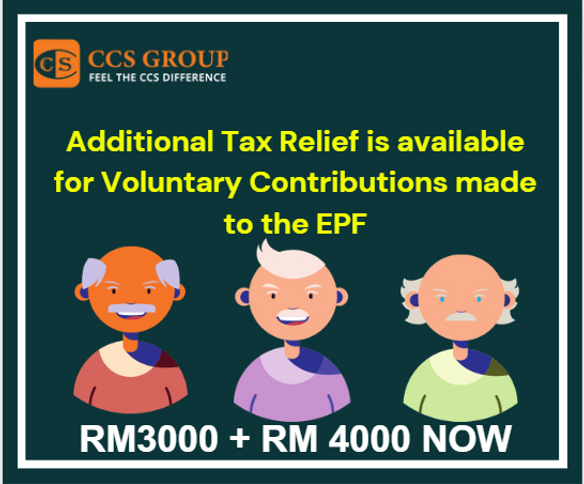
  • Additional tax relief is available for Voluntary Contributions made to the EPF

    Additional tax relief is available for Voluntary Contributions made to the EPF

    The EPF strives to grow their members’ retirement savings while continuously developing a wide range of products and services to support their journey towards a comfortable retirement.

    Individuals who are employed, self-employed or business owners can opt to contribute based on their own requirements.

    As a member, you are eligible not only to enjoy annual dividends on your retirement savings and the many withdrawal options and benefits that come with being an EPF Member but also entitle to tax relief under the Income Tax Act 1967 section 49(1).

    Income Tax Act 1967

    Section 49(1) is read as follows:
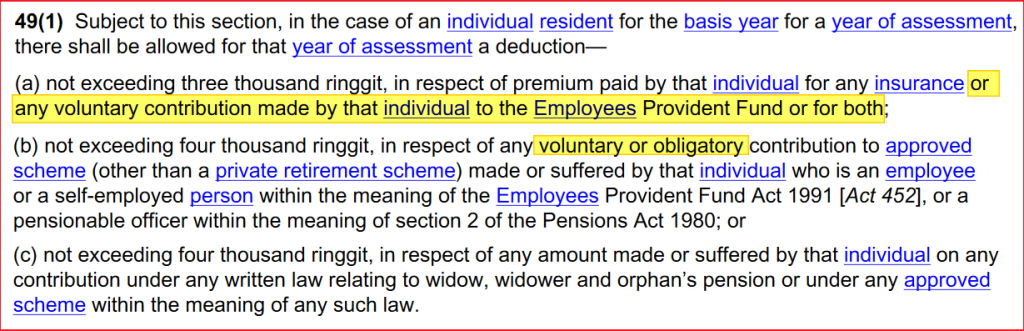
    S. 49(1)(a) amended by Act 845 of 2023, s. 5(a)(i), effective for the year of assessment 2023 and subsequent years of assessment, by inserting “or any voluntary contribution made by that individual to the Employees Provident Fund or for both” after “any insurance.”

    Section 49(1A) is read as follows:
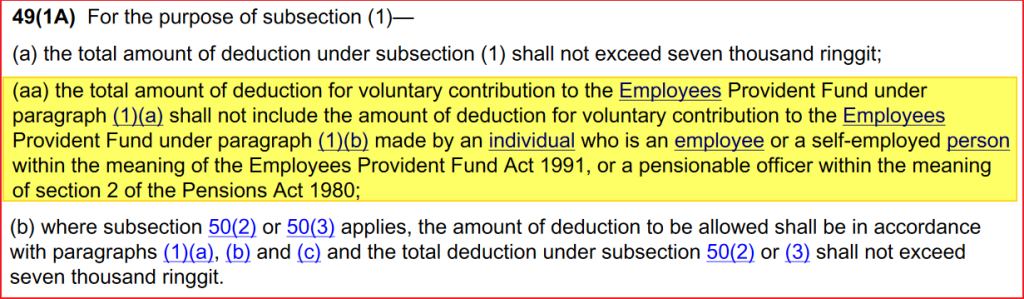
    S. 49(1A)(aa) inserted by Act 845 of 2023, s. 5(b)(i), effective for the year of assessment 2023 and subsequent years of assessment.

    Section 49(2) is read as follows:
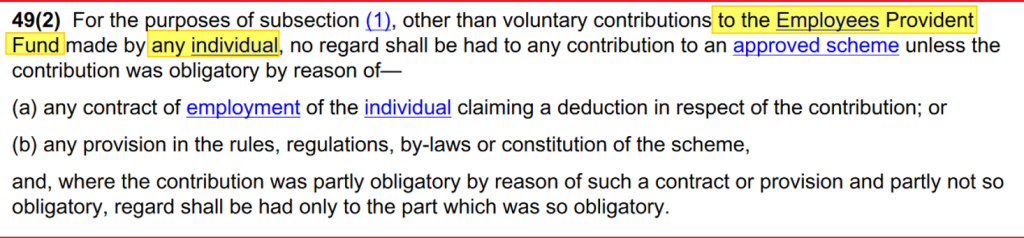
    S. 49(2) amended by Act 845 of 2023, s. 5(c)(i), effective for the year of assessment 2023 and subsequent years of assessment, by inserting “to the Employees Provident Fund” after “other than voluntary contributions”.
    
    S. 49(2) amended by Act 845 of 2023, s. 5(c)(ii), effective for the year of assessment 2023 and subsequent years of assessment, by substituting “any individual” for “a self-employed person within the meaning of the Employees Provident Fund Act 1991 or a pensionable officer within the meaning of section 2 of the Pensions Act 1980”.

    The amendment now allows:

    • for tax relief not exceeding RM3,000 for premiums paid by an individual for any insurance or voluntary contribution to the Employees Provident Fund (EPF) or both.
    • for tax relief not exceeding RM4,000 for voluntary or obligatory contributions made or suffered by an individual to an approved scheme (other than a private retirement scheme). This applies to employees, self-employed persons, or pensionable officers as defined in Section 2 of the Pensions Act 1980.

    In the past, Section 49(1)(b) only represented the obligatory contribution to the EPF. However, under the latest amendments, Section 49(1)(a) and (b) now allow voluntary EPF contributions to be eligible for tax relief.

    Illustration 1: Private sector employees/ Public Sector employees who elect for EPF

    When you contribute 11% of your monthly salary to the EPF, your employer will contribute another 12% or 13% of your salary (the statutory contribution rate is subject to changes by the government) to your EPF savings. However, either you or your employer or both may contribute at a rate exceeding the statutory rates.

    The provision under subsection 49(1) of the Employment Act is eligible to be claimed by the employee in both situations below:-

    • An employee informs their employer to increase their monthly contribution from 11% to 15%, with the additional 4% voluntary.
    • An employee chooses to make self-contributions to EPF at the end of the year in addition to the mandatory deduction from their regular employment income.

    Illustration 2: Self-employed individuals/ Retirees/ Pensionable civil servants who opt to contribute to EPF voluntarily

    According to the guidelines on the EPF website, an individual can make a maximum voluntary contribution of RM100,000 per year, which can be a single contribution or accumulated from multiple contributions (Self Contribution, i-Saraan Contribution and Account 1 Top-up Savings Contribution).
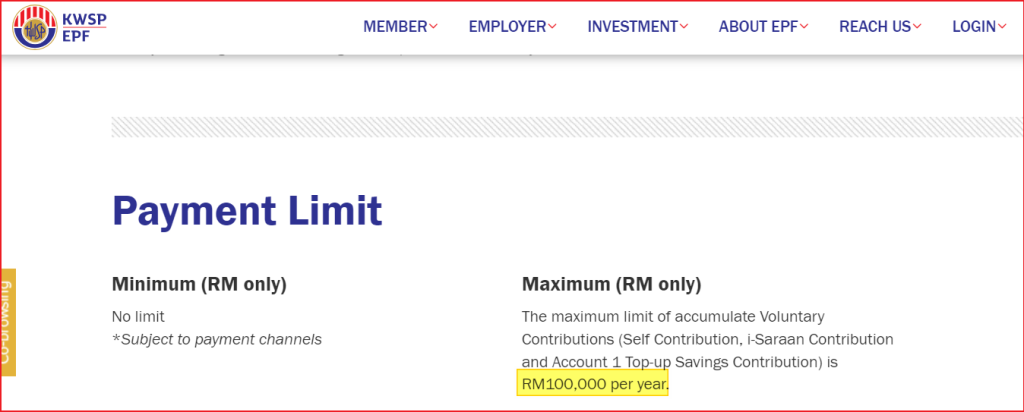
    Assuming that a self-employed individual or retiree chooses to make a one-time contribution of RM100,000 to EPF at the end of the year, they are eligible to claim RM7,000 in voluntary EPF relief.

    This relief consists of RM4,000 under Section 49(1)(b) for voluntary EPF contributions and RM3,000 under Section 49(1)(a) for voluntary relief.

    Disclaimer:

    The articles, templates, and other materials on our website are provided only for your reference.

    While we strive to ensure that the information presented is current and accurate, we cannot guarantee the completeness, reliability, suitability, or availability of the website or its content, including any related graphics. Consequently, any reliance on this information is entirely at your own risk.

    If you intend to use the content of our videos and publications as a reference, we recommend that you take the following steps:

    1. Verify that the information provided is current, accurate, and complete.
    2. Seek additional professional opinions, as the scope and extent of each issue, may be unique.

    免责声明:

    我们网站上的文章、模板和其他材料只供参考。

    虽然我们努力确保所提供的信息是最新和准确的,但我们不能保证网站或其内容,包括任何相关图形的完整性、可靠性、适用性或可用性。因此,您需要承担使用这些信息所带来的风险。

    如果你打算使用我们的视频和出版物的内容作为参考,我们建议你采取以下步骤:

    1. 核实所提供的信息是最新的、准确的和完整的。
    2. 寻求额外的专业意见,因为每个问题的范围和程度,可能是独特的。

    Keep in touch with us so that you can receive timely updates

    请与我们保持联系,以获得即时更新。

    1. Website ✍️ https://www.ccs-co.com/ 2. Telegram ✍️ http://bit.ly/YourAuditor 3. Facebook ✍

    4. Blog ✍ https://lnkd.in/e-Pu8_G 5. Google ✍ https://lnkd.in/ehZE6mxy

    6. LinkedIn ✍ https://www.linkedin.com/company/74734209/admin/
    10
  • Budget 2023: Redefinition of ‘Micro, Small and Medium Enterprise (“MSME”)’

    Budget 2023: Redefinition of ‘Micro, Small and Medium Enterprise (“MSME”)’

    Small and medium-sized enterprises (SMEs) are integral to the Malaysian economy as they contribute 38% or more than RM500bil to our gross domestic product (GDP).

    There were altogether 1,226,494 MSMEs in 2021 which accounts for 97.4% of overall establishments in Malaysia.

    Today we are pleased to inform you of an important update regarding the redefinition of the ‘Micro, Small and Medium Enterprise’ (MSME) under the Income Tax Act 1967.

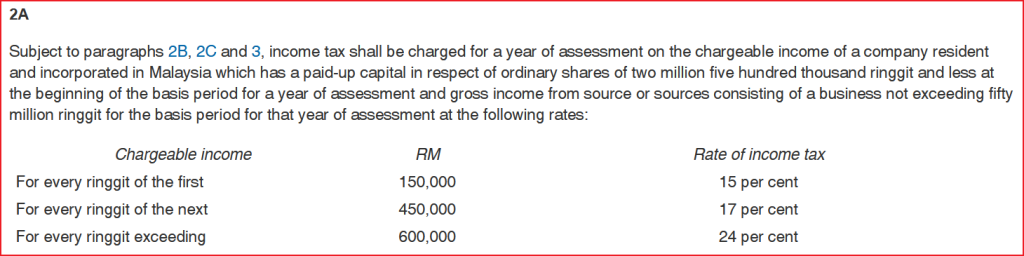
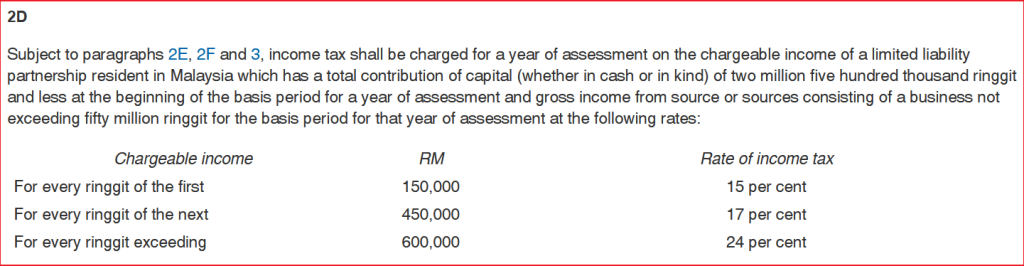
    Effective from the Year of Assessment 2024 (YA 2024), new provisions, namely Para 2B(d) and 2E(d) of Part I of Schedule 1, have been introduced to refine the criteria for qualifying as an MSME.

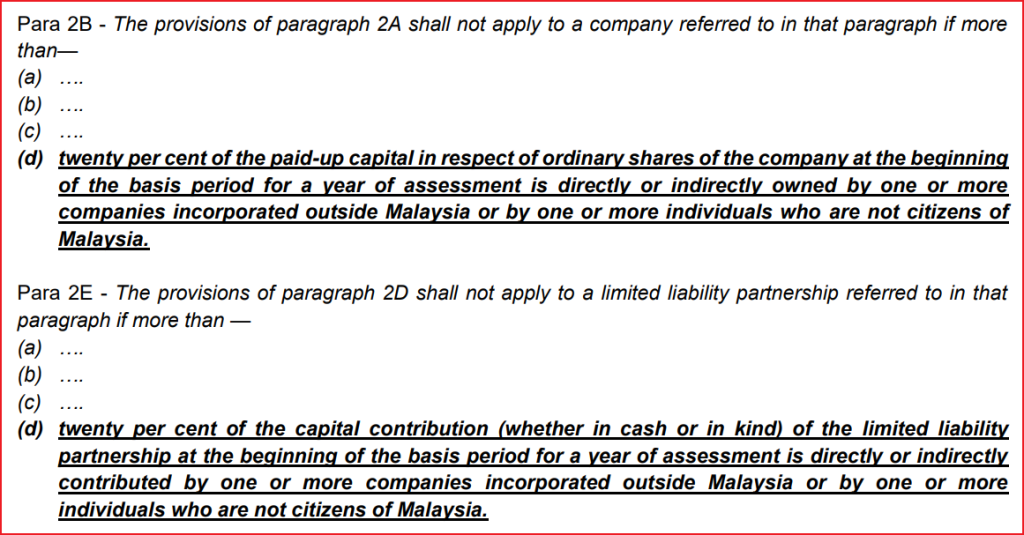
    New Para 2B(d) & 2E(d) of Part I of Sch 1 (with effective YA 2024) are read as follows:-

    Under Para 2B, the existing provisions mentioned in Para 2A will not apply to a company if more than 20% of the paid-up capital in respect of ordinary shares of the company, at the beginning of the basis period for a year of assessment, is directly or indirectly owned by one or more companies incorporated outside Malaysia or by one or more individuals who are not citizens of Malaysia.

    Para 2A of Part I of Sch 1 (with effective YA 2024) is read as follows:-

    Similarly, under Para 2E, the provisions mentioned in Para 2D will not apply to a limited liability partnership (LLP) if more than 20% of the capital contribution, whether in cash or kind, of the LLP at the beginning of the basis period for a year of assessment, is directly or indirectly contributed by one or more companies incorporated outside Malaysia or by one or more individuals who are not citizens of Malaysia.

    These changes aim to refine the definition of an MSME by ensuring that businesses predominantly owned by foreign companies or individuals are excluded from the MSME category.

    The government believes that this modification will better align the definition with the intended purpose of supporting and promoting local enterprises.

    The redefined criteria for MSMEs will apply for the Year of Assessment 2024.

    Grandfathering Rules Does Not Apply

    In response to inquiries regarding grandfathering rules for existing Micro, Small and Medium Enterprises (MSMEs) and Limited Liability Partnerships (LLPs) that currently meet all the pre-requisite conditions as MSMEs or LLPs as of the Year of Assessment (YA) 2023, we would like to provide the following feedback from Lembaga Hasil Dalam Negeri Malaysia (LHDNM):

    There will be no application of grandfathering rules for the proposed amendments. The proposed amendments will take effect from the Year of Assessment 2024 and subsequent assessment years.

    This means that the additional criterion, as stated in Para 2B(d) and 2E(d) of Part I of Schedule 1, will apply to all MSMEs and LLPs from the Year of Assessment 2024 onwards, irrespective of their previous categorisation.

    It is important for existing MSMEs and LLPs to review their ownership structures and assess their eligibility under the redefined criteria.

    While the new provisions may impact their categorisation, it is crucial to comply with the updated regulations to ensure accurate classification and potentially access any benefits or incentives associated with the MSME category.

    We encourage all businesses to review their ownership structures and assess their eligibility under the updated regulations.

    The “more than 20%” threshold is not applicable if the ultimate shareholder (owned more than 50% of the paid-up capital in respect of ordinary shares) is a company incorporated in Malaysia or individuals who are Malaysian citizens.

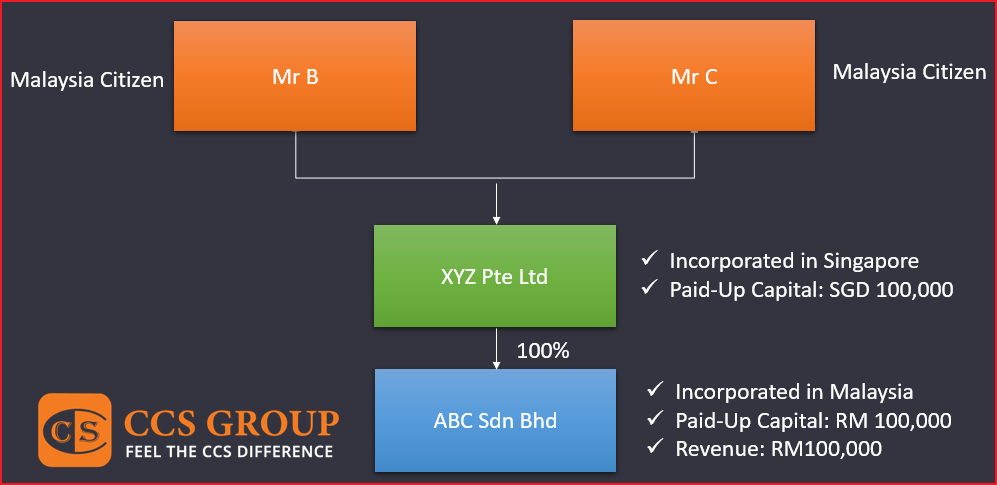
    Illustration:-

    Based on the above illustration, Feedback from LHDNM (Inland Revenue Board of Malaysia):

    Under subparagraph 2B(d), Schedule 1 of the Income Tax Act 1967, to enjoy the preferential tax rate, a company/LLP (Limited Liability Partnership) cannot be owned more than 20% of the paid-up capital either directly or indirectly at the beginning of the basis period for an assessment year by one or more companies incorporated outside Malaysia or by one or more individuals who are not Malaysian citizens.

    Therefore, ABC Sdn Bhd is not eligible to enjoy the tax rate under paragraph 2A, Schedule 1, of the Income Tax Act 1967, as more than 20% of the paid-up capital of ABC Sdn Bhd’s ordinary shares is directly held by XYZ Pte Ltd, which is incorporated outside of Malaysia, even though the ultimate shareholders, Mr A and Mr B, are Malaysian citizens.

    It is important to ensure compliance with the revised provisions to maintain accurate categorisation and receive any benefits or incentives associated with the MSME classification.

    The government remains committed to fostering a conducive environment for the growth and development of MSMEs.

    These changes are aimed at strengthening the support provided to local enterprises and enabling them to thrive in a competitive business landscape.

    If you would like more clarification or guidance on applying the amendments, we encourage affected MSMEs and LLPs to seek professional advice.

    Q&A:

    1. For Para 2A n 2D sch 1, the company is held by a foreign co. with> RM2.5m share cap in some years and < RM2.5m in other years due to forex difference, do we need to determine it yearly?

    Yes. We need to determine the share capital of the SME company at the beginning of the year.

    2. If the taxpayer no longer qualifies as PMKS, the tax rate will be flat 24%.

    Yes. The tax rate will be 24%.

    3. If the 20% foreign company shareholder is ultimately owned by a Malaysian, will this para apply? Can the company enjoy SME status?

    The SME company is not eligible to enjoy the tax rate under paragraph 2A of Schedule 1 because 20% of the company’s shares are held by a foreign company.

    4. Will this affect the exemption for submission of tax estimation for the first 2 years of assessment upon commencement of business?

    Amendment on para 2A, Part 1, Schedule 1 will not affect the exemption for submission of tax estimation.

    5. Besides the RM2.5m paid-up capital and the gross income not exceeding the RM50M criteria, do we need to check the shareholding for the SMSE tax rate?

    Yes

    6. Will it affect Section 107C (4A)- definition for companies not require to submit CP204 for 1st 2 YAs?

    No

    7. Does the 20% rule also applies to shares held by an individual foreigner/Malaysian permanent resident? What if the 20% shareholders are foreigners who are tax residents who have resided in Malaysia for years? Will the company not enjoy the reduced tax rate for their company?

    PMKS Company is not eligible to enjoy the tax rate under paragraphs 2A and 2D, Part I, Schedule I if the company’s ownership consists of more than 20% ordinary shares held directly or indirectly by a company incorporated outside Malaysia or individuals who are not Malaysian citizens.

    The same condition also applies to limited liability partnerships with capital contributions held by more than 20% by a company incorporated outside Malaysia or contributed by individuals, not Malaysian citizens.

    Disclaimer:

    The articles, templates, and other materials on our website are provided only for your reference.

    While we strive to ensure that the information presented is current and accurate, we cannot guarantee the completeness, reliability, suitability, or availability of the website or its content, including any related graphics. Consequently, any reliance on this information is entirely at your own risk.

    If you intend to use the content of our videos and publications as a reference, we recommend that you take the following steps:

    1. Verify that the information provided is current, accurate, and complete.
    2. Seek additional professional opinions, as the scope and extent of each issue, may be unique.

    免责声明:

    我们网站上的文章、模板和其他材料只供参考。

    虽然我们努力确保所提供的信息是最新和准确的,但我们不能保证网站或其内容,包括任何相关图形的完整性、可靠性、适用性或可用性。因此,您需要承担使用这些信息所带来的风险。

    如果你打算使用我们的视频和出版物的内容作为参考,我们建议你采取以下步骤:

    1. 核实所提供的信息是最新的、准确的和完整的。
    2. 寻求额外的专业意见,因为每个问题的范围和程度,可能是独特的。

    Keep in touch with us so that you can receive timely updates

    请与我们保持联系,以获得即时更新。

    1. Website ✍️ https://www.ccs-co.com/ 2. Telegram ✍️ http://bit.ly/YourAuditor 3. Facebook ✍

    4. Blog ✍ https://lnkd.in/e-Pu8_G 5. Google ✍ https://lnkd.in/ehZE6mxy

    6. LinkedIn ✍ https://www.linkedin.com/company/74734209/admin/
    10
  • Redefinition of ‘Plant’ for the Purpose of Capital Allowances

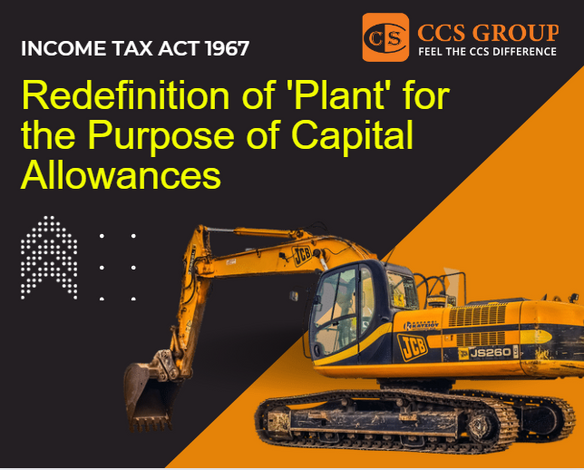
    Redefinition of ‘Plant’ for the Purpose of Capital Allowances

    Plant is currently defined in Paragraph 70A, Schedule 3 of the Income Tax Act 1967 as follows:

    “An apparatus used by a person for carrying on his business but does not include a building, an intangible asset, or any asset used and that functions as a place within which a business is carried on.”

    Finance Act 2023

    However, Paragraph 70A, Schedule 3 of the Income Tax Act 1967 is amended by Finance Act 2023 (Act 845), s. 17(b), effective for the year of assessment 2023 and subsequent years of assessment, by deleting “, an intangible asset” after “a building”.

    Therefore, plant is now redefined as follows:

    “An apparatus used by a person for carrying on his business but does not include a building, or any asset used and that functions as a place within which a business is carried on.”

    The Minister is also empowered (via PU Order) to prescribe any other assets as assets excluded from the definition of “plant”.

    You might be wondering now is there any asset that the Government plans to specifically exclude as ‘Plant’ by way of PU Order?

    The Inland Revenue Board of Malaysia (LHDNM) has completed a study on intangible assets and has submitted it to the Ministry of Finance (MOF) on 2nd June 2023 for further action. The latest discussion between MOF and LHDNM was held on 4th July 2023.

    Chartered Tax Institute Of Malaysia (CTIM) proposed to LHDNM that any asset to be gazetted via the PU Order should have a prospective effective date.

    For example, any basis period which begins on or after the date of the coming into operation of the PU Order.

    LHDNM takes note of it. However, the implementation is subject to policy decisions.

    Conclusion The removal of the exclusion of intangible assets from the plant definition in the Income Tax Act 1967 would simplify the taxation of cases where courts have ruled that databases can be considered qualifying plant.

    Malaysia – Landmark Tax Decision By Court Of Appeal Confirming That Databases Constitute “Plant” And Qualify For Capital Allowances.

    However, there is a possibility that the range of assets eligible for classification as “plant” may become narrower because the Minister now has the power to specify which assets should be excluded from the plant definition.

    Further studies regarding the treatment of capital allowance on intangible assets are still under review and study by the Ministry of Finance (MOF).

    We will update you accordingly.

    Reference:

    1. Back to Basic: The Capital Allowance in Malaysia, Is Horse a Plant?
    2. Capital Allowance: Is Book a Plant?
    3. Capital Allowance: Is Ceilings a Plant?
    4. Capital Allowance: Is Lamps a Plant?
    5. Taxation of Partnerships – Capital Allowance
    6. Capital Allowance: Is a Swimming Pool a Plant?
    7. Capital Allowance: Is Silo for Temporary Storage a Plant?
    8. Capital Allowance: Are Sanitary and Pipeline Fittings a Plant?
    9. Capital Allowance: Is Acoustic Ceilings and Electrical Installations a Plant?
    10. Capital Allowance: When a setting is Plant – Moveable Partitions
    11. Capital Allowance: Is Canopy over Petrol Filling Station a Plant?
    12. Capital Allowance: Whether Car Wash enclosures constitute Plant
    13. Capital Allowance: Premises Test, Functional Test & Business Use Test
    14. Capital Allowance: Whether a Ship used as a Restaurant constitutes Plant
    15. Determining Qualifying Expenditure for Capital Allowances & ”Repair or Upkeep”

    Disclaimer:

    The articles, templates, and other materials on our website are provided only for your reference.

    While we strive to ensure that the information presented is current and accurate, we cannot guarantee the completeness, reliability, suitability, or availability of the website or its content, including any related graphics. Consequently, any reliance on this information is entirely at your own risk.

    If you intend to use the content of our videos and publications as a reference, we recommend that you take the following steps:

    1. Verify that the information provided is current, accurate, and complete.
    2. Seek additional professional opinions, as the scope and extent of each issue, may be unique.

    免责声明:

    我们网站上的文章、模板和其他材料只供参考。

    虽然我们努力确保所提供的信息是最新和准确的,但我们不能保证网站或其内容,包括任何相关图形的完整性、可靠性、适用性或可用性。因此,您需要承担使用这些信息所带来的风险。

    如果你打算使用我们的视频和出版物的内容作为参考,我们建议你采取以下步骤:

    1. 核实所提供的信息是最新的、准确的和完整的。
    2. 寻求额外的专业意见,因为每个问题的范围和程度,可能是独特的。

    Keep in touch with us so that you can receive timely updates

    请与我们保持联系,以获得即时更新。

    1. Website ✍️ https://www.ccs-co.com/ 2. Telegram ✍️ http://bit.ly/YourAuditor 3. Facebook ✍

    4. Blog ✍ https://lnkd.in/e-Pu8_G 5. Google ✍ https://lnkd.in/ehZE6mxy

    6. LinkedIn ✍ https://www.linkedin.com/company/74734209/admin/
    7
  • CTIM, LHDNM & MOF: Joint Memorandum on Issues Arising from 2022 Budget Speech

    CTIM, LHDNM & MOF: Joint Memorandum on Issues Arising from 2022 Budget Speech

    The Budget 2022 was presented in Parliament on 29 October 2021.

    The following summary is extracted from a dialogue between the Ministry of Finance (MOF), the Malaysian Inland Revenue Board (IRBM/LHDNM) and professional organisations on 21 June 2023 on some key issues to be followed up in the Budget 2022 presentation.

    This can be regarded as a post-Budget 2022 follow-up.

    1. Non-Resident Individuals holding key positions in companies relocating operations to Malaysia

    The application period for the special income tax rate of 15% for non-resident individuals holding key positions in companies relocating operations to Malaysia will be extended for another one year for applications received to MIDA by 31 December 2022.

    MOF’S Feedback:

    The subsidiary legislation draft is currently under review by AGC.

    2. Digital Ecosystem Acceleration Scheme (DESAC)

    Tax incentives for activities under Digital Ecosystem Acceleration Scheme (DESAC) be given as follows:

    • Digital Technology Provider — tax rate at 0% to 10% for ten years for a new company, tax rate at 10% for existing companies
    • Digital Infrastructure Provider — Investment Tax Allowance (ITA) of 100% on capital expenditure for qualifying activities for up to 10 years. This allowance can be offset against up to 100% of statutory income.

    MOF’S Feedback:

    Income tax exemption is granted for up to 3 assessment years on all income subject to Social Enterprise Accreditation by the Ministry of Entrepreneur Development and Cooperatives (MEDAC).

    MOF has issued guidelines for applying for income tax exemption under Section 127(3A) of the Income Tax Act.

    Applications can be made to the Tax Division, MOF, until 31 December 2023. The guidelines have been published on the MOF and MEDAC websites.

    3. Rainwater Harvesting System projects

    Rainwater Harvesting Systems (“RHS”) be included in qualifying green services and assets.

    Where the Malaysian Green Technology Corporation approves RHS projects, the following incentives will now be available:

    • GITA of 100% on capital expenditure for qualifying RHS activities — the allowance will be available to be set off against 70% of statutory income
    • GITE, which will provide tax exemption on 70% of statutory income from qualifying RHS activities.

    The incentives are available for applications to MIDA from 1 January 2022 to 31 December 2023.

    MOF’s Feedback:

    The draft exemption order is under final review by the Attorney General’s Chambers (AGC).

    4. Structured Internship Programme (SIP)

    Extension of incentive for a structured internship programme (SIP) for a further four years and that the scope of the incentive is expanded to include students with Master’s Degrees, Professional Certificates and those who have completed Skim Kemahiran Malaysia (SKM) Level 1 and 2.

    MOF’S Feedback:

    MOF has finalised the new policy based on TalentCorp’s request and will complete the exemption order as soon as possible.

    5. Digital Ecosystem Acceleration Scheme (DEAS)

    Tax incentives for the Digital Ecosystem Acceleration Scheme (DEAS)

    • Digital Technology Provider (DTP)
      • Where the DTP is a new company, an income tax rate of 0% to 10% will be given for up to 10 years.
      • For an existing company that diversifies into new service segments/activities, an income tax rate of 10% will be given for up to 10 years.

    MOF’S Feedback:

    MOF and MIDA are finalising the implementation of the incentive.

    • Digital Infrastructure Provider (DIP)
      • A 100% investment tax allowance will be granted for up to 10 years, which can be set off against 100% of statutory income.

    Disclaimer:

    The articles, templates, and other materials on our website are provided only for your reference.

    While we strive to ensure the information presented is current and accurate, we cannot promise the website or its content, including any related graphics. Consequently, any reliance on this information is entirely at your own risk.

    If you intend to use the content of our videos and publications as a reference, we recommend that you take the following steps:

    1. Verify that the information provided is current, accurate, and complete.
    2. Seek additional professional opinions, as the scope and extent of each issue may be unique.

    免责声明:

    我们网站上的文章、模板和其他材料只供参考。

    虽然我们努力确保所提供的信息是最新和准确的,但我们不能保证网站或其内容,包括任何相关图形的完整性、可靠性、适用性或可用性。因此,您需要承担使用这些信息所带来的风险。

    如果你打算使用我们的视频和出版物的内容作为参考,我们建议你采取以下步骤:

    1. 核实所提供的信息是最新的、准确的和完整的。
    2. 寻求额外的专业意见,因为每个问题的范围和程度,可能是独特的。

    Keep in touch with us so that you can receive timely updates

    请与我们保持联系,以获得即时更新。

    1. Website ✍️ https://www.ccs-co.com/ 2. Telegram ✍️ http://bit.ly/YourAuditor 3. Facebook ✍

    4. Blog ✍ https://lnkd.in/e-Pu8_G 5. Google ✍ https://lnkd.in/ehZE6mxy

    6. LinkedIn ✍ https://www.linkedin.com/company/74734209/admin/
    5
  • Additional Tax Deductions under Budget 2023: Gifts and Contributions

    Additional Tax Deductions under Budget 2023: Gifts and Contributions

    The following are allowed to be deducted from the aggregate income of a person for the relevant year of assessment.

    • s 44(6)
      • Gift of money to the Government / State Government / local authority
      • Donations to approved institutions or Government (*)
    • s 44(11B)
      • Gift of money for any sports activity approved by the Minister of Finance (*)
        • Cash or contributions in kind to approved sports activities or sports bodies approved by the Commissioner of Sports appointed under the Sports Development Act 1997 are deductible.
        • From YA 2017, only contributions in cash will be allowed for deductions. The deduction is restricted to a maximum of 7% for persons other than companies and 10% for companies.
    • s 44(11C)
      • Gift of money or cost of contribution in kind for any project of national interest approved by the Minister of Finance (*)
      • Contributions to social enterprises (*)
    • s 44(11D)
      • Gift of money in the form of wakaf to any religious authority / religious body / public university or gift of money in the form of an endowment to a public university (*)
    • s 44(6A)
      • Gift of artefacts/manuscripts/paintings to the Government or State Government
        • An amount equal to the value determined by the Department of Museums Malaysia or the National Archives is deductible against the aggregate income of a person for the gifts of artefacts, manuscripts or paintings made by the person to the Government or State Government ( ITA 1967).
    • s 44(8)
      • Gift of money for the provision of library facilities or to libraries
        • Where s 34(6)(g) ITA 1967 does not apply to a person, a deduction of up to RM20,000 is allowed for the provision of library facilities to public or school libraries and institutions of higher education
    • s 44(9)
      • Gift of money or contribution in kind for the provision of facilities in public places for the benefit of disabled persons
        • Individuals who donate cash or goods, as valued by the relevant local authority, for facilities in public places for the benefit of disabled persons are given a deduction against their aggregate income.
    • s 44(10)
      • Gift of money/cost/value of gift of medical equipment to any healthcare facility approved by the Ministry of Health
        • Individuals who donate money or medical equipment for healthcare facilities approved and valued by the Ministry of Health are given a maximum deduction of RM20,000 against their aggregate income.
    • s 44(11)
      • Gift of paintings to the National Art Gallery or any state art gallery
        • An amount equal to the value of paintings donated to the National Art Gallery or State Art Gallery, and valued by these, is deductible against aggregate income.
    (*) Effective from YA 2009, such deductions shall not exceed the difference between 10% of the aggregate income and the amount deducted under s 44(6)[This restriction applies to only donations made to approved institutions or organisations], 44(11B), 44(11C) and 44(11D).

    Malaysia’s national budget for 2023 was re-tabled again in February 2023.

    To Download Revised Budget 2023 Speech and some other related publications – https://www.ccs-co.com/post/budget-2023-malaysia-madani

    Tax deduction for individuals/companies that contribute to NGOs that implement sports development programmes at the grassroots level

    Para 173 of the 2023 Budget Speech, Prime Minister Datuk Seri Anwar Ibrahim said:

    Feedback from MOF on a dialogue held on 21 June 2023 with professional bodies:

    • This deduction will be provided under section 44(11C) of the ITA 1967.
    • The commencement date will be based on the approval date of specific activities.
    • Guidelines on the application and eligibility will be issued and published on the MOF website.

    Tax deduction for employers who hire former national athletes

    Para 174 of the 2023 Budget Speech, Prime Minister Datuk Seri Anwar Ibrahim said:

    Feedback from LHDNM:

    The total remuneration borne by employers hiring former national athletes for the assessment year 2023 to the assessment year 2024 is eligible for a tax deduction for the employer’s income tax computation.

    And the tax deduction here refers to the further deduction (In simple words, such expenses qualify for a double deduction).

    Tax deduction on contributions made to FINAS

    Para 176 of the 2023 Budget Speech, Prime Minister Datuk Seri Anwar Ibrahim said:

    According to National Tax Seminar (“NTS”), the tax deduction given on contributions made to Tabung Komuniti Filem dan Pembangunan Filem Kenegaraan under National Film Development Corporation Malaysia (“FINAS”) is capped at 10% of aggregate income.

    It was further mentioned in the NTS presentation slide that the total contribution receivable/received is capped at RM10 million.

    CTIM would like to know whether this refers to the total relief claimable being capped at 10% of aggregate income, further subject to a maximum of RM10 million.

    Feedback from MOF:

    The maximum contribution limit of RM10 million is still under discussion with the respective agency (FINAS).

    Approval is granted under Section 44(11C) of the ITA 1967 to the Tabung Komuniti Filem dan Pembangunan Filem Kenegaraan.

    This proposal’s commencement/enforcement date is not applicable as this provision is an existing provision.

    Disclaimer:

    The articles, templates, and other materials on our website are provided only for your reference.

    While we strive to ensure the information presented is current and accurate, we cannot promise the website or its content, including any related graphics. Consequently, any reliance on this information is entirely at your own risk.

    If you intend to use the content of our videos and publications as a reference, we recommend that you take the following steps:

    1. Verify that the information provided is current, accurate, and complete.
    2. Seek additional professional opinions, as the scope and extent of each issue may be unique.

    免责声明:

    我们网站上的文章、模板和其他材料只供参考。

    虽然我们努力确保所提供的信息是最新和准确的,但我们不能保证网站或其内容,包括任何相关图形的完整性、可靠性、适用性或可用性。因此,您需要承担使用这些信息所带来的风险。

    如果你打算使用我们的视频和出版物的内容作为参考,我们建议你采取以下步骤:

    1. 核实所提供的信息是最新的、准确的和完整的。
    2. 寻求额外的专业意见,因为每个问题的范围和程度,可能是独特的。

    Keep in touch with us so that you can receive timely updates

    请与我们保持联系,以获得即时更新。

    1. Website ✍️ https://www.ccs-co.com/ 2. Telegram ✍️ http://bit.ly/YourAuditor 3. Facebook ✍

    4. Blog ✍ https://lnkd.in/e-Pu8_G 5. Google ✍ https://lnkd.in/ehZE6mxy

    6. LinkedIn ✍ https://www.linkedin.com/company/74734209/admin/

    7. Threads ✍ https://www.threads.net/@ccs_your_auditor

    8. 小红书 ID ✍ 2855859831

    8
  • Global Anti-Base Erosion” (GloBE) Rules: Are you  Pillar Two Ready?

    Global Anti-Base Erosion” (GloBE) Rules: Are you Pillar Two Ready?

    What is Pillar Two?

    Pillar Two, also known as the “Global Anti-Base Erosion” (GloBE) Rules, is a component of the ongoing international tax reform efforts led by the Organisation for Economic Cooperation and Development (OECD) and the G20 countries.

    It is part of the Base Erosion and Profit Shifting (BEPS) project aimed at addressing tax challenges arising from the digitalisation of the economy and multinational profit shifting.

    Pillar Two focuses on establishing a global minimum tax to ensure that multinational enterprises (MNEs) pay a minimum level of tax regardless of where they operate and where they allocate their profits.

    The primary goal of Pillar Two is to tackle the issue of tax avoidance and profit shifting by multinational companies and create a more level playing field for businesses worldwide.

    The key elements of Pillar Two include:

    1. Global Minimum Tax Rate: Pillar Two proposes introducing a global minimum tax rate that MNEs must pay on their income. This minimum rate is intended to prevent MNEs from shifting profits to low-tax jurisdictions and ensure a fair distribution of tax obligations.
    2. Income Inclusion Rule (IIR): The income inclusion rule requires countries to tax their resident companies on profits not subject to the minimum tax rate in other jurisdictions. This rule ensures income is not completely shielded from taxation by shifting it to low-tax jurisdictions.
    3. Undertaxed Payments Rule (UTPR): The undertaxed payments rule allows countries to deny deductions or impose withholding taxes on certain payments made to related entities located in jurisdictions with a tax rate below the agreed-upon minimum.
    4. Qualified Domestic Minimum Top-up Tax (QDMTT): Jurisdiction may introduce a QDMTT, which would use the same tax base as the GloBE Rules but take priority against IIR and UTPR in which QDMTT will be sufficient to satisfy the requirements of Pillar Two.

    The implementation of Pillar Two requires international cooperation and consensus among participating countries.

    It aims to establish a more coordinated and equitable international tax framework that reduces tax avoidance and ensures a fair distribution of tax responsibilities among countries and multinational corporations.

    It is important to note that the specific details and implementation of Pillar Two are still being negotiated and developed by the participating countries and international organisations involved in the global tax reform efforts.

    Malaysia expects to implement the two-pillar taxation approach in 2024

    The two-pillar approach refers to the Base Erosion and Profit Shifting (BEPS) 2.0 initiative spearheaded by the Organisation for Economic Co-operation and Development (OECD) and G20.

    Malaysia has agreed to implement the “two-pillar approach” in taxation to create a competitive environment for both foreign and domestic direct investment.

    The approach, which also prevents cross-border tax evasion, is being studied and is estimated to begin in 2024.

    The GloBE Rules serve as the primary reference source in formulating legislation to ensure that this legislation is considered “fit for purpose” during the Peer Review session.

    The Public Consultation Paper (PCP) on implementing the GloBE Rules under Pillar Two in Malaysia was published by MOF in August 2022.

    The stated objectives of the PCP are to:

    • Provide policy insights on the GloBE Rules under Pillar Two, and
    • Gather views and comments from stakeholders on the adoption of the GloBE Rules, including any critical implementation issues which may arise in Malaysia.

    Therefore, the industry should take this opportunity to raise questions or seek clarification for more information.

    By releasing the PCP, Malaysia emphasises its dedication to upholding internationally recognised tax standards.

    Malaysia further believes that implementing the GloBE Rules will effectively address the outstanding BEPS concerns within the country, expand its tax base, safeguard its authority to tax profits generated locally, and concurrently maintain its appeal to foreign investors.

    Disclaimer:

    The articles, templates, and other materials on our website are provided only for your reference.

    While we strive to ensure the information presented is current and accurate, we cannot promise the website or its content, including any related graphics. Consequently, any reliance on this information is entirely at your own risk.

    If you intend to use the content of our videos and publications as a reference, we recommend that you take the following steps:

    1. Verify that the information provided is current, accurate, and complete.
    2. Seek additional professional opinions, as the scope and extent of each issue may be unique.

    免责声明:

    我们网站上的文章、模板和其他材料只供参考。

    虽然我们努力确保所提供的信息是最新和准确的,但我们不能保证网站或其内容,包括任何相关图形的完整性、可靠性、适用性或可用性。因此,您需要承担使用这些信息所带来的风险。

    如果你打算使用我们的视频和出版物的内容作为参考,我们建议你采取以下步骤:

    1. 核实所提供的信息是最新的、准确的和完整的。
    2. 寻求额外的专业意见,因为每个问题的范围和程度,可能是独特的。

    Keep in touch with us so that you can receive timely updates

    请与我们保持联系,以获得即时更新。

    1. Website ✍️ https://www.ccs-co.com/ 2. Telegram ✍️ http://bit.ly/YourAuditor 3. Facebook ✍

    4. Blog ✍ https://lnkd.in/e-Pu8_G 5. Google ✍ https://lnkd.in/ehZE6mxy

    6. LinkedIn ✍ https://www.linkedin.com/company/74734209/admin/
    7. Threads ✍ https://www.threads.net/@ccs_your_auditor

    8. 小红书 ID ✍ 2855859831

    5