Day: November 4, 2022

  • Employees’ Social Security (Minimum Average Monthly Wage) Regulations 2022

    Employees’ Social Security (Minimum Average Monthly Wage) Regulations 2022

    Under the Employees’ Social Security Act 1969 (“the Act”), SOCSO provides Employment Injury and Invalidity schemes. Foreign workers are covered under the Employment Injury Scheme only.

    Employment Injury Scheme

    Employment Injury Scheme protects an employee against accidents or an occupational disease arising from and during his employment.

    The protection under this scheme covers the following accidents:

    1. Industrial accidents which occur while working;
    2. Commuting accident:
      1. on a route between his place of residence or stay and his place of work
      2. on a journey made for any reason which is directly connected to his employment
      3. on a journey between his place of work and the place where he takes his meal during any authorised recess
    3. Accident during emergency
      1. An accident occurs when a worker is in or near his workplace to rescue, assist or protect persons who are injured or in danger during an emergency.
    4. Occupational Disease Diseases that arise from or during employment as described in the Fifth Schedule of the Employees’ Social Security Act 1969.

    The occupational diseases include:

    • Loss of hearing due to continuous excessive noise exposure;
    • Occupational asthma due to work involving constant exposure to the inhalation of dust or harmful chemicals and etc.

    Benefits under the Employment Injury Scheme

    • Medical benefit
    • Temporary Disablement Benefit
    • Permanent Disablement Benefit
    • Constant-attendance Allowance
    • Physical / Vocational / Return to Work (RTW) Rehabilitation facilities
    • Dependants’ Benefit
    • Funeral Benefit
    • Education Benefit

    Invalidity Scheme

    An Insured Person shall be considered as suffering from invalidity because of a specific morbid condition of permanent nature, either incurable or is not likely to be cured and no longer capable of earning, by work corresponding to his strength and physical ability, at least 1/3 of the customary earnings of a sound Insured Person.

    The scheme provides 24-hour coverage to an employee who suffers from invalidity or death due to any cause unrelated to his employment.

    Benefits under the Invalidity Scheme

    • Invalidity Pension
    • Survivors’ Pension
    • Invalidity Grant
    • Funeral Benefit
    • Constant-attendance Allowance
    • Facilities for Physical /Vocational Rehabilitation/ Return To Work (RTW) and Dialysis
    • Education Benefit

    We are now focusing on the first two benefits, i.e. Invalidity Pension & Survivors’ Pension.

    Invalidity Pension

    Invalidity Pension is:

    • Payable to the eligible insured persons who have been certified invalid by the Medical Board or Appellate Medical Board.
    • Payable from the date an invalidity application is received or from the employee’s resignation date if he/she resigns after the invalidity application is received by Organisation.
    • Payable as long as the employee is invalid or until death

    Qualifying Conditions

    • Not attained 60 years of age at the time invalidity application is received; or
    • If the employee exceeded 60 years of age at the time the invalidity application is received, he/she must show evidence of:
      • A morbid condition that has set in before attaining 60 years of age and has not been gainfully employed since then.
      • Certified invalid by the Medical Board or Appellate Medical Board.
      • Fulfils the qualifying contribution conditions, either full or reduced qualifying period.

    Invalidity Pension Rate

    Under section 20(1) of the Act, an insured person who is eligible for an invalidity pension shall be paid:

    1. a basic monthly pension equal to 50% of his average monthly wage, increased by 1% of the average monthly wage for every 12 months’ contributions paid over the first 24 months, in respect of him during the period falling between the date when contributions first become payable by him under this Act and the date on which he submits a notice of invalidity, subject to the maximum of 65% of the average monthly wage if he has completed the full qualifying period as prescribed under subsection 17(2) of the Act; or
    2. a basic monthly pension equal to 50% of his average monthly wage if he has completed the reduced qualifying period as prescribed under subsection 17(3) of the Act.

    Survivors’ Pension

    Survivors’ Pension is payable to the eligible dependants of an Insured Person who dies, irrespective of the cause of death unrelated to employment.

    Qualifying Conditions:

    • The Insured Person dies before attaining 60 years of age and fulfils the qualifying conditions, either full or reduced qualifying period;
    • The Insured Person who is receiving Invalidity Pension dies regardless of his age.

    Survivors’ Pension Rate

    According to the Eighth Schedule of the Act, the rate of survivors’ pension payable is as follows:

    1. the daily rate of survivors’ pension shall be a basic amount equivalent to 50% of the insured person’s average monthly wage, increased by 1% of the average monthly wage for every 12 months of contributions paid over the first 24 months, but subject to the maximum of 65% of the average monthly wage in respect of him during the period between the date when contributions first become payable by the insured person and the date of his death, divided by the number of days in the month in which the pension is paid or payable where the insured person has not attained 60 years of age but has completed the full qualifying period as prescribed under section 17A of the SOCSO Act; or
    2. the daily rate of the survivors’ pension shall be an amount equivalent to fifty per cent of his average monthly wage divided by the number of days in the month in which the pension is paid or payable where the insured person has not attained 60 years of age but has completed the reduced qualifying period as prescribed under section 17A of the SOCSO Act.

    Employees’ Social Security (Minimum Average Monthly Wage) Regulations 2022

    The Employees’ Social Security (Minimum Average Monthly Wage) Regulations 2022 [P.U. (A) 323/2022] (“the Regulations”), which were gazetted on October 11, 2022.

    These Regulations come into operation on 1 January 2023; as a result, the Employees’ Social Security (Minimum Average Monthly Wage) Regulations of 2014 will be revoked.

    The regulations legislate to raise the minimum average monthly wage for an insured person from RM950.00 to RM1,100.00 to qualify for:

    • either the invalidity pension referred to in subsection 20(2) of the Employees’ Social Security Act 1969 (“SOCSO Act”); or
    • the survivors’ pension referred to in paragraph 4 of the Eighth Schedule of the SOCSO Act.

    The minimum average monthly wage shall apply to an insured person if the rate of the invalidity pension or survivors’ pension received on 31 December 2022 by the insured person or his dependants, as the case may be, is less than five hundred and fifty ringgit.

    These regulations can be found here:-

    Our website's articles, templates, and material are solely for reference. Although we make every effort to keep the information up to date and accurate, we make no representations or warranties of any kind, either express or implied, regarding the website or the information, articles, templates, or related graphics that are contained on the website in terms of its completeness, accuracy, reliability, suitability, or availability. Therefore, any reliance on such information is strictly at your own risk.

    Keep in touch with us so that you can receive timely updates |

    要获得即时更新,请与我们保持联系

    1. Website ✍️ https://www.ccs-co.com/ 2. Telegram ✍️ http://bit.ly/YourAuditor 3. Facebook ✍

    4. Blog ✍ https://lnkd.in/e-Pu8_G 5. Google ✍ https://lnkd.in/ehZE6mxy

    6. LinkedIn ✍ https://www.linkedin.com/company/74734209/admin/

    13
  • Registration of a Labuan Trust or Labuan Special Trust

    Registration of a Labuan Trust or Labuan Special Trust

    A Labuan Trust has the same meaning assigned to it by Part II of the Labuan Trusts Act 1996 (LTA).

    What is trust?
    An agreement through which a party (an individual or a settlor) gives the right to another party (the trustee) to manage various assets and properties in the name of a beneficiary (or more beneficiaries), including charities. 

    The LTA recognises the creation of the following types of trust for a specific particular purpose (charitable or otherwise):

    • Purpose Trusts;
    • Charitable Trusts;
    • Spendthrift or Protective Trusts; and
    • Labuan Special Trust.

    A charitable purpose means and includes any of the following descriptions of purposes:

    • The relief or eradication of poverty;
    • The advancement of education;
    • The promotion of art, science and religion;
    • The protection of the environment;
    • The advancement of human rights and fundamental freedom; or
    • Any other purposes which are beneficial to the community.

    Duration of a trust

    Unlimited period of time unless otherwise specified by the founder.

    Is the trust taxed?

    Yes

    What is a Labuan Special Trust?

    A Labuan special trust (LST) is an innovative feature of the Labuan Trusts Act 1996 (LTA) and can be used to hold shares in a Labuan holding company, which in turn may own assets.

    The benefit of an LST is that there is a distinct separation between the custodian role of the trustees and the management of the company, which is the responsibility of the directors only.

    The LST can be used for succession planning, commercial purposes and matrimonial settlement.

    What are the fees payable by Labuan trusts in Labuan IBFC?

    IN exercise of the powers conferred by subsection 57(1) of the Labuan Trusts Act 1996 [Act 554], the Minister, on the recommendation of the Authority, makes the Labuan Trusts (Amendment) Regulations 2022.

    These Regulations come into operation on 1 January 2023.

    Under these Regulations, the Labuan Trusts Regulations 2010 [P.U. (A) 415/2010] are amended by substituting for the Third Schedule the following schedule:

    Reference

    Guidelines on the Establishment of Labuan Trust and Islamic Trust:-

    Labuan Trusts (Amendment) Regulations 2022:-

    Our website's articles, templates, and material are solely for reference. Although we make every effort to keep the information up to date and accurate, we make no representations or warranties of any kind, either express or implied, regarding the website or the information, articles, templates, or related graphics that are contained on the website in terms of its completeness, accuracy, reliability, suitability, or availability. Therefore, any reliance on such information is strictly at your own risk.

    Keep in touch with us so that you can receive timely updates |

    要获得即时更新,请与我们保持联系

    1. Website ✍️ https://www.ccs-co.com/ 2. Telegram ✍️ http://bit.ly/YourAuditor 3. Facebook ✍

    4. Blog ✍ https://lnkd.in/e-Pu8_G 5. Google ✍ https://lnkd.in/ehZE6mxy

    6. LinkedIn ✍ https://www.linkedin.com/company/74734209/admin/

    13
  • Labuan Companies (Amendment) Regulations 2022

    Labuan Companies (Amendment) Regulations 2022

    In Labuan, offshore and foreign offshore companies can be incorporated, registered, and administered under the Labuan Companies Act of 1990.

    Labuan companies are permitted to do business in Malaysian currency with a Malaysian resident and to conduct petroleum activities in Malaysia as of March 20, 1997, under the Labuan Companies (Amendment) Act 1996.

    The sponsors of the companies are the ones who are obligated to provide the Registrar of Companies with information on their shareholders.

    Approval will be needed for any changes made to the shareholdings of banks or Labuan insurance companies.

    Labuan Companies (Amendment) Act 2012

    On August 1, 2012, an order marked “PU (B) 260/2012” was gazetted to notify the public that the Labuan Companies (Amendment) Act 2012 went into effect on the same day.

    The Labuan Companies (Amendment) Act 2012 amends the Labuan Companies Act 1990 in the following areas:

    • s 18(1)(c) to remove a requirement in a Labuan company’s memorandum
    • s 111(2) to require the lodgement of accounts resolution
    • s 121(5) on the determination of the amount and due date of the annual fee payable by a foreign Labuan company
    • s 130O(4)(a) on changes to business permitted to be carried on by a Labuan-protected cell company
    • s 130V(1) on rules applicable to the reduction of share/cell capital of a Labuan-protected cell Company
    • s 151(1A) inserted to impose an administrative penalty on late payment of annual fees by a Labuan company.

    Labuan Companies (Amendment) Regulations 2014

    The Labuan Companies (Amendment) Regulations 2014 amends the Third Schedule to the Labuan Companies Regulations 2010 by inserting a new item 68, which imposes an annual fee of USD2,500/RM7,500 for each marketing office that has been established by a Labuan company in Malaysia outside Labuan upon approval by the Labuan Financial Services Authority.

    The Regulations came into operation on 18 November 2014.

    Labuan Companies (Amendment) Regulations 2022

    IN exercise of the powers conferred by subsection 146(1) of the Labuan Companies Act 1990 [Act 441], the Minister, on the recommendation of the Authority, makes these Regulations, which come into operation on 1 January 2023.

    Under these Regulations, the Labuan Companies Regulations 2010 [P.U. (A) 414/2010] are amended by substituting for the Third Schedule the following schedule:

    These regulations can be found here:-

    Our website's articles, templates, and material are solely for reference. Although we make every effort to keep the information up to date and accurate, we make no representations or warranties of any kind, either express or implied, regarding the website or the information, articles, templates, or related graphics that are contained on the website in terms of its completeness, accuracy, reliability, suitability, or availability. Therefore, any reliance on such information is strictly at your own risk.

    Keep in touch with us so that you can receive timely updates |

    要获得即时更新,请与我们保持联系

    1. Website ✍️ https://www.ccs-co.com/ 2. Telegram ✍️ http://bit.ly/YourAuditor 3. Facebook ✍

    4. Blog ✍ https://lnkd.in/e-Pu8_G 5. Google ✍ https://lnkd.in/ehZE6mxy

    6. LinkedIn ✍ https://www.linkedin.com/company/74734209/admin/

    13
  • Labuan Foundations

    Labuan Foundations

    The Labuan Foundations Act of 2010 regulates the formation of foundations in Labuan as well as their administration and dissolution after they have been established.

    What is a Labuan foundation?

    A Labuan foundation is similar to a company in that it is a corporate body with a separate legal entity, established to hold assets in its own name to manage the assets for the benefit of its beneficiaries, or particular purposes, or both.

    In most cases, it is utilised to administer private wealth and charitable activities.

    A Labuan foundation has the following features:

    • The founder and beneficiaries may/may not be a resident of Malaysia.
    • Its charter must be duly signed by the founder.
    • Its properties are situated outside Malaysia unless otherwise approved by the Labuan Financial Services Authority (Labuan FSA), or it is a foundation for charitable purposes.
    • The main purpose is the management of property, and such purpose must be lawful to Malaysian public policy.

    When the property of a Labuan foundation is located in Malaysia, any income derived is subject to taxation under the Income Tax Act 1967; however, when the property is located outside of Malaysia, such income is subject to taxation under the Labuan Business Activity Tax Act 1990.

    One of the few common law jurisdictions in the Asia Pacific, the Labuan International Business and Financial Center (IBFC) caters to both trusts and foundations.

    Therefore, as an alternative to setting up a trust, investors may instead form a foundation (which is frequently linked to a limited liability partnership), which will allow more control over the assets.

    Trusts and foundations are differentiated as follows:

    Labuan Foundations (Amendment) Regulations 2022

    IN exercise of the powers conferred by subsection 80(1) of the Labuan Foundations Act 2010 [Act 706], the Minister, on the recommendation of the Authority, makes these Regulations, which come into operation on 1 January 2023.

    Under these Regulations, the Labuan Foundations Regulations 2010 [P.U. (A) 418/2010] are amended by substituting for the Third Schedule the following schedule:

    These regulations can be found here:-

    Our website's articles, templates, and material are solely for reference. Although we make every effort to keep the information up to date and accurate, we make no representations or warranties of any kind, either express or implied, regarding the website or the information, articles, templates, or related graphics that are contained on the website in terms of its completeness, accuracy, reliability, suitability, or availability. Therefore, any reliance on such information is strictly at your own risk.

    Keep in touch with us so that you can receive timely updates |

    要获得即时更新,请与我们保持联系

    1. Website ✍️ https://www.ccs-co.com/ 2. Telegram ✍️ http://bit.ly/YourAuditor 3. Facebook ✍

    4. Blog ✍ https://lnkd.in/e-Pu8_G 5. Google ✍ https://lnkd.in/ehZE6mxy

    6. LinkedIn ✍ https://www.linkedin.com/company/74734209/admin/

    14
  • Labuan Islamic Financial Services and Securities (Amendment) Regulations 2022

    Labuan Islamic Financial Services and Securities (Amendment) Regulations 2022

    The Labuan Islamic Financial Services and Securities Act 2010, which went into effect on February 11, 2010, establishes the licencing and regulatory framework for Islamic financial services and securities in Labuan.

    It also allows for the establishment of Islamic banking and Takaful businesses, including captive Takaful businesses, as well as Labuan Islamic trusts, foundations, limited partnerships, and limited liability partnerships.

    The Act covers Syariah compliance in trusts and foundations and the establishment of the Syariah Supervisory Council.

    It also provides for the clarification and streamlining of laws and guidelines that have been published throughout the years regarding Islamic finance.

    IN exercise of the powers conferred by section 156 of the Labuan Islamic Financial Services and Securities Act 2010 [Act 705], the Minister makes the Labuan Islamic Financial Services and Securities (Amendment) Regulations 2022, which come into operation on 1 January 2023.

    Under these Regulations, the Labuan Islamic Financial Services and Securities Regulations 2010 [P.U. (A) 417/2010] are amended by substituting for the Third Schedule the following schedule:

    These regulations can be found here:-

    Our website's articles, templates, and material are solely for reference. Although we make every effort to keep the information up to date and accurate, we make no representations or warranties of any kind, either express or implied, regarding the website or the information, articles, templates, or related graphics that are contained on the website in terms of its completeness, accuracy, reliability, suitability, or availability. Therefore, any reliance on such information is strictly at your own risk.

    Keep in touch with us so that you can receive timely updates |

    要获得即时更新,请与我们保持联系

    1. Website ✍️ https://www.ccs-co.com/ 2. Telegram ✍️ http://bit.ly/YourAuditor 3. Facebook ✍

    4. Blog ✍ https://lnkd.in/e-Pu8_G 5. Google ✍ https://lnkd.in/ehZE6mxy

    6. LinkedIn ✍ https://www.linkedin.com/company/74734209/admin/

    15
  • Income Tax (Deduction for Investment in Approved New Food Production Project) Rules 2022

    Income Tax (Deduction for Investment in Approved New Food Production Project) Rules 2022

    Provided that applications were received by the Ministry of Agriculture and Agro-Based Industry by the end of 2015, the following food production projects are eligible for specific tax incentives:

    • planting of kenaf, vegetables, fruits, herbs or spices
    • aquaculture
    • rearing of cows, buffaloes, goats or sheep, or
    • deep-sea fishing,

    The following are some of the incentives:

    • For a company that invests in a subsidiary company undertaking a new food production project, a tax deduction equivalent to the amount of investment made in that subsidiary for that YA;
    • For a company carrying out new food production projects, a 100% income tax exemption of the statutory income for 10 Years of Assessment; or
    • For a company carrying out an expansion of an existing food production project, a 100% income tax exemption of the statutory income for five Years of Assessment.

    The government, realising that it needs to continue to support the development and growth of the agro-food industry, proposed in Budget 2016 to extend the application period of the incentives for another five years, all the way up until 31 December 2020.

    This would bring the total number of years that the incentives could be applied to ten. In addition, it was also proposed that the list of approved food projects that qualify for tax incentives be extended.

    To enact the proposals above into law, the following Exemption Order and Rules were gazette on December 24, 2020. They are considered to have gone into effect on January 1, 2016:-

    • Income Tax (Exemption) (No. 6) Order 2020 [P.U.(A) 373]
    • Income Tax (Deduction of Investment in New Food Production Project or Expansion Project) Rules 2020 [P.U.(A) 374].

    Exemption Rules

    IN exercise of the powers conferred by paragraph 154(1)(b), read together with paragraph 33(1)(d) of the Income Tax Act 1967 [Act 53], the Minister makes these rules, which are deemed to have come into operation on 1 January 2021.

    Tax Deduction

    Under these Rules, a company incorporated under the Companies Act 2016 and resident in Malaysia:-

    1. which has invested in its related company undertaking an approved new food production project under the Income Tax (Exemption) (No. 6) Order 2020 [P.U. (A) 373/2020]; and
    2. which has made an application to the Minister through the Minister charged with the responsibility of an approved new food production project; such application is received on or after 1 January 2021 but not later than 31 December 2022.

    is allowed a tax deduction in the basis period for a year of assessment on an amount equivalent to the value of an investment for the sole purpose of financing the project referred to (a) above undertaken by the related company.

    A company can only claim this tax deduction for a period of three consecutive years of assessment commencing from the year of assessment the application is approved by the Minister as mentioned in (b) above.

    The value of an investment which eligible for a deduction:

    1. shall be equivalent to the expenditure incurred by the related company in the basis period for the same year of assessment;
    2. shall be made for a period and up to an amount as approved by the Minister through the Minister charged with the responsibility for the approved new food production project; and
    3. shall not be disposed of within five years from the date of the last investment made if such investment is in the form of holding of paid-up share capital in respect of ordinary shares.

    Interpretation

    “Investment” means an investment in the form of cash or holding of paid-up share capital in respect of ordinary shares in a related company;

    “Approved New Food Production Project” means a project which is deemed to be a separate and distinct business concerning:-

    1. planting of the industrial crop, vegetables, fruits, herbs, spices or cash crops;
    2. aquaculture;
    3. rearing of honey or Urena lobata bees;
    4. rearing of cows, buffaloes, goats, sheep or deer;
    5. deep sea fishing or high seas fishing;
    6. planting of seeds for agro-food; or
    7. planting of feed mill cultivated in a project which has been identified by the Minister charged with the responsibility of that project and approved by the Minister;

    “Related Company” means a company incorporated under the Companies Act 2016 [Act 777] where at least seventy per cent of its paid-up share capital in respect of ordinary shares is directly owned by a company that invests for an approved new food production project.

    Clawback

    When a company claims a deduction for that investment and receives payment for the disposal of those shares within 5 years from the date of the last investment, that payment so received is added to the company’s adjusted income for the year in which it was received, but shall not exceed the total deductions allowed concerning that investment.

    Cessation of deduction

    Where an investment is made by a company, that deduction to the company shall be ceased in the basis period for a year of assessment in which the period of exemption of the related company commences upon the related company deriving its first statutory income from that project.

    Non-application

    These Rules shall not apply to a company which:-

    1. has been granted an exemption under paragraph 127(3)(b) or subsection 127(3A) of the Act; or
    2. has claimed deduction under any rules made under section 154 of the Act except:-
      1. the rules concerning allowance under Schedule 3 to the Act;
      2. the Income Tax (Deduction for Audit Expenditure) Rules 2006 [P.U. (A) 129/2006]; or
      3. the Income Tax (Deduction for Expenses concerning Secretarial Fee and Tax Filing Fee) Rules 2020 [P.U. (A) 162/2020].

    These regulations can be found here:-

    Our website's articles, templates, and material are solely for reference. Although we make every effort to keep the information up to date and accurate, we make no representations or warranties of any kind, either express or implied, regarding the website or the information, articles, templates, or related graphics that are contained on the website in terms of its completeness, accuracy, reliability, suitability, or availability. Therefore, any reliance on such information is strictly at your own risk.

    Keep in touch with us so that you can receive timely updates |

    要获得即时更新,请与我们保持联系

    1. Website ✍️ https://www.ccs-co.com/ 2. Telegram ✍️ http://bit.ly/YourAuditor 3. Facebook ✍

    4. Blog ✍ https://lnkd.in/e-Pu8_G 5. Google ✍ https://lnkd.in/ehZE6mxy

    6. LinkedIn ✍ https://www.linkedin.com/company/74734209/admin/

    17
  • Income Tax (Exemption)(No. 6) 2020 (Amendment) Order 2022: Approved New Food Production Project

    Income Tax (Exemption)(No. 6) 2020 (Amendment) Order 2022: Approved New Food Production Project

    Provided that applications were received by the Ministry of Agriculture and Agro-Based Industry by the end of 2015, the following food production projects are eligible for specific tax incentives:

    • planting of kenaf, vegetables, fruits, herbs or spices
    • aquaculture
    • rearing of cows, buffaloes, goats or sheep, or
    • deep-sea fishing,

    The following are some of the incentives:

    • For a company that invests in a subsidiary company undertaking a new food production project, a tax deduction equivalent to the amount of investment made in that subsidiary for that YA;
    • For a company carrying out new food production projects, a 100% income tax exemption of the statutory income for 10 Years of Assessment; or
    • For a company carrying out an expansion of an existing food production project, a 100% income tax exemption of the statutory income for five Years of Assessment.

    The government, realising that it needs to continue to support the development and growth of the agro-food industry, proposed in Budget 2016 to extend the application period of the incentives for another five years, all the way up until 31 December 2020.

    This would bring the total number of years that the incentives could be applied to ten. In addition, it was also proposed that the list of approved food projects that qualify for tax incentives be extended.

    To enact the proposals above into law, the following Exemption Order and Rules were gazette on December 24, 2020. They are considered to have gone into effect on January 1, 2016:-

    • Income Tax (Exemption) (No. 6) Order 2020 [P.U.(A) 373]
    • Income Tax (Deduction of Investment in New Food Production Project or Expansion Project) Rules 2020 [P.U.(A) 374].

    Exemption Order

    IN exercise of the powers conferred by paragraph 127(3)(b) of the Income Tax Act 1967 [Act 53], the Minister makes the Income Tax (Exemption) (No. 6) 2020 (Amendment) Order 2022, which is deemed to have come into operation on 1 January 2016 except for Approved food production project concerning high seas fishing and planting of seeds for agro-food, which are deemed to have come into operation on 1 January 2021.

    Under this Order, the Income Tax (Exemption) (No. 6) Order 2020, which is referred to as the “principal Order”, is amended accordingly.

    Amendment of paragraph 3 – Application

    By substituting for paragraph 3 the following paragraph:

    This Order shall apply to a new food production project or an expansion project:

    1. which an application is received by the Minister through the Minister charged with the responsibility for that project on or after 1 January 2016 but not later than 31 December 2022;
    2. which has not commenced on the date, the application is received by the Minister; and
    3. which commences within one year from the date of approval given by the Minister.”.

    Amendment of paragraph 4 – Exemption

    Sub-subparagraph 4(1)(b) of the principal Order is amended:

    (b) an expansion project for a period of five consecutive years of assessment (referred to in this Order as the “exempt years of assessment”) in respect of the statutory income from “the existing projects and” expansion projects, commencing from the first year of assessment in which the qualified person derived statutory income in relation to the “existing projects and” expansion projects, and the first year of assessment shall not be earlier than the year of assessment in the basis period in which the date of approval from the Minister falls.

    New paragraph 5A – Approved food production project

    The principal Order is amended by inserting after paragraph 5 the following paragraph:

    “Approved food production project

    1. An approved food production project referred to in this Order is a project in relation to:
      1. planting of industrial crop, vegetables, fruits, herbs, spices or cash crops;
      2. aquaculture;
      3. rearing of honey or urena lobate bees;
      4. rearing of cows, buffaloes, goats, sheep or deer;
      5. deep sea fishing;
      6. high seas fishing;
      7. planting of seeds for agro-food; or
      8. planting of feed mill, subject to subparagraph (2) below.
    2. The planting of the feed mill, which is referred to in sub-subparagraph (1)(h) shall be cultivated in a project which has been identified by the Minister charged with the responsibility of that project and approved by the Minister.
    3. An approved food production project in this paragraph shall be regarded as a separate and distinct business in determining the statutory income of the qualified person for the purpose of exemption under this Order.”.

    Amendment of paragraph 6 – New food production project

    The principal Order is amended by substituting for paragraph 6 the following paragraph:

    “6. A new food production project referred to in this Order is the first project carried out by a qualified person for the purpose of undertaking an approved food production project, and the new project is approved by the Minister.”.

    Amendment of paragraph 7 – Expansion project

    The principal Order is amended by substituting for paragraph 7 the following paragraph:

    “7. An expansion project which is exempted under sub-subparagraph 4(1)(b), is a project carried out by a qualified person for the purpose of expanding its existing approved food production project where the expansion project:-

    1. has not been granted an exemption under this Order;
    2. involves a new area of land; and
    3. is approved by the Minister.”.

    Amendment of paragraph 12 – Non-application

    Subparagraph 12(c) of the principal Order is amended in the national language text by substituting for the words “123(3A)” the words “127(3A)”.

    These regulations can be found here:-

    Our website's articles, templates, and material are solely for reference. Although we make every effort to keep the information up to date and accurate, we make no representations or warranties of any kind, either express or implied, regarding the website or the information, articles, templates, or related graphics that are contained on the website in terms of its completeness, accuracy, reliability, suitability, or availability. Therefore, any reliance on such information is strictly at your own risk.

    Keep in touch with us so that you can receive timely updates |

    要获得即时更新,请与我们保持联系

    1. Website ✍️ https://www.ccs-co.com/ 2. Telegram ✍️ http://bit.ly/YourAuditor 3. Facebook ✍

    4. Blog ✍ https://lnkd.in/e-Pu8_G 5. Google ✍ https://lnkd.in/ehZE6mxy

    6. LinkedIn ✍ https://www.linkedin.com/company/74734209/admin/

    19
  • FAQ on 2% WHT deducted from payment by payer companies to agents, dealers, or distributors

    FAQ on 2% WHT deducted from payment by payer companies to agents, dealers, or distributors

    Section 107D was incorporated into the Income Tax Act of 1967 (ITA) on January 1, 2022.

    It says that companies that make payments to agents, dealers, or distributors due to sales, transactions, or schemes must withhold tax at 2% of the gross amount.

    This applies to payments made to agents, dealers, or distributors who are individuals and tax residents of Malaysia and who have received more than RM100,000 (in cash or other forms) from the company in the immediate-preceding year.

    Following the above, the IRB has published a FAQ document in Bahasa Malaysia on its website titled “Soalan Lazim Berkaitan Potongan Cukai 2% Terhadap Pembayaran Oleh Syarikat Pembayar Kepada Ejen, Pengedar Atau Pengagih Di Bawah Bajet 2022“, dated February 28, 2022.

    These Frequently Asked Questions have been updated on August 19, 2022

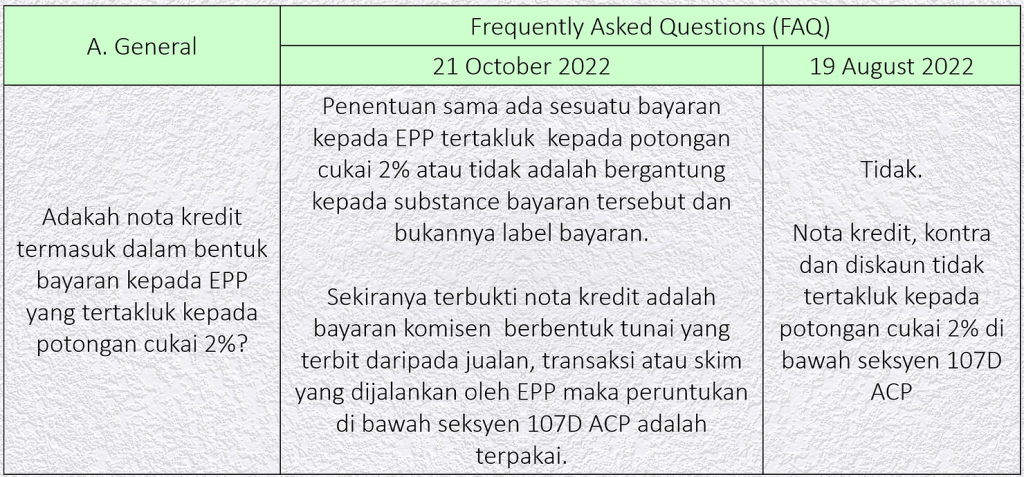
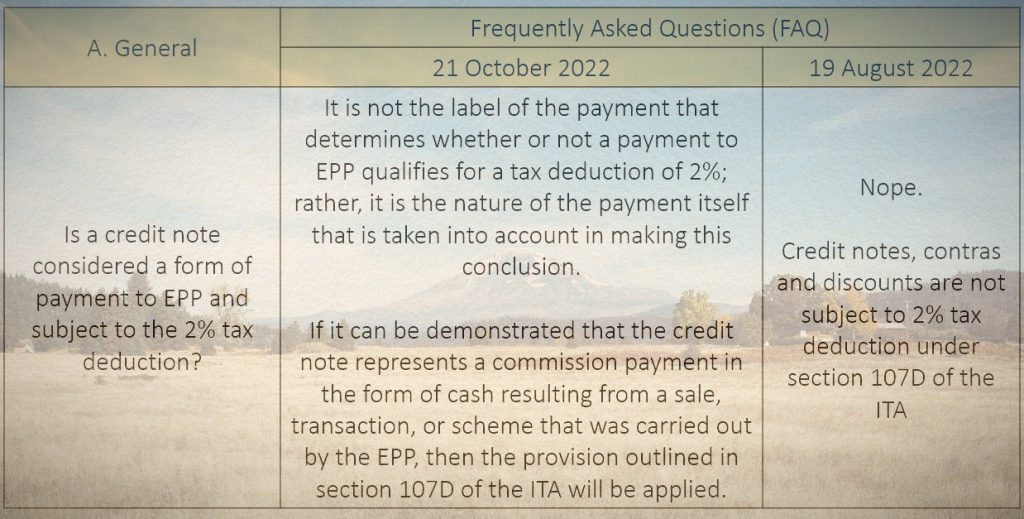
    On October 21, 2022, the Frequently Asked Questions (FAQ) on 2% Tax Deducted from Payment by Payer Companies to Agents, Dealers, or Distributors under Section 107D of the Income Tax Act 1967 was updated by the Inland Revenue Board of Malaysia (IRBM).

    The old FAQ, which was last updated on August 19, 2022, has been replaced by this FAQ.

    The updates are extracted below:

    In English:

    Reference

    Both Frequently Asked Questions can be found here:-

    The latest FAQ, which was last updated on 21 October 2022

    The old FAQ, which was last updated on 19 August 2022

    Our website's articles, templates, and material are solely for reference. Although we make every effort to keep the information up to date and accurate, we make no representations or warranties of any kind, either express or implied, regarding the website or the information, articles, templates, or related graphics that are contained on the website in terms of its completeness, accuracy, reliability, suitability, or availability. Therefore, any reliance on such information is strictly at your own risk.

    Keep in touch with us so that you can receive timely updates |

    要获得即时更新,请与我们保持联系

    1. Website ✍️ https://www.ccs-co.com/ 2. Telegram ✍️ http://bit.ly/YourAuditor 3. Facebook ✍

    4. Blog ✍ https://lnkd.in/e-Pu8_G 5. Google ✍ https://lnkd.in/ehZE6mxy

    6. LinkedIn ✍ https://www.linkedin.com/company/74734209/admin/

    22