Day: August 11, 2022

  • Tax Treatment on the Income of Doctors in Private Hospitals

    Tax Treatment on the Income of Doctors in Private Hospitals

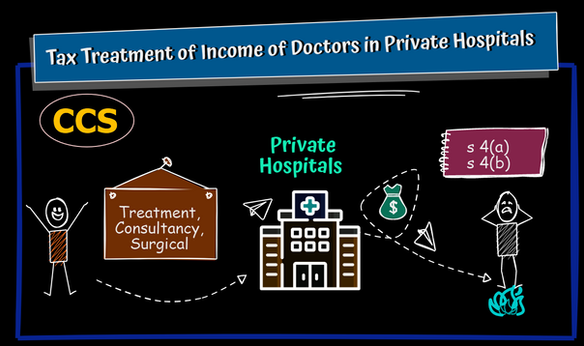
    I am sure many of you will still remember the widespread allegation that doctors (from now on referred to as the doctor) who provide medical services (e.g., treatment, consultancy, surgical, etc.) in Private Hospitals were evading taxes many years ago, and LHDN conducted audits as a result.

    It is not only permissible but common to set up a private limited company (Sdn Bhd, from now on referred to as “the Company”) to carry on business.

    However, when it comes to doctors, this raises a new dilemma as to whether the income in question is taxed in the doctor’s personal name or in the name of the company he has set up.

    The Inland Revenue Board of Malaysia (“IRBM”) has then communicated to the Malaysian Medical Association (“MMA”) via letter dated 28 June 2018 to notify them that effective from the year of assessment (“YA”) 2017, services rendered to the Private Hospitals regardless of the existence or nonexistence of a written agreement, the payment received by a Doctor will be subjected to tax as business income of an individual

    The IRB has published on its website, dated 16 March 2022, technical guidelines regarding the tax treatment of doctors’ income in Private Hospitals.

    The Guidelines are in Bahasa Malaysia and are named “Garis Panduan Layanan Cukai Ke Atas Pendapatan Pengamal Perubatan (Doktor Pakar) Di Hospital Swasta Sama Ada Ditaksir Di Bawah Individu Atau Syarikat“.

    Income to be Assessed as a Business Income

    The doctor will have two different sources of business income, each of which must be stated on the Income Tax Return Form as a separate business source to comply with Section 4(a) of the Income Tax Act 1967.

    To be assessed in the name of the Doctor

    • Consultation fees and other payments received from Private Hospital, even if:
      • the Doctor sets up a company and enters into an agreement with a private hospital to provide specialist services to patients
      • the Doctor sets up a company with other doctors and enters into an agreement with a private hospital to provide specialist services to patients through the company.
      • Whether the contract entered into with a private hospital is in the name of the Doctor or the Company, the tax treatment is the same in both cases.
    • Income Tax Return: Form B

    To be assessed in the name of the Company

    • If the company’s primary activity is engaging in activities related to medical, such as selling medical products, pharmaceutical products, and health aids; or
    • If the doctor operates a clinic:
      • located in a private hospital where patients receive specialist care without being referred by the private hospital, and the doctor does not use any private hospital facilities to treat patients; or
      • not inside the private hospital, and the services provided to patients do not include any private hospital
    • Income Tax Return: Form C

    Income to be Assessed as an Employment Income

    Status of the Doctor:

    As an Employee

    • The doctor who serves for the Private Hospital under a contract of service, whether full or part-time

    As a shareholder and director

    • When a doctor is both a shareholder and a director of the Private Hospital, regardless of whether they are a Specialist Doctor there or not,

    The salaries received for consultation services, surgery, or any treatment provided will be assessed as the employment income of the Doctor by Section 4(b) of the Act.

    • Income Tax Return: Form BE

    Deductible Expenses

    The Guidelines also explain and give examples of certain kinds of expenses that may be tax-deductible in arriving at the adjusted income, such as the following:

    • Professional indemnity insurance (PII)
    • Employer’s contribution to the Employees Provident Fund (EPF). The Guidelines also explain when a contribution would not be tax-deductible.
    • Fees incurred to attend Continuing Professional Development (CPD) seminars, workshops or conferences approved under CPD Review Committees
    • Rental pay to the private hospital for:
      • consultation rooms,
      • surgical instruments, or
      • operating rooms
    • Other allowable expenses under Section 33(1) of the Act

    However, under section 39 of the ITA, certain expenses are prohibited as deductions, such as private expenses or expenses of a capital nature.

    Is Travelling Expenses Tax Deductible?

    In general, travelling expenses are not deductible expenses unless:

    • The travel is part of employment/official duties (required by your employer or necessitated by the circumstances of the business) and not because of your personal circumstances (where you live);
      • To expand on this, quite simply, getting to and from your regular place of work is not deductible, regardless of how far this may be.
    • Travel costs are a necessary consequence of the work or duties;
    • The employer demands the doctor undertakes the travel, or the doctor is required to travel for business purposes; and
    • The travel is undertaken during working/business hours.
    Mfula vs the Federal Commissioner of Taxation

    Dr Mfula was both a salaried employee and a locum doctor/surgical assistant, billing hospitals under his Australian business number (ABN).

    Whilst working as a locum via the Global Medics agency in Wagga Wagga, Dr Mfula travelled by car from his home in Melbourne and flew to other sights in NSW. He sought to claim car travel and food/incidental costs in the tens of thousands, whilst the hospitals covered accommodation and flights.

    Dr Mfula noted that no allowances were paid to him. Furthermore, he was not required to use his vehicle for work purposes, and he was required to pay for his meals.

    Dr Mfula could not claim any travelling expenses except for work as a surgical assistant, for which he worked at multiple sites on the same day. All other car travel was deemed home to work and not ‘on work’ or at the direction of an employer.

    Despite arguing that a meal allowance was rolled into his hourly rate, meal costs were also disallowed.

    Overall, this is not fantastic news for mobile medical professionals. Your travel expenses, including those for your vehicle, lodging, and food, are not likely tax deductible unless you demonstrate that you satisfied specific requirements and kept detailed records.

    Capital Allowance

    A Doctor who incurs capital expenditures on assets or equipment used for business purposes is entitled to claim a capital allowance under Schedule 3 of the ITA 1967.

    Our website's articles, templates, and material are solely for reference. Although we make every effort to keep the information up to date and accurate, we make no representations or warranties of any kind, either express or implied, regarding the website or the information, articles, templates, or related graphics that are contained on the website in terms of its completeness, accuracy, reliability, suitability, or availability. Any reliance on such information is therefore strictly at your own risk.

    Keep in touch with us so that you can receive timely updates |

    要获得即时更新,请与我们保持联系

    1. Website ✍️ https://www.ccs-co.com/ 2. Telegram ✍️ http://bit.ly/YourAuditor 3. Facebook ✍

    4. Blog ✍ https://lnkd.in/e-Pu8_G 5. Google ✍ https://lnkd.in/ehZE6mxy

    6. LinkedIn ✍ https://www.linkedin.com/company/74734209/admin/
    22
  • Guidelines on the application procedure for a Special Deduction in respect of a Qualifying R&D

    Guidelines on the application procedure for a Special Deduction in respect of a Qualifying R&D

    Guidelines on the application procedure for a special deduction in respect of a Qualifying R&D

    On August 13, 2020, the guidelines on the application procedure for a special deduction in respect of a qualifying research and development (R&D)  were issued by the Inland Revenue Board of Malaysia (“IRBM”).

    These guidelines explain the application process for an approved research and development activity eligible for a special deduction under section 34A of the Income Tax Act of 1967. (ITA).

    Public Ruling No. 10/2021

    The IRBM has issued Public Ruling No. 10/2021 entitled “Tax Treatment of Research and Development Expenditure Part II – Special Deductions.”

    This ruling replaces Public Ruling No. 6/2020, titled “Tax Treatment of Research and Development Expenditure Part II.”

    It is recommended that Public Ruling No. 10/2021 be read in conjunction with Public Ruling No. 5/2020 because it explains the expenditures that are eligible for special deductions (incentive) concerning a qualifying R&D activity.

    Public Ruling No. 5/2020

    The Public Ruling No. 5/2020 on “Tax Treatment of Research and Development Expenditure Part I — Qualifying Research and Development Activity” clarifies the definition of R&D and its qualifying criteria, which, in turn, determine whether the R&D activity in question is a qualifying R&D activity.

    These two public rulings need to be read in conjunction with the “Guidelines on the Application Procedure for a Special Deduction in Respect of a Qualifying Research and Development Activity“, dated December 29, 2021.

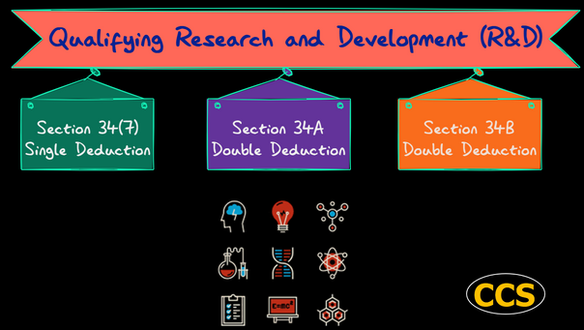
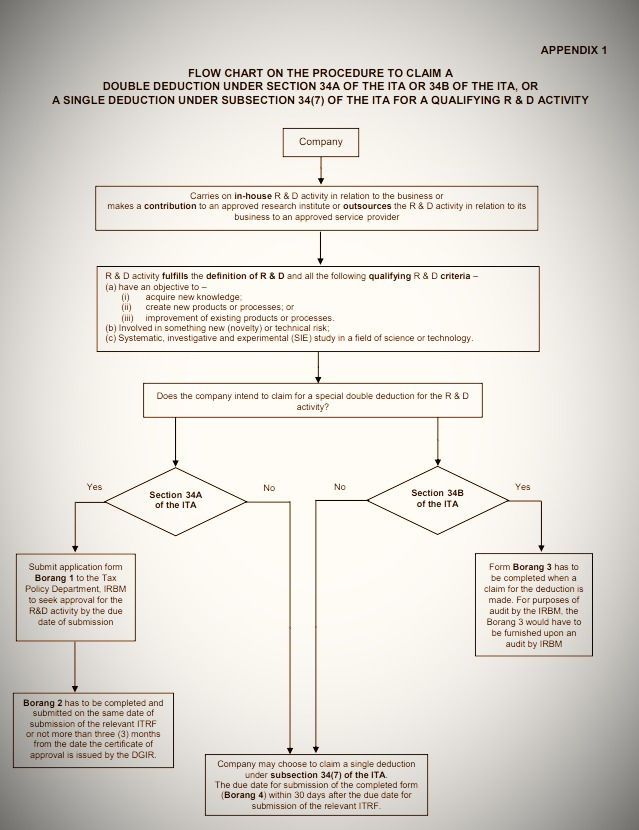
    In the Guidelines, examples 1-4 explain the application procedure for an approved qualifying R&D activity that is eligible for double deduction under Section 34A of the Income Tax Act (ITA) 1967, as well as the requirement to submit the relevant forms when a claim is made for deductions under Sections 34(7), 34A, or 34B of the ITA 1967.

    The previous guidelines, published on 13 August 2020 and since replaced by these new ones, are comparable to the latest ones dated December 29, 2021. The following is an outline of the most significant changes:

    • The legislative amendments passed by the Finance Act 2020 have been included in the Guidelines. These changes were previously emphasised in the Public Ruling No. 10/2021 on Tax Treatment of R&D Expenditure Part II – Special Deductions.
    • An additional condition has been added to apply for an extension project under Section 34A of the ITA 1967. This criterion states that the project’s duration should be anticipated to be more than 12 months.
    • The application Forms have been modified to reflect the latest changes.

    Also, effective 1.1.2021, if the payment for R&D expenditure undertaken outside Malaysia (outsourced) is more than 30% of the total allowable R&D expenditure, the total expenses incurred will not qualify for a double deduction. However, the whole of expenses on R&D incurred shall be allowed as a single deduction under subsection 34A(4) of ITA.

    18
  • Implementation of e-TT system for TT /  EFT and Interbank GIRO (IBG) Payment Methods

    Implementation of e-TT system for TT / EFT and Interbank GIRO (IBG) Payment Methods

    IRBM released a Media Release on implementing an e-TT system for Telegraphic Transfer (TT) / Electronic Fund Transfer (EFT) and Interbank GIRO (IBG) payment methods on March 3, 2022.

    The Media Release can be found here:-

    Beginning on April 1, 2022, this new system will be in place and be known as the e-TT system.

    Within and outside of Malaysia, taxpayers who wish to make payments on the following taxes using TT, EFT, or IBG methods will be able to do so through the e-TT system:-

    • Income Tax;
    • Petroleum (Income Tax);
    • Real Property Gains Tax (RPGT) (*);
    • Compound Payment (*)
    • Income tax paid by Foreign Artist (Public Entertainer) (*); and
    • Withholding Tax (WHT) (*).

    (*) – which previously can only be paid manually at IRBM Payment Counters

    Steps to access the e-TT system

    With the introduction of the E-TT, the IRBM system will generate a unique number as payment identification called Virtual Account Number (“VA”).

    Taxpayers who wish to pay tax through the TT will be required to access the e-TT system as follows:

    1. Visit the My Tax Portal at https://mytax.hasil.gov.my;
    2. Click on ezHasil Services > submenu e-TT;
    3. Fill up the required payment information to generate the Virtual Account (VA) number;
    4. Use the VA number as the payment account number (i.e. payment identification) when making payments through:
      1. TT at the bank counter; or
      2. electronic banking portal; or
      3. Automated Teller Machine (ATM).
    5. Each VA number is limited to one transaction.

    Take note, payment by cash and cheque is not allowed

    Taxpayers may contact IRBM via the following methods for further information on the new e-TT system:

    1. IRBM Care Line at 03-8911 1000 / 603-8911 1100 (Overseas);
    2. IRBM Live Chat; or
    3. Feedback Form at https://maklumbalaspelanggan.hasil.gov.my/MaklumBalas/en-US/

    Other Related Matters

    Any documents related to e-TT for WHT should be submitted to WHTOperasi@hasi|.g0v.my while HelpTT@hasi|.gov.my is for payment matters

    In a situation where a taxpayer generates a VA number but ends up not using it (e.g., where the taxpayer generates a VA number with incorrect details / decides to remit the payment via another mode of payment etc.), the taxpayer does need to cancel that VA number.

    For withholding tax payment, the subsequent CP37 Form still needs to be submitted to the IRBM Non-Resident Branch at the email address [email protected] on the payment day.

    Every payment information must be submitted to the Kuala Lumpur Payment Center via email; at [email protected] on the payment day.

    Tax payment receipts will be issued based on information provided in the e-TT system.

    No amendment to payment detail can be done through the e-TT system once payment has been made (Eg. Change on the payor’s name, name of the payee, tax reference number, payment code, year of assessment etc.). Taxpayers must refer to the respective collection unit at IRBM branches handling their tax files to request the necessary adjustment.

    Non-residents who have sent their applications to [email protected] will have to wait for seven (7) working days for the C number to be generated by IRBM. This is the timeframe that IRBM will follow to generate the number.

    There is no transition period given.

    User Manual of e-Telegraphic Transfer Virtual Account, e-TT (VA):

    Our website's articles, templates, and material are solely for reference. Although we make every effort to keep the information up to date and accurate, we make no representations or warranties of any kind, either express or implied, regarding the website or the information, articles, templates, or related graphics that are contained on the website in terms of its completeness, accuracy, reliability, suitability, or availability. Any reliance on such information is therefore strictly at your own risk.

    Keep in touch with us so that you can receive timely updates |

    要获得即时更新,请与我们保持联系

    1. Website ✍️ https://www.ccs-co.com/ 2. Telegram ✍️ http://bit.ly/YourAuditor 3. Facebook ✍

    4. Blog ✍ https://lnkd.in/e-Pu8_G 5. Google ✍ https://lnkd.in/ehZE6mxy

    6. LinkedIn ✍ https://www.linkedin.com/company/74734209/admin/
    19