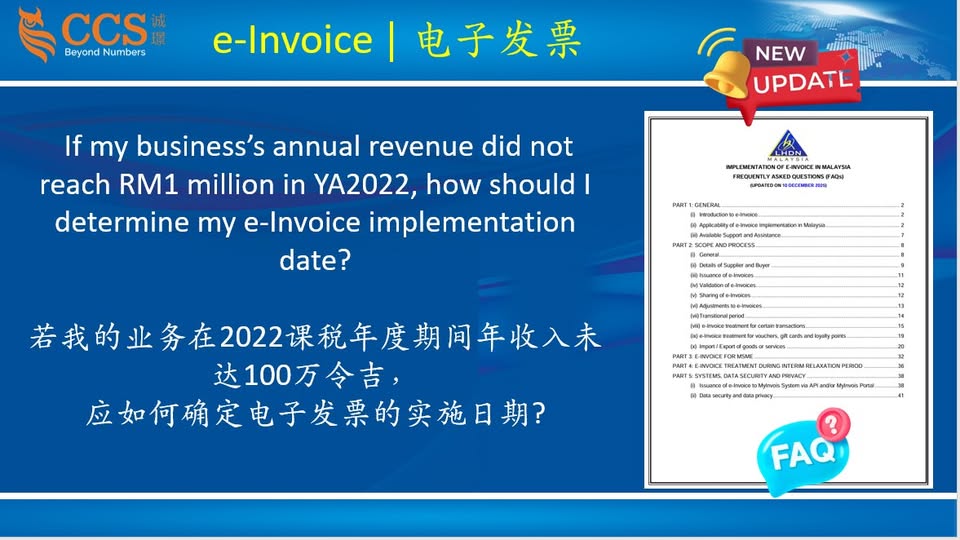
HASiL’s current e-Invoice FAQ uses an RM3 million threshold. Businesses that were already operating in YA2022 and had turnover or revenue below RM3 million in that year should determine their e-Invoice obligations based on both their subsequent revenue and whether they meet the exemption criteria.
Businesses that meet the exemption criteria
If the business meets the exemption criteria, it is initially exempt from implementing e-Invoice. If its annual turnover or revenue reaches or exceeds RM3 million in YA2023, YA2024 or YA2025, it is required to implement e-Invoice from 1 July 2026.
For example, the current HASiL FAQ describes Mountain Jump Sdn Bhd as an independent company with YA2022 revenue of RM400,000. It met the exemption criteria. In YA2024, its revenue reached RM3.1 million. The company is therefore required to implement e-Invoice from 1 July 2026.
If the business first reaches or exceeds RM3 million in YA2026 or a subsequent year, it must implement e-Invoice from 1 January in the second year following the year in which the threshold is reached.
For example, DEF Enterprises recorded revenue below RM1 million in YA2022 to YA2025 and RM1.2 million in YA2026. Under the current RM3 million threshold, RM1.2 million does not trigger implementation. If the business meets the exemption criteria, it remains exempt unless and until its annual turnover or revenue reaches or exceeds RM3 million.
Businesses that do not meet the exemption criteria
A business that does not meet the exemption criteria is required to implement e-Invoice from 1 July 2026, even if its own turnover or revenue was below RM3 million in YA2022.
For example, GHI Services Sdn Bhd recorded YA2022 revenue of RM600,000 and is a subsidiary of JKL Holdings Bhd. If it does not meet the exemption criteria because of its corporate relationship, it is required to implement e-Invoice from 1 July 2026.
Note on the former RM1 million threshold
Some earlier examples, including cases where revenue of RM1.1 million in YA2023, YA2024 or YA2025 triggered implementation from 1 July 2026, were based on the former RM1 million threshold. Under the current RM3 million threshold, that revenue alone does not trigger implementation. Businesses should assess their position using the current threshold and exemption criteria.
已于 YA2022 营业的企业:现行电子发票规定与实施时间
HASiL 现行电子发票 FAQ 采用 RM3 million 门槛。对于在 YA2022 已开始营业、且该年度营业额或收入低于 RM3 million 的企业,须根据后续年度收入及是否符合豁免条件,判断电子发票义务。
符合豁免条件的企业
若企业符合豁免条件,初期可豁免实施电子发票。若其年度营业额或收入在 YA2023、YA2024 或 YA2025 达到或超过 RM3 million,则须从2026年7月1日起实施电子发票。
例如,HASiL 现行 FAQ 提及,Mountain Jump Sdn Bhd 是一家独立公司,YA2022 收入为 RM400,000,并符合豁免条件。该公司在 YA2024 的收入达到 RM3.1 million,因此须从2026年7月1日起实施电子发票。
若企业首次在 YA2026 或之后的评税年度达到或超过 RM3 million,则须从达到门槛的评税年度之后第二年的1月1日起实施电子发票。
例如,DEF Enterprises 在 YA2022 至 YA2025 的收入均低于 RM1 million,并在 YA2026 录得 RM1.2 million。根据现行 RM3 million 门槛,RM1.2 million 尚未触发实施要求。若该企业符合豁免条件,在其年度营业额或收入达到或超过 RM3 million 之前,可继续享有豁免。
不符合豁免条件的企业
不符合豁免条件的企业,即使自身在 YA2022 的营业额或收入低于 RM3 million,仍须从2026年7月1日起实施电子发票。
例如,GHI Services Sdn Bhd 在 YA2022 录得 RM600,000 收入,并且是 JKL Holdings Bhd 的子公司。若该企业因其公司关系而不符合豁免条件,则须从2026年7月1日起实施电子发票。
关于原 RM1 million 门槛的说明
部分较早的例子,例如在 YA2023、YA2024 或 YA2025 录得 RM1.1 million 后须从2026年7月1日起实施电子发票的情况,是依据原有 RM1 million 门槛。根据现行 RM3 million 门槛,仅有该收入水平并不会触发实施要求。企业应依据现行门槛及豁免条件评估自身情况。