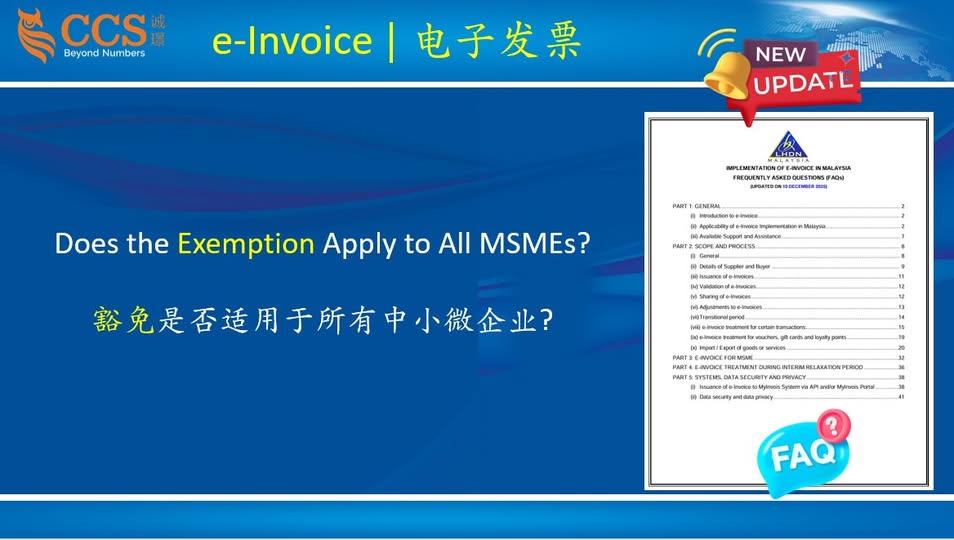
HASiL’s General FAQ version 4.6, dated 10 December 2025, referred to an RM1 million threshold. The current threshold is RM3 million. Under the current FAQ, the exemption generally applies to taxpayers with annual turnover or revenue below RM3 million, including individuals, partnerships, companies and cooperatives.
However, being below the threshold does not automatically mean a taxpayer is exempt. Under Section 1.6.10 of the e-Invoice Guideline, the exemption does not apply if the taxpayer:
- has a non-individual shareholder, or equivalent, with annual turnover or revenue of at least RM3 million;
- is a subsidiary of a holding company with annual turnover or revenue of at least RM3 million; or
- has a related company or joint venture with annual turnover or revenue of at least RM3 million.
For this purpose, “related company” has the meaning assigned to it in Section 2 of the Promotion of Investments Act 1986.
Example from HASiL’s FAQ
RC Cycling Sdn Bhd recorded annual revenue of RM400,000 as at 31 December 2022 and is a subsidiary of JT Motors Sdn Bhd, which has implemented e-Invoice. Although RC Cycling’s revenue was below the applicable threshold, it did not qualify for the exemption because it was a subsidiary of a company required to implement e-Invoice. HASiL’s FAQ states that RC Cycling was required to implement e-Invoice from 1 July 2026.
Businesses should therefore assess both their own annual turnover or revenue and the relevant ownership, subsidiary, related-company or joint-venture relationships before concluding that the exemption applies. Taxpayers whose circumstances involve an earlier implementation schedule should also refer to HASiL’s specific transitional guidance.
马来西亚电子发票豁免:营业额低于 RM3 million,哪些企业仍可能需要遵守?
HASiL 于2025年12月10日发布的《一般常见问题解答》4.6版提及的门槛为 RM1 million。现行门槛为 RM3 million。根据现行 FAQ,年营业额或收入低于 RM3 million 的纳税人一般可享有豁免,适用对象包括个人、合伙企业、公司及合作社。
不过,营业额低于门槛并不代表纳税人必然符合豁免资格。根据《电子发票指南》第1.6.10节,若纳税人符合以下任何一项情况,便不适用该豁免:
- 拥有年营业额或收入至少为 RM3 million 的非个人股东或同等实体;
- 是年营业额或收入至少为 RM3 million 的控股公司的子公司;或
- 拥有年营业额或收入至少为 RM3 million 的关联公司或合资企业。
在此, “关联公司”一词采用《1986年投资促进法》第2条所赋予的含义。
HASiL FAQ 中的例子
RC Cycling Sdn Bhd 截至2022年12月31日的年度收入为 RM400,000,并且是已实施电子发票的 JT Motors Sdn Bhd 的子公司。虽然 RC Cycling 的收入低于适用门槛,但由于它是须实施电子发票的公司的子公司,因此不符合豁免资格。HASiL 的 FAQ 指出,RC Cycling 须从2026年7月1日起实施电子发票。
因此,企业在判断是否符合豁免资格时,除了评估自身的年度营业额或收入,也应审视相关的股权、子公司、关联公司或合资关系。若企业涉及较早的实施时间表,也应参阅 HASiL 针对过渡安排发布的具体指引。