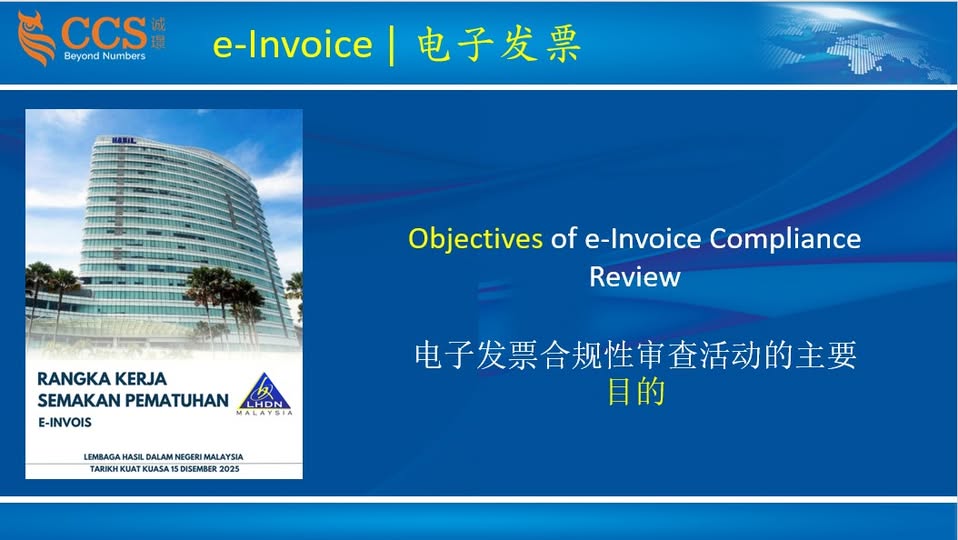
The main objective of the Inland Revenue Board of Malaysia’s (IRBM) e-Invoice compliance reviews is to encourage taxpayers to comply voluntarily with the tax laws and regulations relating to e-Invoice implementation. These reviews also form part of IRBM’s enforcement activities.
The e-Invoice Compliance Officer (PEI) is responsible for ensuring that taxpayers properly implement the relevant e-Invoice requirements, supporting an effective tax administration system in Malaysia.
What a compliance review covers
An e-Invoice compliance review assesses a taxpayer’s compliance with the tax laws and regulations governing e-Invoicing. It involves reviewing, examining and verifying business records and documents, whether submitted manually or through the e-Invoice system.
For audit activities generally, IRBM uses two review methods: general review and comprehensive review. However, e-Invoice compliance reviews are conducted using the comprehensive review method only. This includes an interview about the business’s operations and takes place at the taxpayer’s premises or at another location agreed by the taxpayer and IRBM.
The review may cover sales invoice records, sales receipts and other sales documents. It may also include purchase invoice records, purchase orders and related documents, records of debit notes, credit notes and refund notes, as well as other invoice-related source documents.
If business records have not been kept completely, the review may extend to the taxpayer’s non-business records, such as personal bank statements, asset ownership records and other documents. Taxpayers will be notified in advance by official letter or email before a comprehensive review is carried out.
电子发票合规审查:目标、方式与范围
马来西亚内陆税收局(IRBM)开展电子发票合规审查的主要目标,是鼓励纳税人自愿遵守与电子发票实施相关的税务法律及规定。这类审查也是 IRBM 执行税法的一种方式。
电子发票合规官(PEI)负责确保纳税人妥善落实相关电子发票要求,以支持马来西亚建立有效的税务管理体系。
合规审查的范围
电子发票合规审查旨在评估纳税人是否遵守与电子发票相关的税法规定。审查包括检查、查阅及核实业务记录与文件,无论这些资料是以纸本方式提交,还是通过电子发票系统提交。
对于一般审计活动,IRBM 采用两种审查方式:一般审查与全面审查。但电子发票合规审查仅采用全面审查方式。全面审查包括了解企业营运方式的访谈,并在纳税人营业场所或纳税人与 IRBM 同意的其他地点进行。
审查范围可能包括销售发票记录、销售收据及其他销售文件,也可能包括采购发票记录、采购订单及相关文件、借项通知单、贷项通知单与退款通知单的记录,以及其他发票相关原始文件。
如果业务记录保存不完整,审查范围可能延伸至纳税人的非业务记录,例如个人银行对账单、资产所有权记录及其他文件。进行全面审查前,纳税人将通过正式信函或电邮预先收到通知。