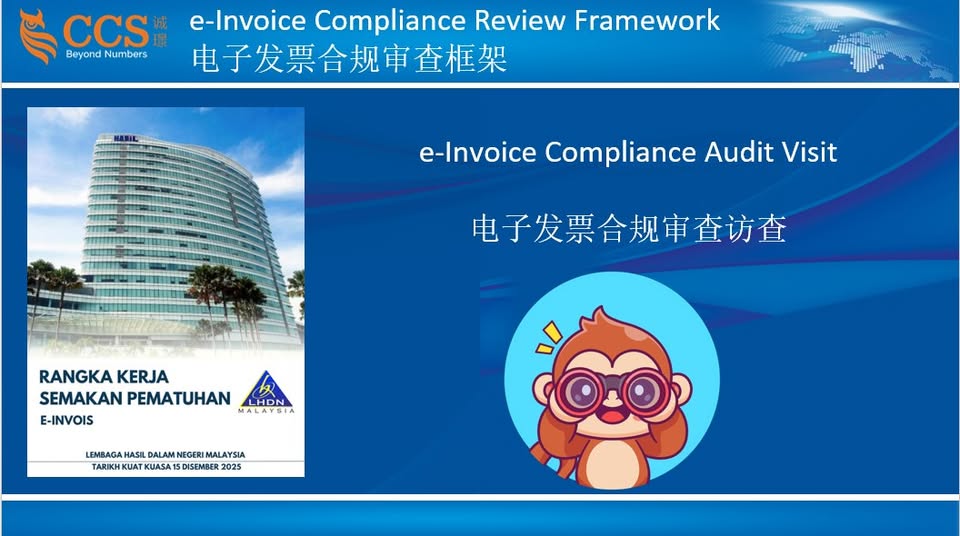
An e-Invoice Compliance Officer (PEI) has specific responsibilities and legal powers during an on-site compliance review. The e-Invoice Compliance Review Framework also sets out what the officer must explain and how the review should be conducted.
Identification and purpose of the visit
When arriving, the PEI must identify themselves by showing an official LHDNM authority card bearing their name and photograph, or an official authorisation letter issued by LHDNM.
At the start of the visit, the PEI must explain its purpose, including the period or years under review. For example, the officer may explain that the review will check whether the company correctly issued e-Invoices for sales made in 2024 and 2025 and whether the submitted data is consistent with the accounting records.
The PEI must also inform the taxpayer or tax agent of the relevant legal powers under Section 80 of the Income Tax Act 1967, Section 33 of the Petroleum Income Tax Act 1967 and Section 22D of the Labuan Business Activity Tax Act 1990.
Powers during the review
Within the scope of the applicable laws, a PEI may enter and inspect relevant land, buildings, offices, warehouses, shops or other business premises. For instance, an officer may visit a warehouse where invoices are processed or stored to understand how sales records and e-Invoices are handled.
The PEI may inspect relevant books, documents, records and materials, and take copies or extracts without charge. These may include sales invoices, e-Invoice submission reports, debit notes and credit notes.
Where records are stored electronically, the PEI may access relevant computers, servers or systems and download e-Invoice-related data for review.
The officer’s responsibilities
The PEI must explain the scope of the review, including which documents will be examined and how long the review is expected to take. The officer must also provide their name and office telephone number, together with details of the senior officer supervising the visit.
The PEI must explain the taxpayer’s rights and responsibilities, including the need to cooperate and provide information honestly. Taxpayers may ask questions and seek clarification if anything is unclear.
The review of documents is normally conducted at the taxpayer’s business premises. The PEI may also interview the taxpayer, key staff, finance personnel or other relevant employees to understand how e-Invoices are prepared and submitted and how related internal controls operate.
Knowing what to expect can help businesses prepare relevant records and understand how the review will be conducted.
电子发票合规审查访查:企业应了解的事项
电子发票合规官(PEI)在进行现场合规审查时,依法拥有特定权限,也须履行相应职责。《e-Invoice Compliance Review Framework》说明了官员应向纳税人解释的事项,以及审查期间应遵循的程序。
核实身份与访查目的
PEI 到达现场时,须出示载有姓名与照片的 LHDNM 官员证,或由 LHDNM 发出的正式授权信,以证明其身份。
访查开始时,PEI 必须说明访查目的,包括所审查的期间或课税年度。例如,官员可能说明,此次访查是为了核查公司在2024年及2025年的销售是否正确开具电子发票,以及提交的数据是否与会计记录一致。
PEI 也须告知纳税人或税务代理有关的法定权限依据,包括《1967年所得税法令》第80条、《1967年石油所得税法令》第33条,以及《1990年纳闽商业活动税法令》第22D条。
审查期间的权限
在相关法律规定的范围内,PEI 可进入并检查有关土地、建筑物、办公室、仓库、商店或其他营业场所。例如,官员可前往处理或存放发票的仓库,了解销售记录及电子发票的处理方式。
PEI 可查阅相关账簿、文件、记录及资料,并免费复制或摘录内容。有关资料可能包括销售发票、电子发票提交报告、借项通知单及贷项通知单。
若记录以电子方式储存,PEI 可查阅相关电脑、服务器或系统,并下载电子发票相关数据进行审查。
官员的职责
PEI 必须说明审查范围,包括将查阅哪些文件,以及预计审查所需的时间。官员也须提供姓名、办公室电话号码,以及负责监督此次访查的高级官员资料。
PEI 必须说明纳税人在审查期间的权利与责任,包括配合审查及如实提供资料的责任。如果有任何事项不清楚,纳税人可以提问并要求进一步说明。
文件审查通常会在纳税人的营业地点进行。PEI 也可按需要访谈纳税人、主要员工、财务人员或其他相关员工,以了解电子发票的制作与提交流程,以及相关内部控制如何运作。
了解访查程序,有助企业准备相关记录,并清楚掌握审查的进行方式。